On this page
It might seem like a straightforward task to pick an automation tool, but when that choice affects your day-to-day work, the reality is quite different.
Most teams don’t have issues with writing playbooks or states. Their main problem is usually starting with a tool that is totally wrong for their environment. A solution that works very well in a small environment can be a nightmare in a large one. Something that initially seems very easy may turn into a very limiting tool when the needs of the organization grow.
That is exactly why discussions comparing Ansible vs Salt are more relevant than ever.
Besides being different in a way they look like a language, these tools are something different on a philosophical level. For example, one makes the greatest effort to be the easiest and to work without agents, while the other one has been designed to offer the fastest speed and control in real-time. When you include other tools in the discussion, such as Ansible vs Chef vs Puppet vs Salt or even Ansible vs Puppet vs Chef vs Salt vs Terraform, the choice is quite complicated.
Although on a superficial level they may seem alike, each of them is aimed at solving a different issue.
This article will help you understand the genuine differences in a straightforward, practical way without any fluff, so you can decide not based on hype but on the basis of your environment.
What Is Ansible?
Ansible is an automation tool that works without agents and uses SSH for system management.
It aims to be simple and very understandable. Its Playbooks are based on YAML, which even beginners find very easy to comprehend. Here are its key strengths:
- no agents required
- simple syntax
- quick setup
- strong community support
What Is Salt?
SaltStack (Salt) is an automation platform that is fast and highly responsive to events.
It is based on a master-minion setup. In some instances, it can also operate without agents. Here are its key strengths:
- extremely fast execution
- real-time event system
- scalable architecture
- strong remote execution
Ansible vs Salt: Major Differences
| Feature | Ansible | Salt |
|---|---|---|
| Architecture | Agentless | Master-minion |
| Speed | Moderate | Very fast |
| Learning curve | Easy | Moderate |
| Execution | Push-based | Push + Event-driven |
| Setup | Minimal | More complex |
Salt vs Ansible: Where Salt Wins?
If you are stuck in Salt vs Ansible, Salt is a better choice if:
- You need real-time monitoring
- You have infrastructure on a large scale
- Your execution speed is critical
- You need an event-driven automation
Ansible vs Chef vs Puppet vs Salt
| Tool | Approach | Complexity | Best Use Case |
|---|---|---|---|
| Ansible | Agentless | Low | Quick automation |
| Chef | Code-driven (Ruby) | High | Complex infra |
| Puppet | Declarative | Medium | Enterprise config |
| Salt | Event-driven | Medium | Real-time systems |
Ansible vs Puppet vs Chef vs Salt vs Terraform
Terraform is not a configuration tool. It is an infrastructure provisioning tool.
| Tool | Role |
|---|---|
| Ansible | Configuration + automation |
| Salt | Configuration + orchestration |
| Chef | Configuration management |
| Puppet | Configuration management |
| Terraform | Infrastructure provisioning |
Real-World Decision Guide
The decision on which tool to go for really lies in what you really want and need.
If you want simplicity, your team is small, and you need quick deployment, then you should pick Ansible. If you need speed at scale, real-time automation is a matter of concern, and the infrastructure is large, then you should definitely choose Salt.
On the other hand, if you are working in an enterprise environment, have strict compliance requirements, and need long-term configuration control, then you should consider Chef or Puppet. Besides, when you are handling cloud infrastructures and provisioning is a requirement, you should consider using Terraform along with them.
Common Mistakes When Choosing Tools
Many teams pick tools based on trends instead of needs.
- Choosing Salt for small setups
- Choosing Chef without Ruby expertise
- Using Terraform alone for configuration
- Ignoring team skill level
The wrong choice brings in long-term difficulties.
Role of CyberPanel in This Ecosystem
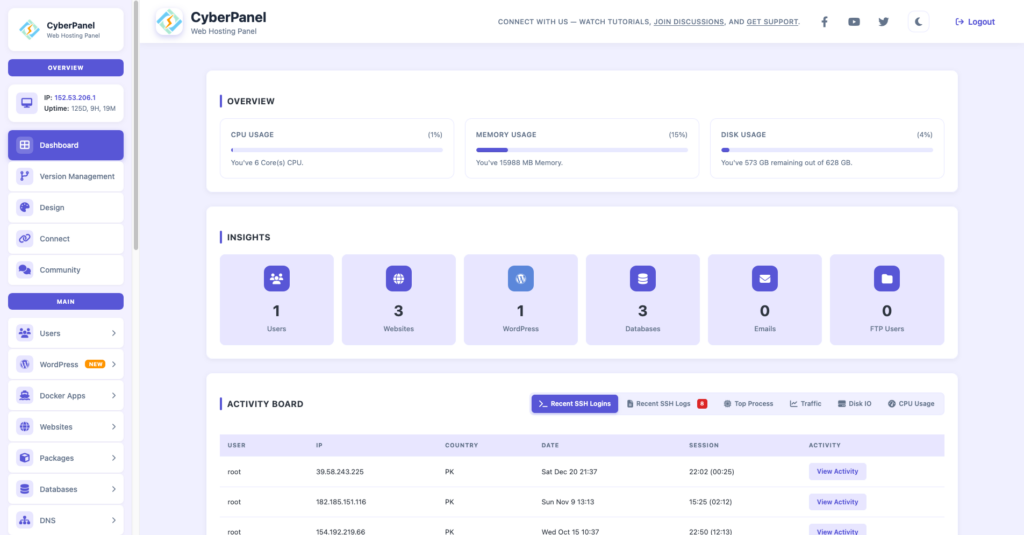
CyberPanel is a free and open-source web hosting control panel.
Tools like Ansible and Salt are primarily oriented towards automation and configuration, whereas CyberPanel offers an orchestrated environment for hosting management.
Where it matches:
Ansible or Salt provides automation, Terraform manages infrastructure, and CyberPanel manages servers and hosting. At the ground level, Terraform sets up the server, Ansible decorates applications, and CyberPanel deals with hosting and services.
Such segmented stages are very typical in a modern DevOps setup.
Conclusion
When we compare Ansible vs Salt, or even Ansible vs Puppet vs Chef vs Salt vs Terraform, we are actually not concerned about which tool is better. We only want to know which tool bests our system.
Ansible’s strong point is simplicity and user-friendliness. Salt is a winner in terms of rapidity and ability to cover a large-scale environment. Chef and Puppet are offering very detailed control for very large enterprise environments. Terraform is doing the infrastructure provisioning.
In the majority of cases, the perfect combination will consist of several tools, each doing what it does best.
First of all, take a look at your infrastructure’s scale and the expertise of your team. Select a tool for a minor use case and try it out thoroughly in the real environment. After you get used to it, starting with a small probe, step-wise expansion will be less risky than going all out at once.
FAQs
Can Ansible replace Puppet or Chef completely?
Yes, for many use cases, but enterprise environments may still prefer Puppet or Chef for compliance and long-term management.
Is Salt harder to learn than Ansible?
Yes, Salt has a steeper learning curve due to its architecture and concepts.
Is Ansible faster than Salt in large environments?
No, Salt is generally faster due to its event-driven architecture and persistent connections.