On this page
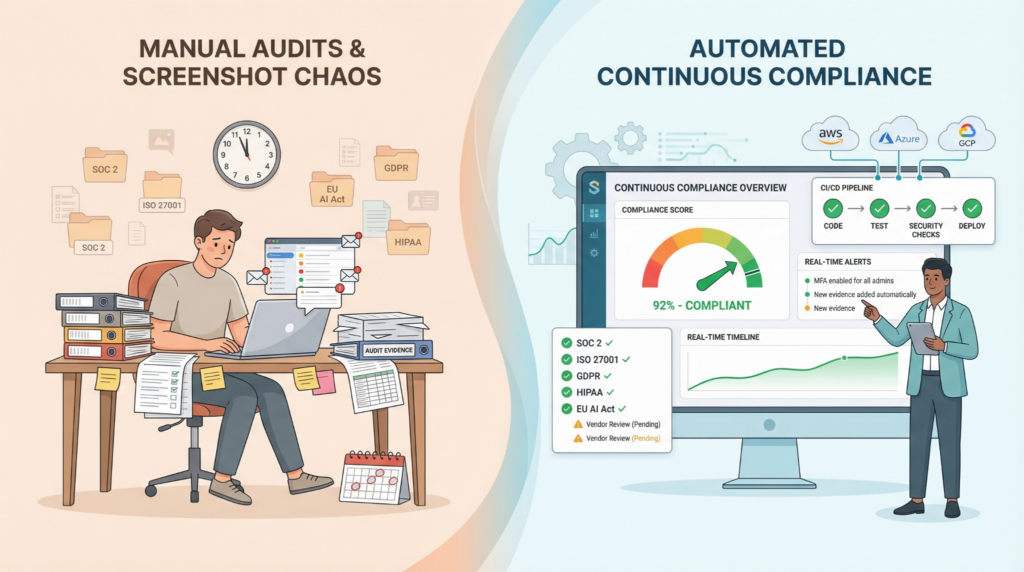
You already spend about 4,300 staff-hours a year chasing screenshots and answering auditor emails—roughly two full employee-years lost to paperwork, not protection (Intelligent CIO, 2023). Meanwhile, GDPR fines keep climbing, CPRA widens California’s reach, and the new EU AI Act forces tech teams to prove they govern algorithms responsibly. Manual checklists can’t keep up.
The answer is continuous compliance: always-on monitoring that spots drift instantly and exports audit evidence on demand. In this guide we rank the 5 leading platforms for 2026, explain exactly how we scored them, and show which one fits your stack so you can secure systems instead of sifting through spreadsheets.
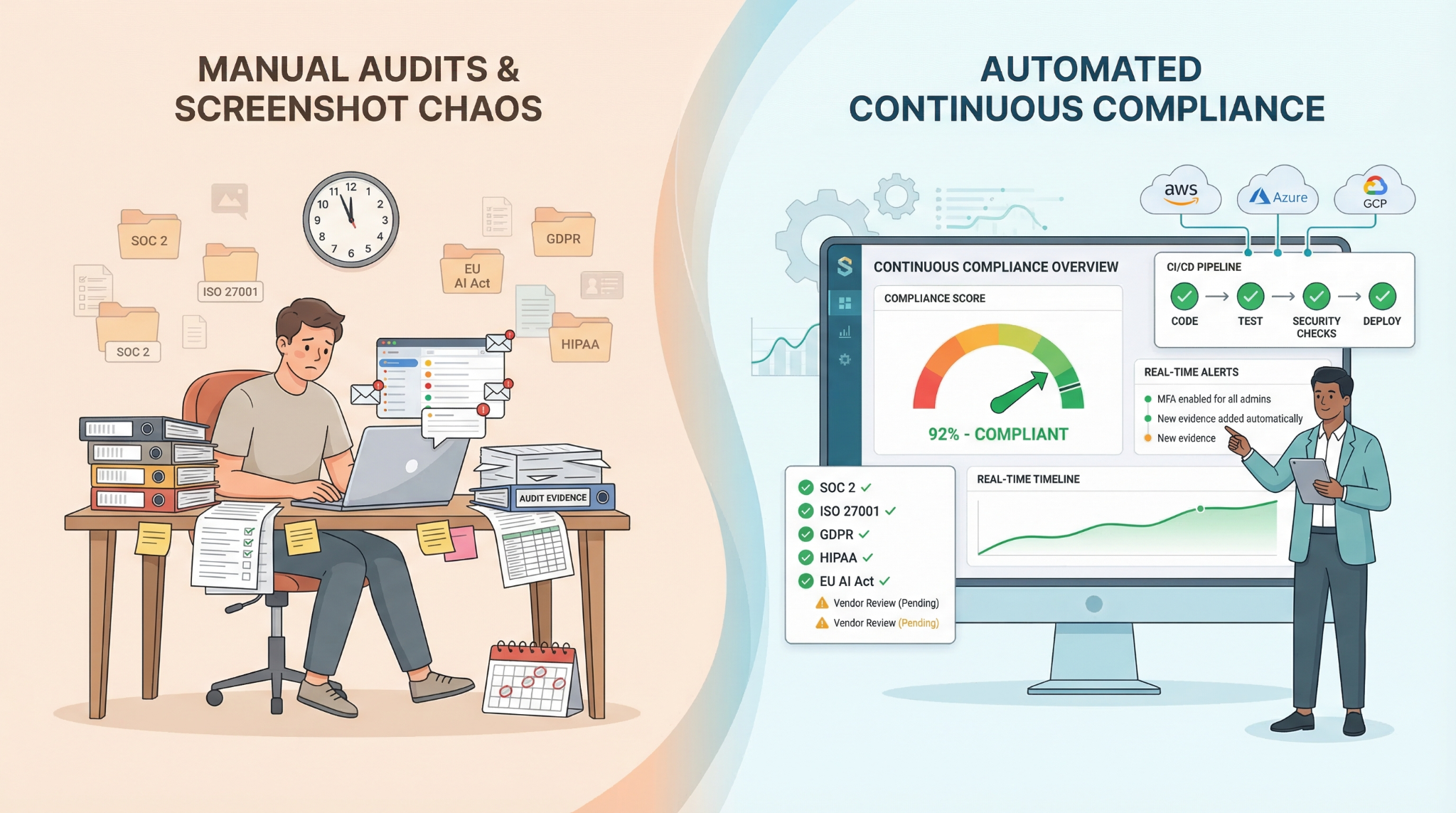
Five trends redefining compliance in 2026
Regulation is multiplying faster than we can say “data subject request.” SaaS teams now juggle SOC 2, ISO 27001, HIPAA, GDPR, and the new EU AI Act all at once. Each framework adds dozens of controls and hundreds of evidence items, with deadlines that don’t move. One-and-done audits are history.
The overload has turned automation from a nice-to-have into a survival kit. Manual tracking collapses under weekly releases, cloud sprawl, and hybrid work. Continuous monitoring fills the gap by flagging misconfigurations the moment they appear.
Artificial intelligence is the rocket fuel. Leading platforms map controls automatically, surface anomalies in real time, and draft policies for review. You skim AI-suggested links and keep moving, like following turn-by-turn navigation.
DevOps is part of the solution. Policy-as-code checks run inside CI/CD pipelines, so a public S3 bucket fails the build just like a broken unit test. Engineers get instant feedback, and security stops being a retroactive gate. That means fewer late-night scrambles before launch.
Cloud and container monitoring round things out. With workloads on AWS, Azure, and Kubernetes, tools now scan thousands of resources continuously, compare them with CIS benchmarks, and highlight drift in plain-language dashboards. Auditors see live evidence; you avoid fire drills.
The numbers back it up. Analysts value the broader GRC market at more than 60 billion dollars this year, while SaaS compliance automation already tops 1.3 billion and is climbing fast (CloudEagle, 2026). Investors are funding vendors that cut audit timelines from months to weeks, sometimes days.
Together, these five trends show why continuous compliance is now the default operating model. If your code ships every hour, your controls must keep pace every minute. Automated platforms make that possible.
How we picked the winners
Choosing a compliance platform is high-stakes, so our ranking had to be airtight.
We reviewed analyst reports, blog roundups, and Reddit threads from the past year. Any vendor that showed up in at least three independent sources made the long list, giving us 5 contenders.
Next, we scored each tool against five criteria that matter to cloud-native SaaS teams:
- Framework coverage. Can the platform map one control to many standards, from SOC 2 to GDPR, without double work?
- Automation depth. We looked for real-time evidence collection, continuous alerts, and true “set-it-and-forget-it” monitoring.
- Integrations and DevOps fit. A winner plugs into AWS, GitHub, Okta, and Jira, and offers open APIs for everything else.
- Scalability. Startups need a fast launch; enterprises need role-based access, custom workflows, and solid performance at thousands of assets.
- Pricing and proof. Transparent plans, strong G2 ratings, named customer wins, and responsive support all earned points.
We weighted the first three criteria at 20 percent each, scalability at 15 percent, and pricing and proof at 10 percent. After scoring, we debated edge cases and verified results in live demos.
The final list reflects the numbers plus one editorial lens: which tools will serve a fast-moving SaaS team best over the next 12 months.
The shortlist at a glance
Before you explore each platform, scan the table below to see who each tool is built for, which frameworks it covers, and the edge that sets it apart.
| Platform | Best for | Key frameworks | Automation highlights | Notable integrations | Pricing snapshot* |
| Vanta | Teams racing to first SOC 2 | SOC 2, ISO 27001, HIPAA, GDPR | 400+ always-on checks | AWS, GitHub, Okta, Jira, Slack | About USD 12 000 / yr |
| Hyperproof | Mid-market ops teams | SOC 2, ISO, NIST | Cross-framework mapping | Jira, ServiceNow | Quote |
| OneTrust | Privacy-heavy orgs | GDPR, CCPA, SOC 2 | Policy automation | Salesforce, ServiceNow | Modular |
| LogicGate | Custom workflows | Any (template builder) | Drag-and-drop processes | Snowflake, Slack (API) | By module/user |
| Certa | Third-party risk | Anti-bribery, AML | AI vendor vetting | SAP, Coupa | SaaS license |
*Pricing reflects publicly shared starting points or typical customer reports. Always confirm with the vendor.
Vanta: fast-track compliance with agentic automation and a Trust Center
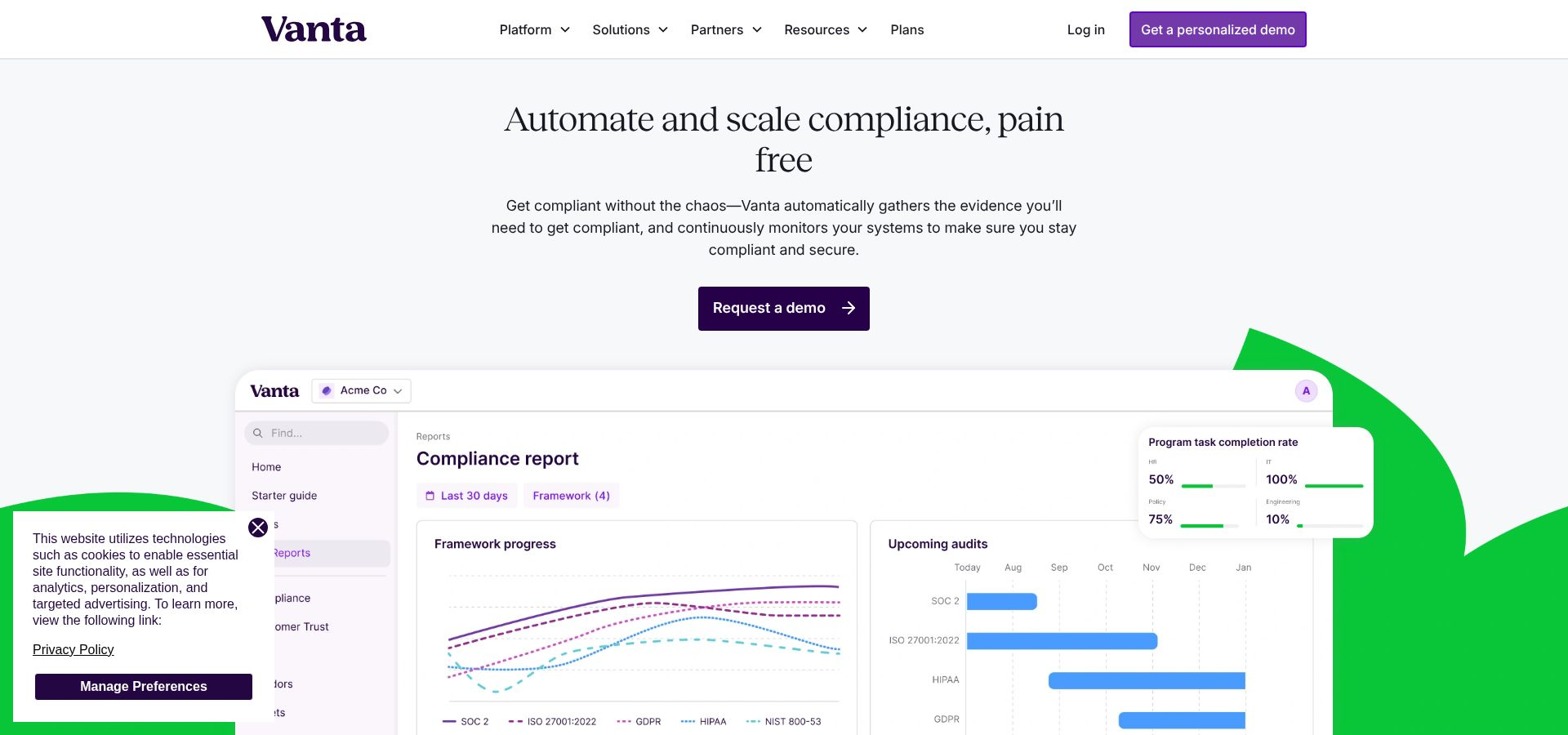
Vanta is a leading trust management and compliance automation platform built for SaaS teams that want to stay audit-ready without turning every release into an evidence fire drill. Its automated compliance platform integrates with 400+ tools and continuously monitors controls—a level of coverage that IDC found cuts 82 percent of the time companies usually spend preparing each framework and audit. Instead of relying on point-in-time checklists, Vanta connects to your stack and keeps controls continuously tested, so you can spot drift early and walk into audits with current evidence already organized.
Best for: SaaS teams that need to get to a first SOC 2 quickly, and also want a platform that can scale to multi-framework compliance without re-platforming later.
Why teams pick Vanta
Vanta combines breadth (framework coverage) with depth (automation cadence). It supports 30+ frameworks, including SOC 2, ISO 27001, HIPAA, PCI DSS, GDPR, HITRUST, FedRAMP, CMMC, SOX ITGC, ISO 42001, and NIST 800-53/171. That matters when you start with one badge for sales, then add requirements for new markets, enterprise buyers, or regulated customers.
On the automation side, Vanta offers 400+ integrations and 1,300+ pre-built automated tests that run hourly. That gives you a tighter feedback loop than tools that only refresh checks daily, and it reduces the odds that a misconfiguration lives quietly for weeks.
AI, built for the work you actually do
Vanta’s AI Agent is designed to reduce the repetitive work that usually slows compliance down, especially when you are juggling multiple frameworks and constant infrastructure change. It supports agentic workflows like searching across policies, controls, tests, and documents, checking evidence, generating and importing policies in bulk, and tracking SLAs through remediation. When technical tests fail, it can also produce AI-generated remediation snippets for tools like Terraform, AWS CLI, and CloudFormation, helping engineering teams move from “finding” to “fix” faster.
External trust, without the questionnaire treadmill
Vanta’s Trust Center is a standout for go-to-market teams. It gives prospects a place to review security and compliance posture, access reports, and reduce back-and-forth during security reviews. Vanta also offers Questionnaire Automation (QAuto), and the Trust Center can include an AI chatbot for buyer self-service, which helps reduce time spent answering repeated questions.
Risk management and vendor risk, in the same system
If you want compliance to connect to real risk decisions, Vanta includes a dedicated risk management capability (risk registers, scoring, dashboards, and treatment plans). It also offers vendor risk management (VRM) features like vendor inventory, AI-powered security reviews, shadow IT discovery, and continuous monitoring, supported by its acquisition of Riskey.
Pricing and watch-outs
Vanta is sold in four tiers, Essentials, Plus, Professional, and Enterprise, with pricing commonly reported in a broad range (roughly $10K to $80K+ per year, depending on size, frameworks, and add-ons).
The trade-off is straightforward:
- Higher entry price than budget-first tools, especially if you only need a single framework and minimal automation.
- Some advanced capabilities (for example, deeper risk customization and multiple risk registers) are tied to higher tiers.
Market signal
Vanta is used by 10,000+ customers across 60+ countries, with strong third-party visibility including 2,100+ G2 reviews and a 4.6/5 rating, plus recognition as a Leader in the 2025 IDC MarketScape for worldwide GRC.
If your goal is to get compliant quickly, stay continuously audit-ready, and reduce customer security-review friction as you scale, Vanta is the most complete “start now, grow later” option in this list.
Hyperproof: strong cross-framework mapping, lighter out-of-the-box automation
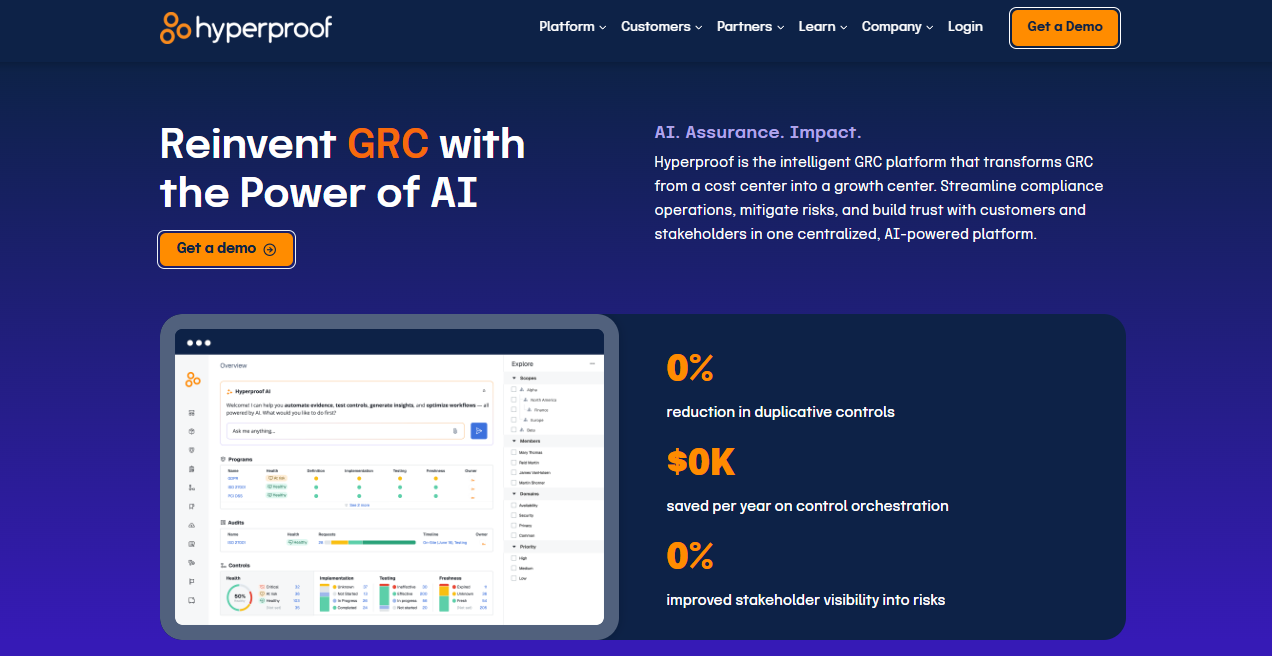
Hyperproof is a mid-market compliance and risk platform known for cross-framework organization. If your biggest pain is duplication, running the same control across SOC 2, ISO 27001, NIST, and GDPR, Hyperproof’s control mapping can help you rationalize the program and keep ownership clear.
Best for: mid-market teams that value cross-framework mapping and risk visibility, and have the internal resources to configure tests and workflows manually.
Framework coverage and program design
Hyperproof supports a broad set of standards, including SOC 2, ISO 27001, NIST, GDPR, PCI DSS, and HIPAA, with coverage across 30+ frameworks. The platform’s model is built around a central control library, then mapping those controls across the frameworks you care about, which reduces rework on paper.
Integrations and automation, what to expect
The automation story is where buyers need to slow down and read the fine print. Hyperproof has fewer than 100 integrations (Hypersyncs), and it does not provide preconfigured automated tests out of the box. Based on the expert research, teams generally have to configure each test manually, which increases implementation time and makes the platform feel less “plug in your stack and go.”
When checks do run, cadence is at best daily, not hourly. Many integrations skew toward evidence gathering and access-review style pulls, rather than deep, continuous technical testing.
Ticketing support is also narrower than many SaaS teams expect, with integrations limited to Jira, Asana, and ServiceNow.
AI capabilities
Hyperproof’s AI features are relatively new. The expert research notes they launched in September 2025 and are still early. They can help with monitoring and suggestions, plus an AI chatbot for help-center style answers, but key automation gaps remain, including:
- No AI-generated remediation code snippets for fixing failed technical checks
- No AI evaluation of whether evidence is actually audit-worthy
- No AI chatbot embedded into a Trust Center experience (because there is no native Trust Center)
Trust and external proof
Hyperproof does not have a native Trust Center or questionnaire automation product. Instead, it partners with HyperComply for those workflows. One practical impact called out in the expert research is that HyperComply operates with a 72-hour SLA for questionnaire responses because human review is required, which can slow down sales cycles that depend on fast turnaround.
Risk management and collaboration
Hyperproof includes a risk register, “work items” for tracking remediation, and risk visualization like heat maps. The expert notes limitations in areas like custom RBAC and group-based task assignment visibility, which can matter as programs scale across many teams.
Pricing and watch-outs
Hyperproof’s entry pricing is reported to start around $12K per year. For a 200-employee SaaS company, the expert research cites typical ranges of $16K to $32K, with a Vendr median ACV of $39K. It also commonly charges an implementation fee (around $10K), and costs can increase through add-ons (for example, policy builder, scopes, risk register, vendor risk, and user access reviews).
Two other watch-outs are worth noting:
- The policy module is an add-on and is described as lightweight, with 25 templates as Word documents and sync support limited to Google Drive (no Confluence or SharePoint sync).
- No auto-generated System Description (SOC 2) or Statement of Applicability (ISO 27001), which can add manual work.
Operationally, the expert research also flags no APAC data center and relatively limited funding (around $100M), which may matter for global teams or buyers who want a rapid pace of product expansion.
If your priority is control mapping and program visibility, Hyperproof can be a good fit. If you want deep, out-of-the-box technical automation with minimal setup, plan for more configuration effort than the marketing suggests.
OneTrust: privacy and governance suite, with compliance automation as an add-on layer
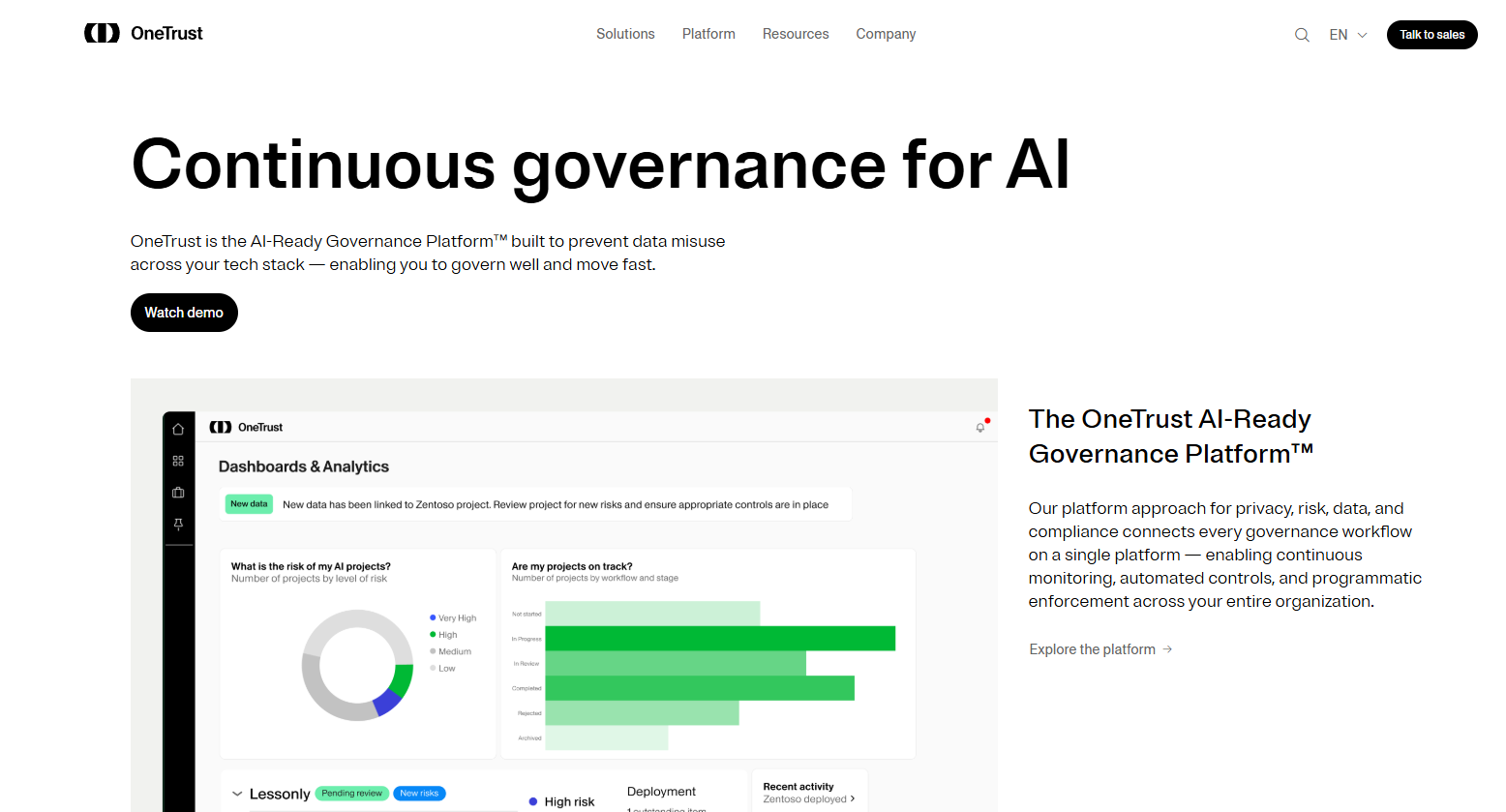
OneTrust is a broad privacy and governance platform built for organizations where global data regulations drive the program. It covers the workflows legal and privacy teams live in, then extends into security compliance through additional modules, including compliance automation capabilities that came via its Tugboat Logic acquisition.
Best for: larger, privacy-heavy organizations operating across regions, where GDPR, CCPA, and similar privacy obligations are the primary driver, and security frameworks like SOC 2 and ISO 27001 are important but secondary.
What OneTrust covers
OneTrust’s breadth is its headline advantage. In addition to supporting security compliance (for example, SOC 2 and ISO 27001 via its compliance automation module), it supports major privacy regimes like GDPR, CCPA, and India’s DPDP. It also offers governance-focused capabilities tied to emerging requirements, including products aligned to the EU AI Act, ISO 42001, and the NIST AI Risk Management Framework (AI RMF).
If your trust obligations span privacy, data governance, and AI governance, OneTrust is one of the few vendors trying to keep those threads in one platform.
Integrations and automation, with practical limits
For SaaS teams shopping specifically for continuous compliance automation, the expert research flags meaningful constraints:
- Limited out-of-the-box integrations for compliance automation compared to compliance-first platforms
- Few vulnerability management integrations (the expert notes Vanta has 35)
- Limited real-time alerts, described as basic and focused on AWS
- No MDM integrations and no built-in device monitoring, which pushes the experience toward point-in-time evidence rather than continuous endpoint assurance
The result is that OneTrust can be powerful for governance workflows, but it is typically not the fastest path to “connect your stack and start passing automated checks.”
AI and responsible AI governance
OneTrust’s AI capabilities show up most naturally in its governance and privacy tooling. The expert research highlights AI that can classify data, suggest missing controls, and flag suppliers without proof. It also offers a Responsible AI product aimed at EU AI Act governance, which is a differentiator for teams that need to show how they govern AI systems, not just secure infrastructure.
Trust and external proof
The expert input is explicit here: OneTrust does not have a true Trust Center product today, and is reportedly working on one. Earlier iterations were missing the pieces buyers tend to expect from a modern Trust Center, including proof of continuous monitoring, strong customization, AI features, and CRM integration.
If your sales team depends on a Trust Center to reduce security review friction, validate what is currently available before you commit.
Risk management and third-party risk
OneTrust is strong in privacy risk and data governance, and it offers third-party risk management as a product area. For security-focused vendor risk reviews, the expert notes VRM functionality is more limited than compliance automation leaders that built VRM directly into the compliance workflow.
Pricing and watch-outs
OneTrust is modular and priced based on factors like admin users and asset inventory. That can be a benefit if you only need one or two capabilities, but costs can rise quickly as additional modules are added.
The expert research also notes that OneTrust has sold off its Ethics and ESG/sustainability businesses to private equity firms, which is helpful context if those were part of your original business case.
Market context
OneTrust is a large enterprise player, previously valued at $5.1B (2021), with breadth built through 11 acquisitions. If your program is privacy-led and you want a single suite across consent, DSARs, privacy risk, and AI governance, it can be a strong fit. If you are primarily buying for SOC 2 and ISO automation in a fast-moving SaaS environment, treat it as a privacy platform with compliance capabilities, not a compliance automation-first system.
LogicGate: no-code GRC workflows for teams that need custom process, not pre-built checks
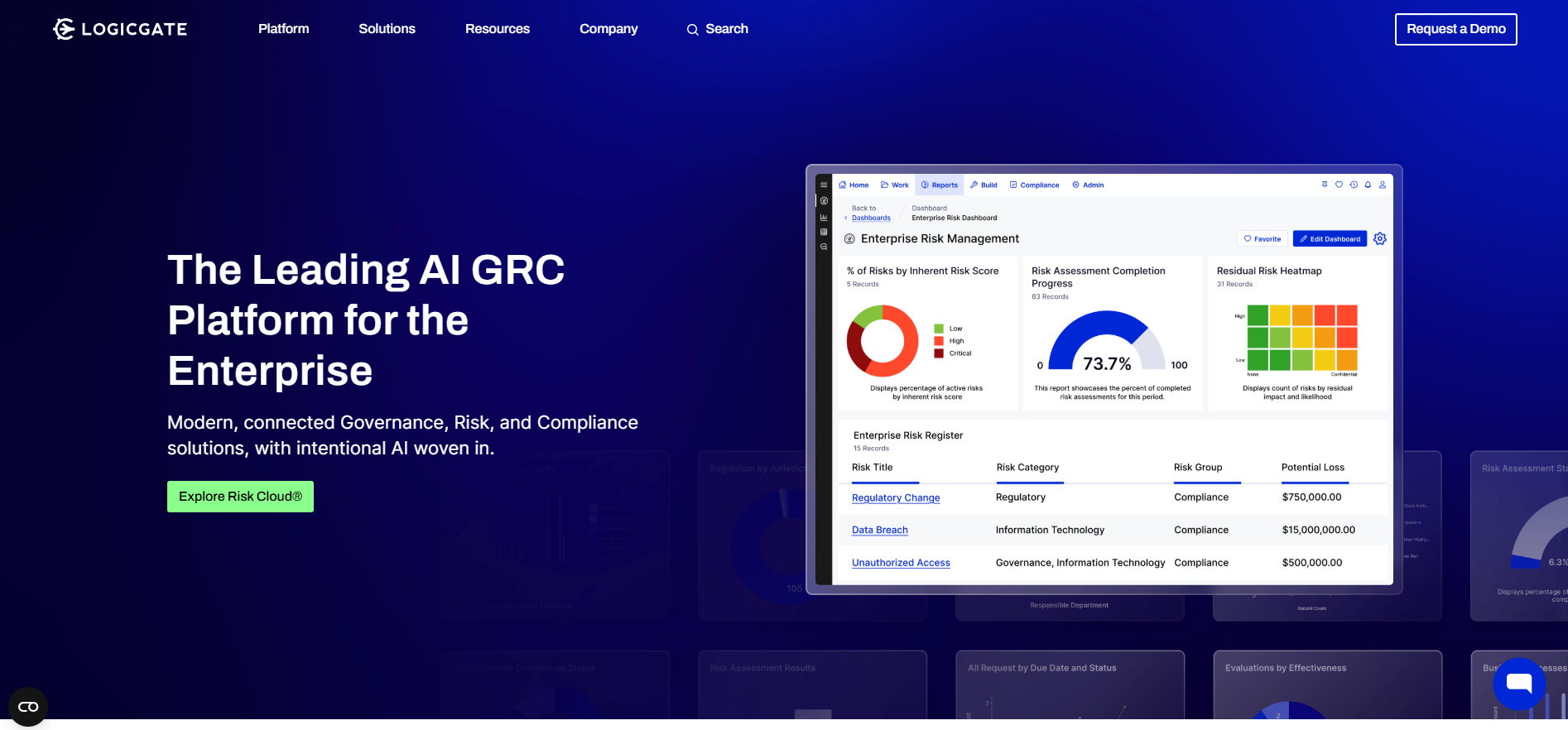
LogicGate (Risk Cloud) is a no-code GRC platform designed for enterprises that want to build their own workflows, not force their program into a vendor’s default template. If your compliance program includes bespoke approvals, exception handling, and cross-functional routing that changes by business unit, LogicGate gives you a builder to model that reality.
Best for: enterprise GRC teams that need highly customizable risk and compliance workflows, and have the time and ownership to maintain them.
What it does well
LogicGate’s strength is flexibility. You can start with a template and then tailor fields, approvals, and handoffs to match how your organization actually runs. That makes it a strong fit for programs where “SOC 2 in a box” is not the goal. The goal is a consistent operating system for risk and compliance across many processes.
Risk management is the core of the platform, spanning use cases like enterprise risk management (ERM), third-party risk management (TPRM), internal audit, regulatory compliance, and operational resilience.
Frameworks and coverage
LogicGate supports 30+ frameworks, but the expert research notes it lacks out-of-the-box coverage for several region-specific frameworks, including Cyber Essentials (UK), Essential Eight (Australia), TISAX, CJIS, AWS FTR, and Microsoft SSPA. If those matter to your roadmap, you should plan for more customization work.
Integrations and automation, with realistic expectations
LogicGate is not a compliance automation platform in the same way Vanta, Drata, or Secureframe are. The expert research highlights:
- About 40 pre-built integrations, which is materially fewer than compliance automation leaders.
- Automated evidence collection is typically reserved for higher-tier packages.
- It does not appear to ship with pre-configured automated tests out of the box. Instead, teams often rely on configurable “Jobs” and custom logic to get to the automation they want.
The original draft’s point about APIs still matters here. LogicGate’s power move is connectivity through an open API (and common automation hooks), so teams can push and pull data from systems like ticketing, data platforms, and chat tools. The trade-off is that you are assembling more of the machine yourself.
AI and decision support
LogicGate has been adding “Spark AI” capabilities across the platform, oriented around accelerating workflow creation and risk work, not generating remediation code for failed technical tests. The expert research also points to broader positioning around AI-infused features and AI governance, plus support for diverse risk quantification methodologies.
Trust and external proof
LogicGate does not offer a Trust Center or questionnaire automation product comparable to the platforms designed to reduce customer security review effort.
Pricing and watch-outs
Pricing is highly variable and depends on modules, user type, and services. The expert research cites a range of $11K to $126K per year, with a median around $52K, and you should expect implementation effort and potential services costs as part of getting to value.
Two practical watch-outs:
- This platform rewards dedicated ownership. Without someone maintaining the model, customization can turn into sprawl.
- If your goal is fast, out-of-the-box continuous compliance automation, LogicGate can feel like heavy lifting. It is a workflow engine first, not a pre-built testing and evidence automation layer.
Market presence
LogicGate is an established GRC vendor with around 300 employees, $156M raised (Series 5A in Sept 2024), and a 4.6/5 G2 rating across 180+ reviews, with “hundreds” of customers.
If you need a highly tailored GRC program and have the team to run it, LogicGate is a strong candidate. If you want pre-built automated checks with minimal setup, it is worth looking at compliance automation-first tools instead.
Certa: third-party risk automation for vendor onboarding and procurement workflows
Certa is an AI-powered third-party lifecycle management platform focused on vendor onboarding, due diligence, and third-party risk management (TPRM). It is not a compliance automation platform for achieving SOC 2 or ISO 27001. Instead, it tackles a different bottleneck that can quietly derail security programs: getting vendors to complete questionnaires, share reports, and stay current through renewals.
Best for: larger organizations with complex vendor ecosystems that need automated workflows for third-party onboarding, risk assessment, and procurement coordination.
What it automates
Certa is built around vendor-facing workflows. When a supplier is onboarded, it can automate steps like sending questionnaires, checking sanction lists, and requesting documents, then tracking status until each requirement is complete. Because it connects into procurement and business systems, it can also keep the process tied to how purchasing decisions are actually made, rather than living in a separate security inbox.
Notable integrations include tools like SAP, Coupa, and Salesforce, plus connections into contract repositories, which helps procurement, legal, and security work from the same source of truth.
AI capabilities and risk focus
Certa uses AI to streamline vendor questionnaires, document handling, and risk assessment workflows. The center of gravity is third-party risk. You use it to evaluate suppliers, maintain audit trails, and keep renewals from slipping through the cracks.
Trust Center and framework coverage
This is where category boundaries matter:
- Trust/external proof: Certa is not a customer-facing Trust Center product.
- Framework coverage: It does not “support frameworks” in the same way compliance automation platforms do. It can support vendor risk assessments aligned to compliance requirements, but it does not automate your SOC 2 evidence collection or run continuous control tests across your infrastructure.
Pricing and watch-outs
Pricing is not publicly available and is generally positioned as enterprise-level.
The main watch-out is fit. If your goal is to get audit-ready for SOC 2, ISO 27001, or HIPAA, Certa is not a substitute for a compliance automation platform. It is best viewed as a complementary tool: pair a compliance automation platform for internal controls and evidence with Certa for vendor due diligence and third-party risk workflows.
If third-party risk and procurement friction are your limiting factors, Certa can remove a lot of manual chasing and keep vendor compliance from becoming the weak link.
Frequently asked questions
What exactly is an automated compliance platform?
Think of it as a security camera for controls. Instead of chasing screenshots once a year, the platform plugs into your cloud, code, and laptops, watches every setting around the clock, and stores tamper-proof evidence for the auditor. You swap frantic, point-in-time sprints for quiet, continuous assurance.
How does continuous compliance differ from continuous auditing?
Continuous compliance is the practice: your controls stay on track day after day. Continuous auditing is the outcome: auditors can review evidence whenever they choose, often remotely. Good tooling supports both; you fix drift, and auditors sample live data.
Will these tools slow our developers down?
Used correctly, they do the opposite. Policy-as-code checks run inside pull requests, giving engineers instant feedback like unit tests. Most fixes are a line of Terraform or a console toggle handled before code reaches production.
How do vendors keep frameworks current?
Top platforms maintain research teams that push rule updates as soon as a standard changes, whether it is PCI DSS 4.0 or the latest EU AI Act clause. Your dashboard flags new requirements, and you tackle them alongside regular backlog work.
What is the smartest first step?
Start small. Pick the framework blocking your next deal—often SOC 2—and connect the easiest integrations first (cloud, identity, ticketing). Once the green checks roll in, add more frameworks and tighten policies. Momentum beats perfection every time.
Conclusion
Continuous compliance platforms automate evidence collection, reduce audit time, and let SaaS teams focus on shipping code. Choosing the right tool from the 5 reviewed above will help you stay ahead of 2026’s expanding regulations and customer expectations.