On this page
Choosing a free hosting panel is not only about saving money on control panel licenses. The web server, PHP stack, caching system, server resources, and configuration behind the panel can all affect website response time.
Time to First Byte (TTFB) is one useful way to measure how quickly a server begins responding to a request. However, a fair server performance benchmark must use the same hardware, website, PHP version, cache settings, test location, and workload for every panel.
This guide explains how to compare free hosting panels using TTFB, what affects the results, and how CyberPanel and CloudPanel differ from a performance perspective.
What Is a Free Hosting Panel?
A free hosting panel is server management software that provides a graphical interface for hosting and managing websites without requiring a paid control panel license.
Depending on the platform, you can use a hosting panel to manage:
- Websites and domains
- Databases
- PHP versions
- SSL certificates
- DNS
- Backups
- Cron jobs
- Server resources
- Application deployments
- Web server configuration
The panel itself does not serve your website. It manages the software and services that do.
This distinction matters when comparing performance.
For example, CyberPanel uses OpenLiteSpeed as its core web server, while CloudPanel uses NGINX with PHP-FPM and other lightweight components.
The underlying server stack can therefore influence how requests are processed.
How Does TTFB Measure a Free Hosting Panel?
TTFB, or Time to First Byte, measures how long it takes for a browser or testing client to receive the first byte of a response after making a request.
A simplified request looks like this:
Visitor → DNS → Network → Web Server → Cache/PHP → Database → First Response
TTFB can include several stages of that process, including connection setup, server processing, and the time required before the first response byte is received.
Google’s web.dev guidance suggests aiming for a TTFB of 800 milliseconds or less as a general target. It considers values above 1.8 seconds poor, while measurements between those ranges need improvement. TTFB is useful for diagnosing response speed, but it is not itself a Core Web Vital.
What TTFB Range Should You Aim For?
Use these as practical reference ranges rather than strict hosting panel rankings:
| TTFB | General interpretation |
|---|---|
| Under 200 ms | Very fast response |
| 200 to 500 ms | Good response |
| 500 to 800 ms | Generally acceptable |
| 800 ms to 1.8 s | Room for improvement |
| Above 1.8 s | Slow server response |
These numbers should not be used to declare one hosting panel faster than another.
A website can have a high TTFB because of a distant server, slow database queries, uncached WordPress requests, overloaded PHP workers, or network latency even when the control panel itself is lightweight.
Which Free Hosting Panels Can You Compare?
Several free control panels use different server architectures.
| Free hosting panel | Primary web stack | Useful performance comparison |
|---|---|---|
| CyberPanel | OpenLiteSpeed | LiteSpeed-based hosting |
| CloudPanel | NGINX + PHP-FPM | Lightweight NGINX hosting |
| HestiaCP | NGINX + Apache | Dual web server setup |
| ISPConfig | Apache or NGINX | Flexible hosting environments |
| aaPanel | Multiple configurable stacks | Flexible server management |
CyberPanel currently describes its free edition as open source with OpenLiteSpeed at its core. It also provides website, WordPress, SSL, backup, and server management tools.
CloudPanel describes itself as a free server control panel built around lightweight components including NGINX, PHP-FPM, and MySQL. It supports PHP applications, Node.js, Python applications, static websites, and reverse proxies.
The important point is that these panels do not use identical server stacks.
How Should You Benchmark a Free Hosting Panel?
A reliable server performance benchmark requires controlled testing.
Installing CyberPanel on one VPS and CloudPanel on another VPS does not provide a meaningful comparison if the servers have different CPUs, storage, network routes, or locations.
Use the same environment wherever possible.
| Test variable | What should remain the same |
|---|---|
| CPU | Same model and vCPU count |
| RAM | Same memory capacity |
| Storage | Same SSD or NVMe class |
| Data center | Same location |
| Operating system | Same supported OS version where possible |
| PHP | Same PHP version |
| Database | Same database version |
| Website | Exact same website copy |
| Theme | Same theme |
| Plugins | Same plugins |
| Cache | Identical test conditions |
| Traffic | Same load pattern |
| Test location | Same geographic location |
| Test tool | Same testing platform |
This removes variables that could make one panel appear faster simply because it was tested under better conditions.
CloudPanel also publishes server benchmark guidance and recommends controlled server conditions when evaluating performance.
How Do You Measure TTFB for a Free Hosting Panel?
You can measure TTFB with several tools.
WebPageTest
WebPageTest allows you to test from different locations and examine server response timing alongside other loading metrics.
This is useful when you want to understand how network location affects TTFB.
Browser Developer Tools
Chrome DevTools can show timing information for the main document request.
Open the Network panel, reload the page, and inspect the document request to examine its timing breakdown.
cURL
For a simple command-line measurement, you can use cURL:
curl -o /dev/null -s -w "TTFB: %{time_starttransfer}s\n" https://example.comRun the command multiple times instead of relying on a single request.
Real User Data
Field data can show how actual visitors experience your website from different networks and locations.
This is important because a server can perform well in a controlled test while visitors in another geographic region experience higher network latency.
CyberPanel’s existing web hosting performance guide also identifies TTFB as a server response metric and recommends tools such as WebPageTest and cURL for testing it.
What Is a Good TTFB Benchmark for a Hosting Server?
There is no single TTFB number that makes a hosting server objectively fast.
A useful benchmark depends on what you are testing.
For example:
Static page
The server may return a file with very little processing.
Cached WordPress page
The server can return a previously generated page without running the complete WordPress stack.
Uncached WordPress page
The request may require PHP, WordPress plugins, database queries, and application processing.
Dynamic application
The response may depend on database operations, API calls, authentication, or other backend processing.
These scenarios should not be mixed into one benchmark.
CyberPanel vs CloudPanel TTFB: What Is the Difference?
The CyberPanel vs CloudPanel TTFB comparison should begin with their underlying architectures.
CyberPanel is built around OpenLiteSpeed. CloudPanel uses NGINX and PHP-FPM.
That means the two environments process requests differently.
| Performance factor | CyberPanel | CloudPanel |
|---|---|---|
| Web server | OpenLiteSpeed | NGINX |
| PHP architecture | LiteSpeed PHP stack | PHP-FPM |
| Full-page caching ecosystem | LiteSpeed Cache | Varnish and other caching options |
| WordPress support | Yes | Yes |
| Server monitoring | Yes | Yes |
| SSL management | Yes | Yes |
| Primary strength to benchmark | OpenLiteSpeed + LSCache | NGINX + PHP-FPM |
This does not mean one panel will produce a lower TTFB in every situation.
The result depends on the website and configuration being tested.
A heavily cached WordPress website can produce very different results from an uncached WooCommerce store, even on the same panel.
Does CyberPanel Reduce WordPress TTFB?
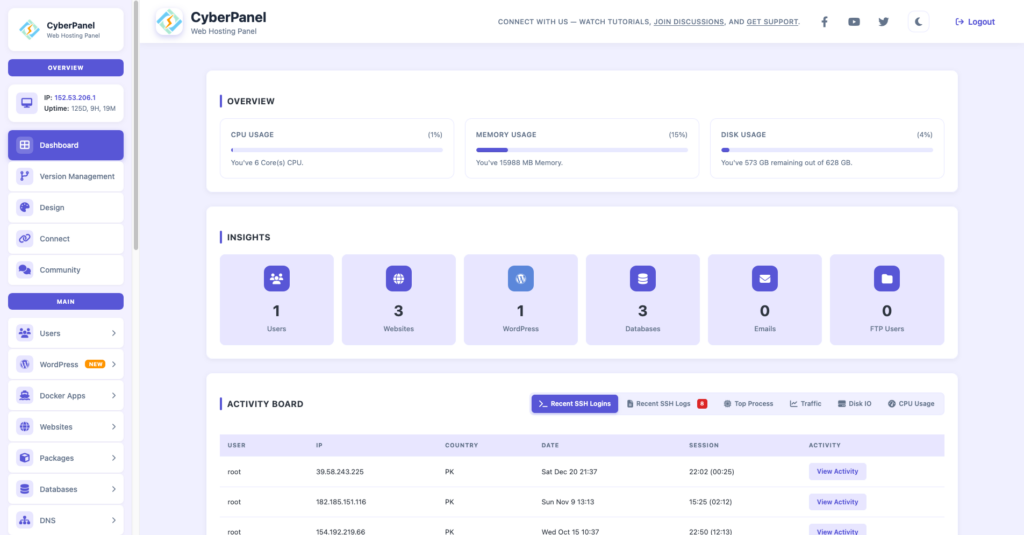
CyberPanel can provide a performance-oriented WordPress environment because it uses OpenLiteSpeed and supports the LiteSpeed caching ecosystem.
The important distinction is between the control panel and the cache.
CyberPanel manages the server environment.
OpenLiteSpeed handles web requests.
LiteSpeed Cache can cache eligible WordPress pages at the server level.
When a cached page can be served directly, WordPress may not need to rebuild that page through PHP and the database for every visitor.
CyberPanel’s current documentation identifies OpenLiteSpeed as the core of its free control panel, while its WordPress ecosystem supports LiteSpeed Cache.
For this reason, a CyberPanel benchmark should test cached and uncached requests separately.
How Does LiteSpeed Cache Affect TTFB?
Caching can dramatically change TTFB.
Without page caching, a WordPress request may follow this path:
Visitor → OpenLiteSpeed → PHP → WordPress → Database → HTML
With an available full-page cache, it can become:
Visitor → OpenLiteSpeed → Cached HTML
The second path requires much less application processing.
LiteSpeed Cache for WordPress is designed to communicate with the LiteSpeed server cache. Its full page caching functionality requires a compatible LiteSpeed environment or supported QUIC.cloud setup.
This is why you should never compare a cached CyberPanel installation with an uncached CloudPanel installation and call the result a panel benchmark.
For a deeper explanation of this caching system, see our guide to LiteSpeed Cache Plugin for WordPress.
Is CloudPanel a Fast Free Hosting Panel?
CloudPanel is designed around a lightweight NGINX and PHP-FPM stack.
Its current documentation describes CloudPanel as a free server control panel with support for PHP, Node.js, Python, static websites, and reverse proxies. It also provides monitoring for CPU usage, memory usage, disk usage, and load average.
CloudPanel’s architecture can therefore provide a useful comparison with OpenLiteSpeed-based hosting.
However, its TTFB still depends on the application running on top of the stack.
A poorly optimized WordPress installation can be slow on any panel.
A lightweight static website can be fast on several different panels.
The panel should therefore be evaluated as part of the complete hosting stack.
How Does Caching Change Free Hosting Panel Benchmarks?
Caching is one of the biggest variables in a TTFB test.
Suppose you test two WordPress websites.
Test A: Uncached
The server must process PHP, WordPress, database queries, and plugins before returning the response.
Test B: Cached
The server can return an already generated response.
These are fundamentally different workloads.
Your benchmark should therefore report separate results.
| Test | What it measures |
|---|---|
| Cold request | Initial application processing |
| Warm request | Repeated request behavior |
| Cached request | Cache delivery performance |
| Uncached request | Backend processing |
| Dynamic request | Application responsiveness |
CloudPanel also provides caching options, including Varnish, which can serve cached responses without sending every request through PHP-FPM.
The same principle applies when testing CyberPanel with LiteSpeed Cache.
Does Server Location Affect TTFB?
Yes.
The physical and network distance between the visitor and the server can affect the measured response time.
A server located close to the testing location can have lower network latency than the same server stack hosted on another continent.
For example, a TTFB test from Pakistan can produce a different result for a server in Europe than a test from a location near that European data center.
Therefore, every panel in a comparison should use the same test location.
Do not compare:
CyberPanel tested from Singapore
against:
CloudPanel tested from Germany
and call the difference a control panel performance result.
Does VPS Hardware Affect TTFB?
Yes.
CPU performance, memory, storage, and network capacity can all influence server response time.
This is especially important for PHP applications.
A WordPress website that performs many PHP calculations or database queries can behave very differently on a low-performance VPS compared with a high-performance CPU.
CloudPanel’s documentation also provides benchmark guidance for evaluating server performance, reinforcing the importance of controlled infrastructure when making comparisons.
For this reason, the VPS should be treated as part of the benchmark environment rather than ignored.
If you are selecting infrastructure for CyberPanel, our guide on How to Choose the Right VPS for CyberPanel Hosting covers the server resources that can affect performance.
What Should a Server Performance Benchmark Measure?
TTFB should not be the only metric.
A useful server performance benchmark should also measure resource usage and behavior under load.
| Metric | Why it matters |
|---|---|
| TTFB | Measures response start time |
| Requests per second | Shows throughput |
| CPU usage | Shows processing demand |
| RAM usage | Shows memory overhead |
| Load average | Shows system pressure |
| PHP response time | Shows backend processing |
| Cache hit rate | Shows cache effectiveness |
| Concurrent requests | Tests behavior under load |
| Error rate | Shows stability |
| Disk performance | Can affect database and application work |
This provides a more complete picture than one TTFB measurement.
For example, Panel A might produce a slightly lower TTFB while consuming considerably more CPU under load.
Panel B might have a similar TTFB while handling more concurrent requests.
The better choice depends on the workload.
What Is the Fastest Free Panel?
There is no universal fastest free panel based on TTFB alone.
The answer changes depending on:
- Website type
- Web server
- PHP workload
- Cache configuration
- Database size
- VPS hardware
- Server location
- Traffic volume
- Number of concurrent requests
- Application architecture
For a WordPress website using full-page caching, a LiteSpeed-based environment may behave differently from an uncached PHP application.
For a static website, the difference between panels may be much smaller because very little application processing is required.
For a dynamic application, PHP-FPM or another application runtime may become a larger part of the response time.
Therefore, the correct way to identify the fastest free panel for your workload is to benchmark the exact workload you plan to host.
How Can You Run a Fair CyberPanel vs CloudPanel Benchmark?
Use a controlled test environment.
Step 1: Create Identical Servers
Use the same CPU, RAM, storage, operating system, and data center.
Step 2: Install Each Panel
Install CyberPanel on one server and CloudPanel on the other using their current supported installation procedures.
Step 3: Deploy the Same Website
Use the same WordPress files, database, theme, plugins, images, and configuration.
Step 4: Match PHP Versions
Use the same supported PHP version on both servers.
Step 5: Test Without Full-Page Caching
Measure uncached response performance first.
Step 6: Test With Caching
Configure the appropriate caching system on each platform and repeat the test.
Step 7: Test From the Same Location
Use the same WebPageTest location or testing machine.
Step 8: Run Multiple Requests
Do not use a single measurement.
Record multiple requests and compare the median rather than focusing on the fastest individual result.
Step 9: Add Load Testing
Test how the servers behave when several requests arrive simultaneously.
Step 10: Record Resource Usage
Measure CPU, RAM, load average, and errors during every test.
This creates a useful benchmark instead of a marketing-style speed claim.
What Makes a Free Hosting Panel Benchmark Unreliable?
Several mistakes can make a comparison misleading.
Different Server Hardware
A stronger CPU can make the underlying application faster regardless of the control panel.
Different Cache Settings
A cached response can be dramatically different from an uncached response.
Different Websites
Different plugins, themes, databases, and content produce different workloads.
Different PHP Versions
PHP versions can have different performance characteristics.
Different Test Locations
Network distance changes response time.
One-Time Testing
A single request does not represent normal server behavior.
Using Vendor Claims as Independent Results
A hosting panel’s own performance claim is not the same as an independently controlled benchmark.
Use vendor documentation to understand architecture and features, but use controlled testing to establish your own performance results.
How Should You Interpret TTFB Results?
Do not look only at the lowest number.
Imagine a controlled test produces these results:
| Test | Panel A | Panel B |
|---|---|---|
| Cold TTFB | 420 ms | 450 ms |
| Warm TTFB | 280 ms | 300 ms |
| Cached TTFB | 90 ms | 110 ms |
| CPU under load | 65% | 48% |
| RAM under load | 1.4 GB | 1.1 GB |
The difference in TTFB alone does not tell the complete story.
Panel A may respond slightly faster in this particular test, while Panel B may consume fewer resources under the same workload.
This is why commercial hosting decisions should consider performance, resource usage, stability, features, caching, and workload compatibility together.
Which Free Hosting Panel Is Suitable for WordPress?
Both CyberPanel and CloudPanel can be used for WordPress, but their server stacks are different.
CyberPanel uses OpenLiteSpeed and integrates naturally with the LiteSpeed Cache ecosystem.
CloudPanel uses NGINX and PHP-FPM and provides a lightweight environment for PHP applications, including WordPress.
For WordPress users, the practical comparison should therefore include:
- Uncached TTFB
- Cached TTFB
- PHP processing
- Database response
- CPU usage
- RAM usage
- Cache hit behavior
- Performance under concurrent requests
Do not select a panel based solely on a single TTFB number.
Free Hosting Panel Benchmark Checklist
Use this checklist before publishing or trusting a control panel performance comparison.
| Benchmark factor | Requirement |
|---|---|
| Server hardware | Identical |
| CPU | Same model and cores |
| RAM | Same capacity |
| Storage | Same class |
| Data center | Same location |
| Operating system | Same version where possible |
| PHP | Same version |
| Database | Same version |
| Website | Same copy |
| Theme | Same |
| Plugins | Same |
| Cache | Test separately |
| Test location | Same |
| Test tool | Same |
| Number of tests | Multiple |
| TTFB | Record median |
| Load testing | Same workload |
| Resource usage | Record CPU and RAM |
| Errors | Record failures |
Frequently Asked Questions
Can TTFB improve without changing the hosting panel?
Yes. Optimizing PHP, reducing database queries, improving caching, removing unnecessary plugins, upgrading server resources, and moving the server closer to your visitors can all reduce response time without changing the control panel.
Should you benchmark a hosting panel before moving a production website?
If performance is an important reason for the migration, testing first is useful. A small staging environment can reveal how the panel, web server, PHP stack, caching, and application behave before you move the production workload.
Does a free hosting panel use more server resources than a paid panel?
Not necessarily. Resource usage depends on the panel’s architecture, enabled services, monitoring tools, web server, database, mail services, and configuration. The best way to compare overhead is to measure CPU and RAM usage on otherwise identical servers.
Final Thoughts
A free hosting panel can provide a capable server management environment without a recurring control panel license, but the panel alone does not determine website speed.
TTFB is useful because it shows how quickly the server begins responding, but it must be measured under controlled conditions.
CyberPanel uses OpenLiteSpeed, while CloudPanel uses NGINX and PHP-FPM. Those different architectures make them useful candidates for a controlled performance comparison, but they do not make one universally faster for every website.
If you want meaningful server performance benchmark results, use identical hardware, identical websites, identical PHP versions, identical test locations, and separate cached and uncached tests.
Do not ask only which panel has the lowest TTFB.
Ask which hosting stack provides the response time, resource efficiency, caching behavior, and stability your actual workload requires.
Benchmark the workload, not just the panel.