
On this page
What if deploying a full OpenStack cloud didn’t seem like building a hundred moving parts by hand, but instead like the automation of a repeatable and predictable process? This is actually precisely what Kolla Ansible was designed to address.
Making OpenStack work has always been difficult. Dozens of services, strict dependencies, networking layers, databases, message queues, and storage backends all have to work together.
Even a tiny discrepancy will cause the whole stack to break. Have a large OpenStack deployment, always needed to configure everything by hand or run long scripts.
This is what Kolla Ansible changes the game by containerizing the services of OpenStack and deploying them based on playbooks of Ansible.
If you are asking OpenStack Ansible vs Kolla Ansible, Ansible Kolla workflows, or searching for Kolla Ansible Git repositories for deployment, this is the guide that makes all things simple.
What Is Kolla Ansible?
OpenStack Kolla Ansible is an automation tool that deploys OpenStack services using containers and Ansible playbooks.
Rather than deploying services on the host, Kolla implements each OpenStack service in containers.
Main point:
- OpenStack services are run inside containers
- Ansible handles deployment and configuration
- Docker (or container runtime) runs the process here
This is what makes deployments more predictable and reproducible.
Working of Kolla Ansible
At a high level, Kolla Ansible follows a structured workflow:
- First, prepare the target nodes
- Then install dependencies
- After that, pull OpenStack container images
- Then, configure services using Ansible
- Finally, deploy containers across nodes
Each service runs in isolation, but all are orchestrated together. Moreover, you don’t install OpenStack manually. You deploy it like an application stack.
What is Ansible Kolla?
It usually refers to the Ansible-based automation layer inside Kolla. It handles:
- inventory management
- configuration generation
- service orchestration
- cluster deployment
It is essentially the engine that drives Kolla deployments.
Kolla Ansible Git: Everything Begins There
Here is the typical workflow:
git clone https://opendev.org/openstack/kolla-ansible.git
cd kolla-ansibleHere is why Git matters:
- It gives access to the latest OpenStack deployment scripts
- It allows version control for infrastructure
- It enables custom modifications
- It supports stable releases and development branches
Common use cases include:
- Clone repository
- Configure inventory
- Run Ansible playbooks
OpenStack Ansible vs Kolla Ansible
| Feature | OpenStack Ansible | Kolla Ansible |
|---|---|---|
| Deployment Style | From source packages | Container-based |
| Complexity | High | Moderate |
| Speed | Slower setup | Faster deployment |
| Flexibility | High customization | Standardized containers |
| Maintenance | Harder upgrades | Easier upgrades |
Why Kolla Ansible Is Becoming Popular?
For several sound reasons, a lot of teams are migrating to Kolla.
1. Consistency
Containers guarantee all nodes operate in the identical environment.
2. Faster Deployment
Automated dependency resolution.
3. Easier upgrades
You just updated container images.
4. Reduced configuration drift
All is defined in Ansible playbooks.
Architecture of Kolla Ansible
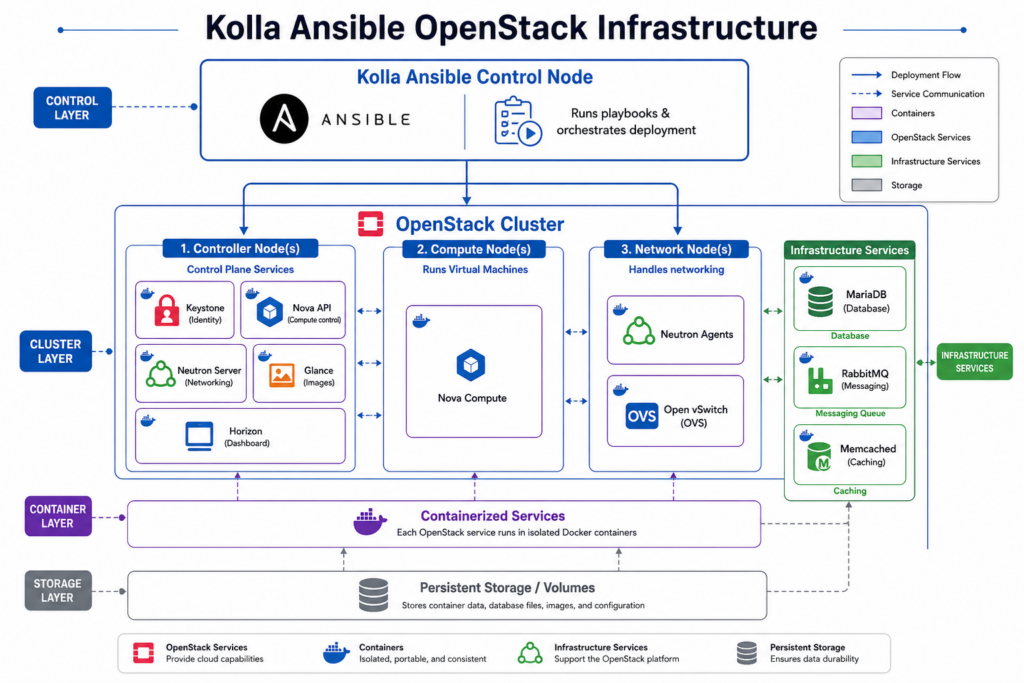
Kolla uses a layered architecture:
1. Control Plane
- Keystone
- Nova
- Neutron
- Glance
2. Infrastructure Services
- MariaDB
- RabbitMQ
- Memcached
3. Container Layer
They are individually hosted in isolated containers.
4. Ansible Layer
Orchestrates everything.
Example Workflow: Deploying OpenStack with Kolla
Step 1: Install dependencies
pip install kolla-ansibleStep 2: Prepare configuration
cp -r /etc/kolla /etc/kolla-backupStep 3: Bootstrap servers
kolla-ansible bootstrap-serversStep 4: Deploy OpenStack
kolla-ansible deployResult
A full OpenStack environment running in containers.
Challanges of Kolla Ansible
There is no doubt that Ansible Kolla make deployment simple. Here are few challanges:
1. Learning Curve
You need knowoedge of OpenStack.
2. Debugging Containers
You can find troubleshooting inside containers complex.
3. Resource Heavy
It requires strong infrastructure.
4. Networking Complexity
OpenStack networking is still non-trivial.
Best Practices to Follow
Here are some best practices you should follow:
Use Stable Releases
You should avoid bleeding-edge branches in production.
Separate Environments
You should use different inventories for staging and production.
Monitor Containers
You must track logs and resource usage oftenly.
Automate Backups
You must automate backups especially for databases and configuration.
Role of CyberPanel
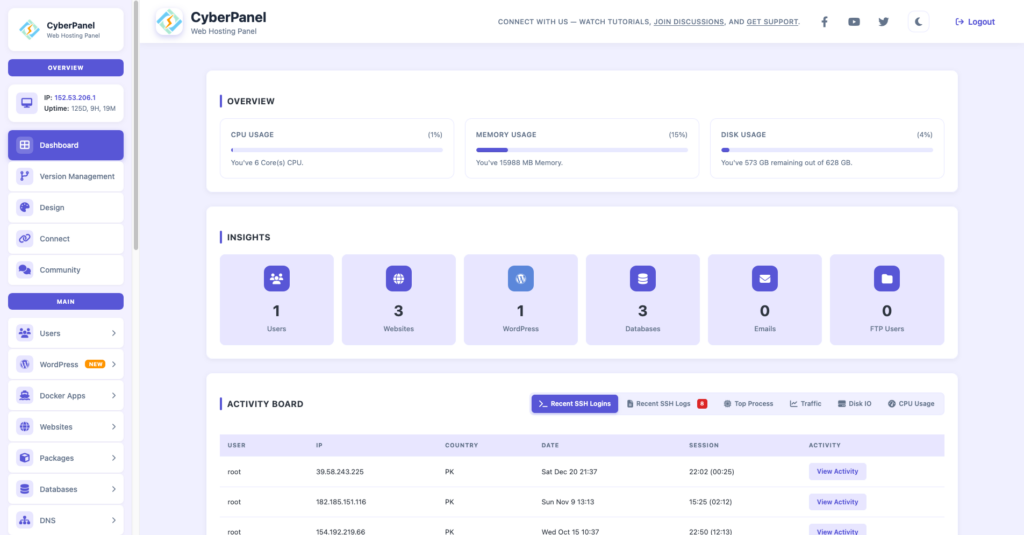
CyberPanel is a free and open-source web hosting control panel. It is not a replacement for OpenStack. However, it can complement infrastrucrure management.
Kolla Ansible deploys OpenStack cloud. CyberPanel manages web hosting layer on the top. Ansible connects both automation layers.
It means OpenStack provides infrastructure. CyberPanel manages websites and applications on that infrastructure. This creates a full-stack cloud ecosystem.
Final Thoughts!
To sum up, Kolla Ansible simplifies one of the most complex areas in cloud computing. This is OpenStack deployment. By combining containerization with Ansible automation, it removes many traditional pain points. These pain points include dependency management, inconsistent environments, and slow upgrades.
If you compare OpenStack Ansible with Kolla Ansible, Kolla will always stands out. It does so because of modern and container-based deployments. But, this powerful system needs proper understanding of both OpenStack and infrastructure design.
Are you working with OpenStack? Start by cloning the Kolla Ansible Git repository and deploying a small test environment. Once you understand the flow, you will scale it to production-grade infrastructure!
FAQs
Do I need Docker for Kolla Ansible?
Yes, container runtime is required since services run inside containers.
Is Kolla Ansible production ready?
Yes, it is widely used in production environments, especially for containerized OpenStack deployments.
Can I customize Kolla Ansible deployments?
Yes, but customization is more structured compared to traditional OpenStack setups.