

Linux users are often caught between a rock and a hard place when it comes to choosing their distribution. Some distros kick the reliability factor up a notch at the expense of providing older versions of software. The rest of them come with the latest packages, which are a bit more prone to problems and would demand a higher level of maintenance and troubleshooting. Getting a distributor that has modern technologies, but is still very user-friendly, can be very difficult. Mostly for other platform users, like Windows and macOS, who want to make a transition to Linux.
That is the reason why Ultramarine Linux is a thing.
Fedora-based, Ultramarine Linux intends to offer a much easier way for the user, a way that still rarely compromises on Fedora’s characteristics, such as high performance, great security, and constant innovation. Their goal is to give people a nice working environment straight from the box and not make people spend time installing separate repositories, codecs, drivers, and desktop settings, as it usually happens with Fedora.
Demand for Ultramarine Linux keeps increasing, and there are lots of users looking on the internet for Linux Ultramarine, Ultramarine Linux 40, Ultramarine Linux 41, and Ultramarine Linux download options while checking out modern Linux distros. No matter if you are a Linux beginner programmer, content maker, student, or system admin, Ultramarine gives a fresh way of a simple Fedora system, which is also very powerful.
Walking you through the amazing world of Ultramarine Linux, this article will cover the basics like what it is, how it works, features, desktop availability, installation method, release date, and its suitability for you in 2026.
What Is Ultramarine Linux?
Ultramarine Linux is a Linux distro based on Fedora aimed at turning Fedora into a simpler and more user-friendly Linux for the average person.
Since Fedora is still among the top-tier Linux distributions, there are people who consider its default installation a bit unfriendly to beginners compared to other variants like Linux Mint and Ubuntu.
Ultramarine solves that by offering:
- Preloaded and prearranged desktops
- User experience upgrade
- More software repos
- Support for multimedia
- Easier system installation
- Better hardware recognition
So, as a result, Ultramarine is a package that not only keeps Fedora’s advantages but at the same time gives users much less tweaking and configuring after installation.
Why Ultramarine Linux Was Created?
Ultramarine Linux’s main and only purpose is:
To simplify Fedora for all users.
Fedora is well known for being:
- Secure
- Fast
- On top of its software versions
- With great developer tools
And yet, for the less experienced Linux users, the very first steps may give headaches.
That is why Ultramarine makes it easier for you to get there and even get a nice, fully functional desktop at your very first login.
Features Of Ultramarine Linux
Fedora Foundation
Ultramarine is based on Fedora and inherits the features of the latter.

Some of these are:
- Up-to-date Linux kernels
- Quick software updates
- Highly secure practices
- Technologies of the level of the enterprise
- Out-Of-The-Box Experience
After installation, a lot of the usual tools and setups are available.
It means that users can dedicate less time to the configuration and more to the actual work.
Various Desktop Editions
Ultramarine has the capability to run multiple desktop environments.
Some of the most well-known choices are:
- KDE Plasma
- GNOME
- Budgie
- XFCE
With this freedom, people can pick an environment that goes well with their work style.
Better Support For Multimedia
Playing media and setting up codecs are, in many cases, simpler than in a default Fedora system.
User-Friendly Defaults
The distro is geared towards recommending defaults that are useful for both novice and expert users.
Ultramarine Linux Desktop Editions
The range of desktops that Ultramarine offers is one of its biggest points of strength.
KDE Plasma Edition
KDE Plasma Edition is best for users who like:
- Up-to-date looks
- Almost unlimited changing possibilities
- Workflows focused on productivity
GNOME Edition
This edition equips you with a neat and simple desktop experience.
Perfect for:
- Software developers
- Working professionals
- Users who like minimalism
XFCE Edition
Offers:
- Lower resource usage
- Strong performance
- Excellent support for older hardware
Budgie Edition
Combines modern aesthetics with ease of use.
Popular among users transitioning from Windows.
Ultramarine Linux Download
Numerous users who are new to Ultramarine Linux keep looking for a download of it.
Before you download, ask yourself:
- Which desktop environment do I prefer?
- Do I have the hardware specs?
- How much free disk space do I have?
- Is my hardware compatible with UEFI?
With an official image, you will have the most recent security updates and new hardware-support features.
How To Install Ultramarine Linux?
It is quite easy to get through the installation process.
Step 1: Download The ISO
Select your preferred desktop edition.
Step 2: Create Installation Media
Take advantage of tools like:
- Ventoy
- Rufus
- Balena Etcher
to prepare a USB stick that is bootable.
Step 3: Boot From USB
Turn off the computer, and the installer will show up.
Step 4: Configure Storage
You can decide:
- Automatic partitioning
- Manual partitioning
Dual-boot configuration
depending on your requirements.
Step 5: Complete Installation
Follow the setup wizard and reboot when finished.
Ultramarine Linux 40
Ultramarine Linux 40 was a Fedora 40-based release and brought a lot of new features aimed at making the system easier to use, more reliable, and more visually appealing.
Main features:
- Updated Linux Kernel
- Revamped Desktop
- Better Package Management
- Increased Hardware Compatibility
- More User-friendly Installer
With this version, Ultramarine made a name for itself as a feasible Fedora alternative for users who didn’t want the setup work that comes with Fedora.
Ultramarine Linux 41
Ultramarine Linux 41 features the desktop environment, where the project’s main emphasis was still on presenting a highly refined Fedora-based desktop experience.
Major updates:
- More advanced Fedora technologies
- Fresh software versions
- Stronger protection layers
- More agile desktop interaction
- Enhanced compatibility with the latest hardware
If you want to experience the very latest Fedora platform with its latest software, Ultramarine Linux 41 is the best place to start for most users.
Ultramarine Linux Vs Fedora
Many users compare Ultramarine directly with Fedora.
Ultramarine Linux Vs Linux Mint
Another common comparison involves Linux Mint.
| Feature | Ultramarine Linux | Linux Mint |
|---|---|---|
| Base System | Fedora | Ubuntu |
| Software Freshness | Very High | Moderate |
| Beginner Friendly | Excellent | Excellent |
| Development Tools | Strong | Strong |
| Hardware Support | Excellent | Excellent |
| Feature | Ultramarine Linux | Fedora |
|---|---|---|
| Beginner Friendly | Excellent | Good |
| Default Configuration | More Complete | Minimal |
| Multimedia Support | Easier | Additional Setup |
| Software Availability | Expanded | Standard |
| Customization | High | High |
| Stability | Excellent | Excellent |
Who Should Use Ultramarine Linux?
Ultramarine Linux is perfect for:
Beginners
This distro eliminates quite a few typical Linux setup hassles.
Developers
With the latest programming tools and Fedora-based technologies, building software is a breeze.
Students
Since it hardly takes time to get up and running, students can put more energy into studying.
Content Creators
Having the right kind of equipment and apps is a big plus for any artist.
Power Users
Besides, users keep the flexibility and performance of Fedora.
Advantages of Ultramarine Linux
Some major benefits include:
- Modern software packages
- Fedora reliability
- User-friendly defaults
- Multiple desktop choices
- Excellent hardware support
- Simplified multimedia setup
If anything, these features make Ultramarine a very unique player in the Linux distro market.
Potential Limitations
There is no such thing as a perfect distribution.
Things to maybe think about:
Smaller Community
Fedora, with its bigger community and ecosystem, is the point of comparison.
Newer Project
Ultramarine cannot yet boast a long history like Debian or Ubuntu.
Fedora Release Cycle
Compared to long-term support distributions, users get updates more often.
Reasons Why Ultramarine Linux is a Game-Changer in 2026
Linux is increasingly becoming the software choice of developers, students, creators, and even most businesses.
People prefer operating systems that offer:
- Latest software
- Performance
- Usability
- Protection
Ultramarine Linux is an OS that perfectly meets these requirements by integrating the cutting-edge aspects of Fedora with a more user-friendly experience.
How CyberPanel Complements Ultramarine Linux?
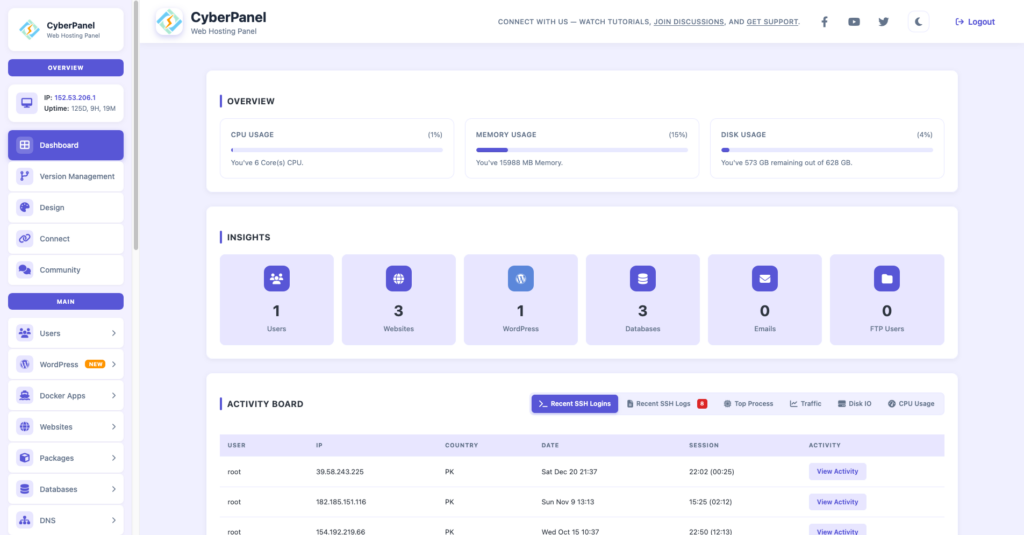
At the start, Ultramarine users are mostly interested in the desktop experience, but later many of them get involved with website management, cloud infrastructure, and Linux servers.
For instance, CyberPanel is a free and open-source web hosting control panel running on OpenLiteSpeed. It can greatly help in areas that include the launching of websites, making backups, dealing with SSL, email hosting, database server management, etc.
Basically, Ultramarine Linux and CyberPanel make an excellent pair by bringing together a reliable desktop processing environment and a graphical interface for the server.
Conclusion
Ultramarine Linux is a great example of how Fedora’s up-to-date technology stack can be merged with a more casual and user-friendly experience. So whether you turn to Linux Ultramarine for your next Linux OS, research Ultramarine Linux 40, evaluate Ultramarine Linux 41 or simply wish to light up your computer with an Ultramarine Linux download, at its core the distribution is a great mixture of performance, usability, and software freshness. For anyone looking to enjoy the power of Fedora but without the hassle of extra configuration, Ultramarine Linux could very well be one of the most attractive offerings on the market in 2026.
Do you want to enjoy a desktop based on Fedora that is almost ready for use? Get some Ultramarine Linux today and get to know an even faster, more welcoming and more productive Linux world.
FAQs
Does Ultramarine Linux Receive Regular Updates?
Yes. Since it is based on Fedora, Ultramarine benefits from frequent software and security updates.
Can You Upgrade Between Ultramarine Linux Releases?
Yes. Existing installations can typically be upgraded to newer releases through the distribution’s supported upgrade process.
Can Ultramarine Linux Be Used For Software Development?
Absolutely. Its Fedora foundation makes it particularly attractive for developers who need modern programming tools and libraries.