On this page
Managing network traffic, proxies, and secure connections on Linux usually involves using powerful and flexible tools. A popular solution in this area is Clash for Linux, a rule-based proxy client that allows users to have advanced control over traffic and performance optimization.
If you are a developer, network engineer, or privacy-first user, the Clash will give you the capability of routing your traffic with the help of custom-made rules.
This tutorial will walk you through the meaning of Clash, the Linux functionality of it, how to download and install it safely, and how to configure it properly for everyday use.
What Is Clash for Linux?
Clash is a rule-based proxy client that supports multiple proxy protocols and allows users to define routing rules for network traffic.
Essentially, Clash for Linux is about running the core of the Clash or its graphical client on a Linux system to get:
- HTTP and SOCKS5 proxies
- Shadowsocks
- VMess
- Trojan
- Custom routing rules
And it offers users very advanced network configuration and traffic segmentation possibilities.
How Does Clash Client for Linux Work?
First of all, the Clash client for Linux runs a local proxy server. After that, the traffic is redirected in accordance with the rules set. Then, routing policies based on the domain, the IP, or the location of the IP are applied.
Instead of tunneling all the traffic through one proxy, Clash offers the following options:
- local traffic direct routing
- selected domains proxy routing
- request blocking better
- reliability fallback logic
This type of control level is what makes it more potent than basic VPN utilities.
Clash for Linux Download: How to Install
Two main parts of the application are:
- Clash Core (command line version)
- GUI frontends (optional but highly recommended for beginners)
Step 1: Download Clash Core
Visit the official GitHub releases page of Clash and download the latest Linux version.
Or use terminal:
wget https://example.com/clash-linux-amd64.tar.gz<br>tar -xvf clash-linux-amd64.tar.gz<br>cd clashMake it executable:
chmod +x clashRun:
./clashStep 2: Install a Clash GUI Client (Optional)
Popular GUI frontends include:
- Clash Verge
- Clash for Windows (Linux builds available in some cases)
- Third-party Electron-based clients
These make configuration easier than editing YAML files manually.
Basic Configuration Setup
Clash requires a configuration file (usually config.yaml).
Typical configuration includes:
- proxy server details
- rule definitions
- port settings
- DNS configuration
Place the config file inside:
~/.config/clash/Start Clash again, and it will load your rules automatically.
Performance Tips for Clash on Linux
Here are some tips to enhance your performance:
- Enable TUN mode for system-wide routing
- Set up the right DNS settings
- Use first-class proxy nodes
- Don’t use very complicated rule sets
- Keep an eye on CPU usage if the rule list is very big
- Correct configuration not only improves stability but also speed
Security Considerations
If you use Clash:
- Be sure you only download from official sites
- Keep your configuration files under lock and key
- Do not use suspicious proxy providers
- Update the Clash regularly
- Security is really a matter of your proxy setup
Using Clash with Server Management: CyberPanel
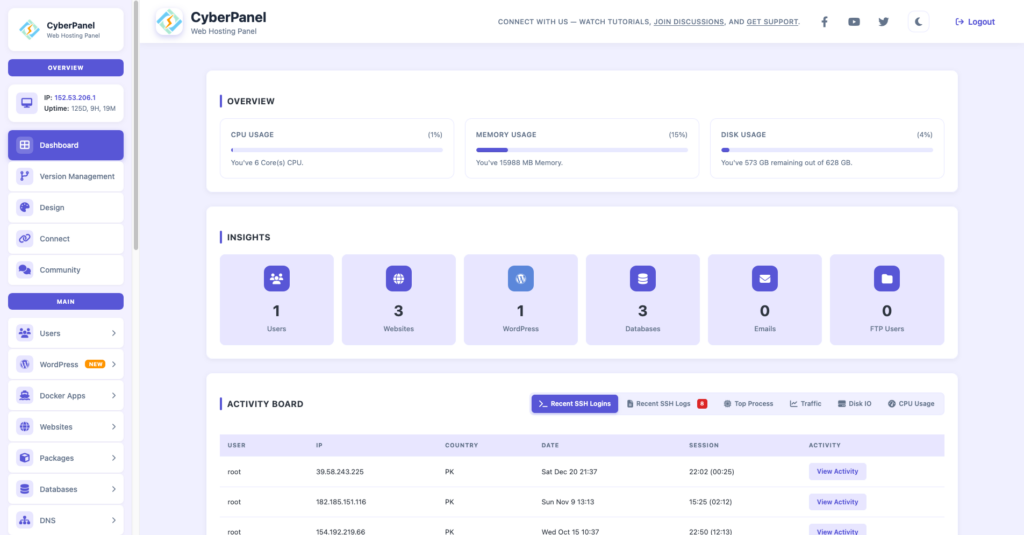
CyberPanel is your free and open-source web hosting control panel. It is powered by OpenLiteSpeed. It might be the case that you run your servers through panels like CyberPanel or command-line tools like Ansible. In that case:
- Use Clash when you want your server to make external requests securely
- Separate the traffic that is meant for testing from that which is production
- Route the development traffic through different ways
- Dont forget that you hold network policies in your hands
This arrangement allows developers to have their cake and eat it too in terms of control and freedom.
Common Mistakes to Avoid
- Running Clash without configuration file
- Using outdated core versions
- Mixing incompatible proxy protocols
- Ignoring DNS configuration
- Running without sufficient permissions
Clash-for-Linux vs Traditional VPN
| Feature | Clash for Linux | Standard VPN |
|---|---|---|
| Rule-based routing | Yes | No |
| Multiple proxies | Yes | Limited |
| Custom domain rules | Yes | No |
| Performance control | High | Moderate |
| GUI support | Optional | Built-in |
Conclusion
Clash is a proxy client for Linux that offers users very powerful and versatile network control features. If you want to run it from the command line or prefer to work with a GUI, Clash can still deliver you rule-based traffic routing that is not confined by the limitations of conventional VPNs.
When you combine it with the right configuration and download it from a trustworthy source, it can serve as a dependable tool for software developers, privacy, focused individuals, and IT administrators.
Get Clash for Linux now, set up your rules appropriately and enjoy complete network traffic management through fine-grained routing.
People Also Ask
Is Clash for Linux free?
Yes, the core is open-source and free to use.
Do I need a GUI for Clash?
No. It works via terminal, but GUI clients simplify management.
Is Clash a VPN?
Not exactly. It is a proxy client with rule-based routing.
Can Clash improve internet speed?
It can optimize routing, but speed depends on proxy server quality.
Does Clash work on all Linux distributions?
Yes, as long as the architecture is supported (amd64, arm, etc.).