On this page
What if your Kubernetes networking could be easily scalable across the nodes? Resultantly, it offers complex routing functionalities and is still very reliable even in very complicated situations. Most teams only start to think about the network when something goes wrong. For example, pods might not be able to communicate, services could become inaccessible, or there could be unexplained spikes in latency. It is where OVN Kubernetes steps in.
At that point, the problem is no longer about simple deployment. It turns into an intricate networking issue. While regular networking layers are usually the go-to option, ovn-kubernetes takes a step further by turning to an advanced software-defined approach based on virtual networking.
It makes it possible to have an improved level of management over the traffic, policies, and scalability. This is the case especially for enterprise platforms like OpenShift, where networking is required to deal with very heavy and complex workloads. In this guide, we will deeply explore OVN Kubernetes.
Let’s get started!
What is OVN Kubernetes?
Kubernetes uses Container Network Interface (CNI) to manage networking. Open Virtual Network (OVN) is a software-defined networking system. Thus, OVN Kubernetes is a CNI plugin that integrates OVN with Kubernetes. It does so to provide advanced networking capabilities.
How Does This Work?
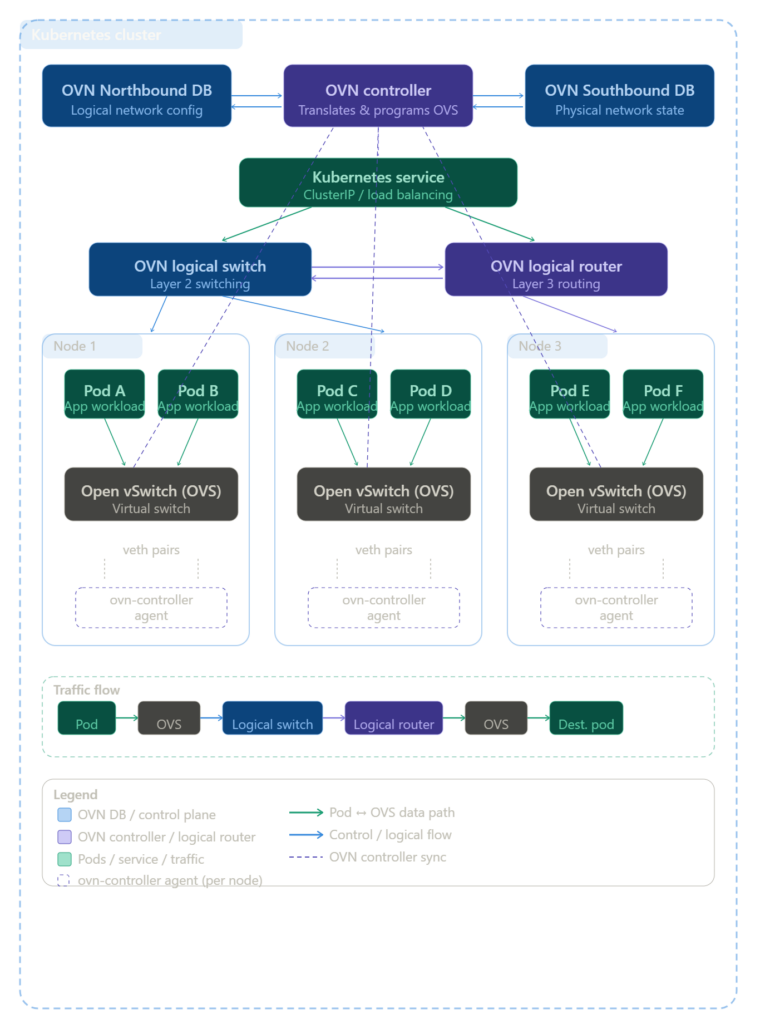
The architecture is based on virtual networking concepts. Here are its core components:
- OVN Northbound Database defines network intent.
- OVN Southbound Database manages the actual state.
- OVS (Open vSwitch) coordinates pods and services.
OVN uses logical switches and routers. It is similar to cloud networking systems.
What Makes Kubernetes OVN Stand Out?
Default Kubernetes networking can perform adequately, but it is limited when it comes to scaling.
It has the following features:
- more secure network isolation
- enhanced routing capabilities
- increased flexibility
- support for complex policies
It is like having a virtual cloud network within your cluster.
Decoding OpenShift OVN Kubernetes
OpenShift has been using OpenShift OVN Kubernetes as its default networking solution since recent versions.
It replaces the old SDN strategy with a more scalable and flexible option.
Main features:
- deep integration with OpenShift
- superior multi-tenant isolation
- powerful network policies
- good performance at a large scale
Therefore, it is fit for use in big companies.
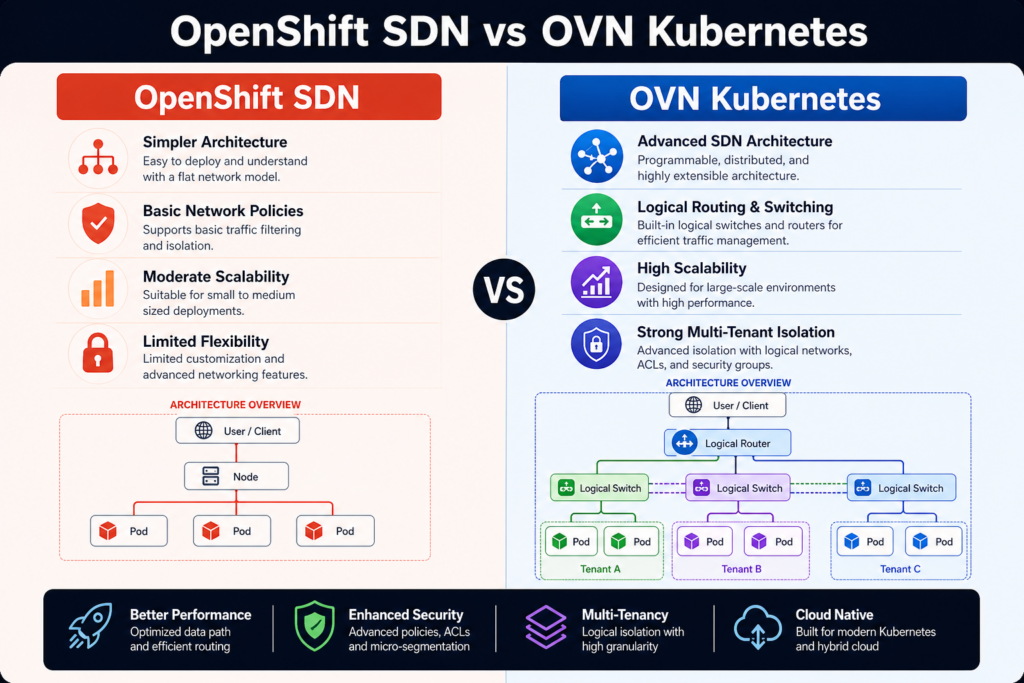
OpenShift SDN vs OVN Kubernetes
| Feature | OpenShift SDN | OVN Kubernetes |
|---|---|---|
| Architecture | Simpler | Advanced SDN |
| Scalability | Moderate | High |
| Network Policies | Basic | Advanced |
| Performance | Good | Better at scale |
| Flexibility | Limited | High |
When to Use OVN Kubernetes?
Choosing it really boils down to your specific environment and requirements.
Deploy it if you:
- operate very sizable clusters
- you require a high level of network policy control
- multi-tenancy is a must
- you care a lot about performance levels at scale
On the other hand, avoid it if you are simply running a small setup and need pretty basic networking, or if the members of your team are not very knowledgeable about networking.
Real-World Example: Traffic Flow
In a cluster using OVN-Kubernetes, traffic flow works differently.
- Pod sends request
- OVN logical switch processes it
- OVN router decides path
- Open vSwitch forwards packet
- Destination pod receives traffic
This layered approach gives more control but adds complexity.
Common Challenges
While powerful, OVN Kubernetes is not always easy to manage. Here are a few challenges:
- complex troubleshooting
- high learning curve
- dependency on OVN components
- more difficult debugging compared to basic CNI
An understanding of the fundamentals of the network is a must.
Best Practices for Using ovn-kubernetes
Implement these strategies to maximize your use of ovn-kubernetes.
- monitor network performance regularly
- use clear network policies
- avoid overcomplicating configurations
- document architecture clearly
- test scaling scenarios early
CyberPanel’s Contribution to This Ecosystem
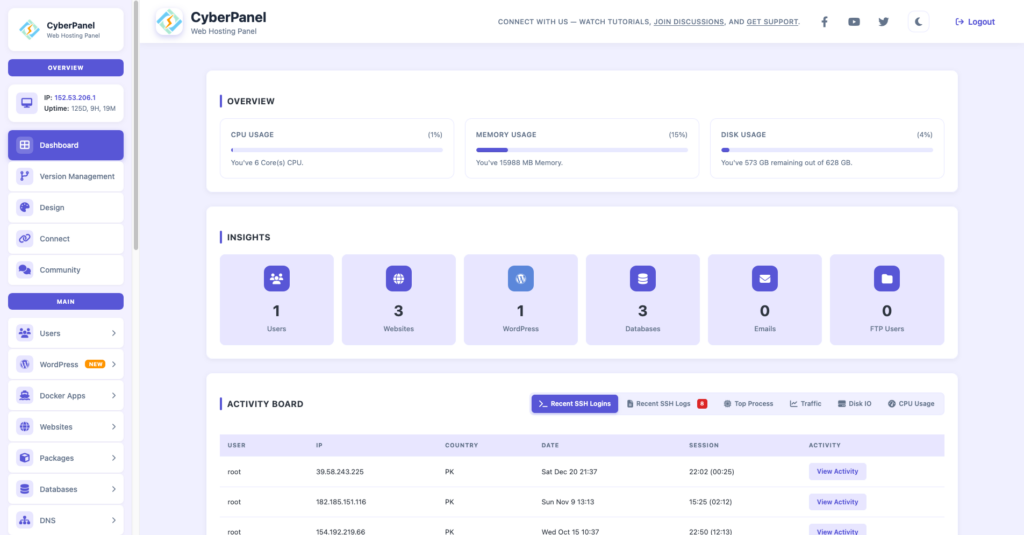
CyberPanel is a free web hosting control panel powered by OpenLiteSpeed. It works well with Kubernetes components, especially when the capability of hosting applications and managing containers is combined.
Even though OVN Kubernetes takes care of networking aspects within clusters, CyberPanel deals with:
- web hosting environments
- application deployment layers
- server-level configurations
Combined workflow
- Kubernetes + OVN takes care of container networking
- CyberPanel is in charge of application hosting
It’s a perfect combo in hybrid configurations where containerized and traditional apps jointly exist.
Summary
OVN Kubernetes is more than just another networking add-on. This is a move to software-defined networking inside Kubernetes. It is a good option if you want scalability, flexibility, and better control. However, if your setup is basic, it might introduce extra complexity.
Choosing OpenShift SDN or OVN Kubernetes standard networking depends largely on your scale, requirements, and team expertise. Open
Assess your present cluster size and networking requirements. In case you are preparing for scaling or advanced policies, consider doing staging environment testing of OVN Kubernetes before production migration.
FAQs
Is OVN Kubernetes difficult to learn?
Yes, it requires an understanding of networking concepts like SDN and routing.
Is OVN Kubernetes replacing OpenShift SDN completely?
Yes, newer OpenShift versions are moving toward OVN Kubernetes as the default.
Is OVN Kubernetes faster than standard Kubernetes networking?
It can be more efficient at scale due to optimized routing, but performance depends on configuration.