
On this page
Have you ever resorted to writing long if-else blocks in your Ansible playbooks just to assign a simple value? It feels like a heavy load, repetitive, and difficult to maintain. The Ansible ternary operator is just the tool to turn such situations around. It enables you to write concise, one-line conditional statements that are simple to read and quick to run.
Gone are the days when you wanted your automation to only work. These days, along with being functional, you also want it to be simple, understandable, and capable of growing big. By using Ansible ternary expressions, you can shorten complex conditions into very small pieces of logic. This not only enhances performance and minimizes mistakes, but also helps keep your playbooks tidy.
Regardless of whether you are setting up servers, creating dynamic templates, or managing environment-based variables, going the ternary Ansible way will give you the power to instantly make the right decisions. It is a great combination with Jinja templating and seamlessly integrates with real-world automation scenarios.
This tutorial will give you a thorough understanding of the ternary operator Ansible. You will get to know how it works, witness hands-on this powerful tool through several examples and practical use cases, and also find out how you can deploy it in production environments. All concepts come with code and output so that you can directly start using them in your projects.
What is Ansible Ternary?
Ansible Ternary is a shorthand conditional expression. It is used to return a value based on a condition. It replaces longer if-else statements with a single line. Here is a basic syntax:
{{ condition | ternary(value_if_true, value_if_false) }}Working of Ansible Ternary Operator Work
It evaluates a condition and returns one of two values. Here is a simple example:
{{ (env == "production") | ternary("Live", "Development") }}Variable:
env: productionoutput:
env: productionAnsible Ternary Example with Playbook
It is a practical example inside a playbook:
- hosts: localhost
  vars:
    env: staging
  tasks:
    - debug:
msg: "{{ (env == 'production') | ternary('Use secure config', 'Use test config') }}"Output:
Use test configHow to Use Ternary Ansible in Templates?
You can use Ternary Ansible directly inside Jinja templates to generate dynamic configurations. Here is an example:
Environment: {{ (env == "prod") | ternary("Production", "Non-Production") }}Ternary Operator Ansible vs if-else
| Feature | Ternary Operator | If-Else Block |
|---|---|---|
| Length | Short | Long |
| Readability | High (simple cases) | Better for complex logic |
| Use Case | Quick decisions | Multiple conditions |
Use Cases of Ansible Ternary
Here are some real-world use cases of Ansible Ternary:
1. Environment-based configurations:
{{ (env == "production") | ternary("/etc/prod.conf", "/etc/dev.conf") }}22. Dynamic port selection
{{ (ssl_enabled) | ternary(443, 80) }}User role assignment
{{ (user == "admin") | ternary("Full Access", "Limited Access") }}Ansibe Ternary with Jinja Filters
When you combine Ansible Ternary with filters, it offers more control.
{{ (username is defined) | ternary(username, 'guest') | upper }}Output:
GUESTUsing Multiple Ternary Conditions (Nested)
{{ (env == "production")
   | ternary("Live",
       (env == "staging")
| ternary("Staging", "Development")) }}Output:
StagingCommon Problems & Solution
| Mistake | Problem | Solution |
|---|---|---|
| Missing parentheses | Wrong evaluation | Always wrap condition |
| Overuse | Hard to read | Use if-else for complex logic |
| Undefined variables | Errors | Use default filter |
Best Practices for Using Ansible Ternary Operator
Here are the best practices for you to apply:
- Use ternary for simple conditions only
- Avoid deep nesting
- Combine with
defaultfor safety - Keep expressions readable
- Test outputs using debug module
DevOps Workflow Illustration
- hosts: localhost
  vars:
    env: production
    ssl: true
  tasks:
    - debug:
        msg: "{{ (env == 'production' and ssl)
| ternary('Deploy secure live app', 'Deploy basic app') }}"Role of CyberPanel in Automation Workflows
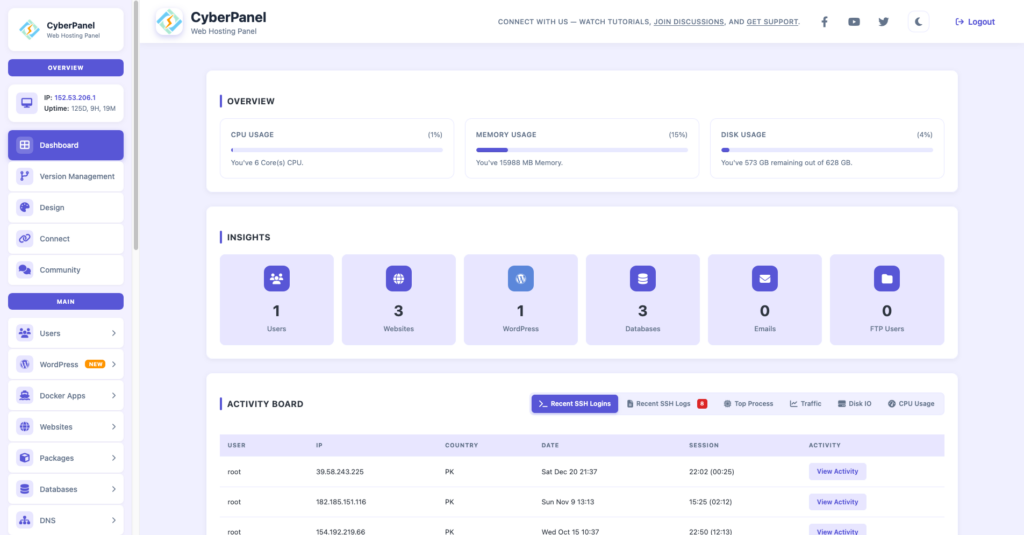
CyberPanel is a free and open-source web hosting control panel. When you automate infrastructure with Ansible, it becomes important to manage the server environment. This is where CyberPanel adds value. Here is why CyberPanel fits with Ansible:
- Automate deployments using Ansible playbooks
- Use ternary logic to create dynamic configurations
- Manage domains, SSL, and databases from one place
- Reduce manual setup time significantly
In Boost Automation with Ternary Ansible Logic!
Small feature but huge impact, that’s the Ansible ternary operator. It helps you write smarter decision-making logic, reduce unnecessary lines, and make automation more streamlined and quicker.
Are you still using lengthy if-else constructions to make single decisions? You are indeed making your work less efficient.
Learn to use ternary expressions right away. Use them with Jinja, tie them with CyberPanel, and make your automation that is prompt, scalable, and capable of being produced.
Take one of your playbooks and change one if-else block to a ternary expression at least. That one change will undoubtedly make your workflow better.
FAQs
Can ternary handle undefined variables?
Not directly. You should use the default filter with it.
Can I use ternary inside Ansible playbooks and templates?
Yes, it works in both playbooks and Jinja templates.
When should I use Ansible ternary instead of if-else?
Use ternary when the condition is simple and returns only two values.