On this page
Databases are not that hard except when you want them to scale. p.
You begin with a very simple configuration. Then your visitors increase. Your data accumulates. What was a smoothly running operation suddenly comes with much lower performance, higher risks of downtime, and at the same time, trying to keep it all under control becomes a headache. And that is when Cassandra Kubernetes enters the scene.
Apache Cassandra excels at distributed architectures. Kubernetes is designed for scaling and automation. So, combining Cassandra and Kubernetes delivers a framework that can process huge volumes of data while staying highly available and with very little downtime. However, it is very unlikely that you will have a fully-functional Cassandra Kubernetes cluster after just one command. Also, if it is done improperly, you are likely to encounter data loss, unstable nodes, and backup difficulties.
This article is a hands-on guide. It will help you to:
- Deploy Kubernetes Cassandra with best practices
- Establish a robust Cassandra Kubernetes cluster
- Perform Kubernetes Cassandra backup efficiently
- Prevent errors that can lead to failure
We will make it work together.
What is Cassandra Kubernetes And Why Use It?
It refers to the operation of Apache Cassandra clusters within Kubernetes pods.
With this, you will have:
- Horizontal scaling
- High availability (no single point of failure)
- Automatic pod recovery
- Efficiency in resource management
Simply put, you will have a database that can be scaled up as your data expands.
What Do You Need Before You Start?
Before deploying Cassandra on Kubernetes, you should have:
Core Requirements
- A Kubernetes cluster (either local or in the cloud)
- kubectl configured
- Helm installed
- Storage class (for persistent volumes)
Recommended Setup
- Monitoring tools (Prometheus, Grafana)
- Backup strategy
- Dedicated nodes for database workloads
How to Deploy Cassandra on Kubernetes?
Here is the stepwise guide to deploy:
Step 1: Add Helm Repository
helm repo add bitnami https://charts.bitnami.com/bitnami
helm repo updateStep 2: Deploy Cassandra Kubernetes Cluster
helm install cassandra bitnami/cassandraStep 3: Check Cluster Status
kubectl get podsStep 4: Connect to Cassandra
kubectl exec -it cassandra-0 -- cqlshHow Does Cassandra Kubernetes Cluster Work?
It runs multiple nodes or pods. Each stores part of the data, replicates data across nodes, and handles read/write requests. The concept of working of Cassandra Kubernetes is replication. Data is copied across nodes. Even if one pod fails, your data is safe.
Cassandra Kubernetes Architecture
| Component | Role |
|---|---|
| StatefulSet | Manages Cassandra pods |
| Pods | Database nodes |
| Persistent Vol | Stores data |
| Service | Connects cluster internally |
| Backup System | Protects data |
Kubernetes Cassandra Backup
Backups are your backbone. Without them, data loss will result in a permanent loss. Let’s discuss some backup options:
1. Snapshot Backup
You can use Cassandra snapshots.
nodetool snapshot2. Scheduled Backups with CronJobs
If you want to automate backups, you can use Kubernetes CronJobs. Here is an example for you:
apiVersion: batch/v1
kind: CronJob
metadata:
  name: cassandra-backup
spec:
schedule: "0 2 * * *"3. External Backup Storage
Another option for backup is external backup storage. You can store backups in AWS S3, Google Cloud Storage, or remote servers.
Common Mistakes to Avoid
Now, it’s time to learn some common mistakes to avoid:
1. No Persistent Storage
Simply put, if you’re not using volumes, your data will disappear after the container stops.
2. Incorrect Replication Settings
If you set your replication at a very low level, you are risking data loss.
3. Not Thinking of Backups
Make it a habit to set up a Kubernetes Cassandra backup right from the start.
Best Practices to Follow
If you want to build a reliable Cassandra Kubernetes cluster, you should follow these best practices:
Use StatefulSets
Cassandra requires a stable network identity.
Set Resource Limits
Always set resource limits:
resources:
  limits:
    cpu: "2"
memory: "4Gi"Keen Monitoring
You should monitor everything. You can use Prometheus or Grafana for this purpose.
Secure Your Cluster
Always make your cluster secure. For this purpose, enable authentication and use TLS encryption.
Role of CyberPanel
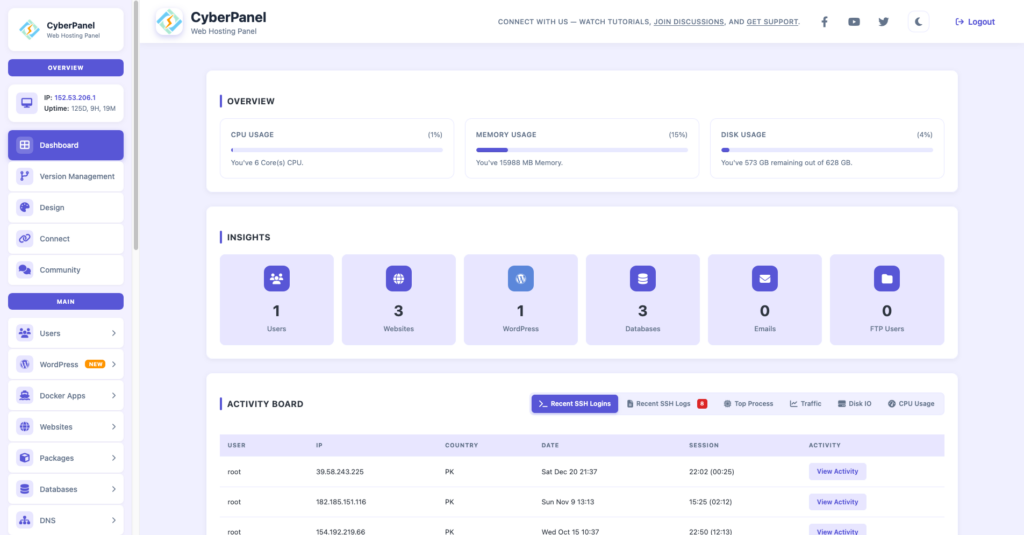
CyberPanel is your free and open-source web hosting control panel powered by OpenLiteSpeed. It handles app access without relying on Kubernetes for front-end control. Here is how it supports you:
- Manage domains connected to apps using Cassandra
- Handle reverse proxy for APIs
- Improve performance using LiteSpeed
- Simplify deployment of frontend services
Thus, Kubernetes runs your database, and CyberPanel manages how users access your application.
Conclusion
Cassandra Kubernetes offers a strong, scalable, and resilient database system. By operating Cassandra on Kubernetes, you are guaranteed high availability and improved performance as your data expands.
Begin with a simple cluster. Set up backups without delay. Afterwards, increase your system’s capacity at your convenience.
Launch your Cassandra Kubernetes cluster now and perform your initial backup. Having a stable database now will help you avoid future catastrophes.
People Also Ask
What is the best way to handle Kubernetes Cassandra backup?
Use snapshots with automated CronJobs and store backups externally.
How many nodes are needed in a Cassandra Kubernetes cluster?
At least 3 nodes are recommended for fault tolerance.
Can I scale Cassandra on Kubernetes easily?
Yes. You can increase replicas to scale horizontally.