On this page
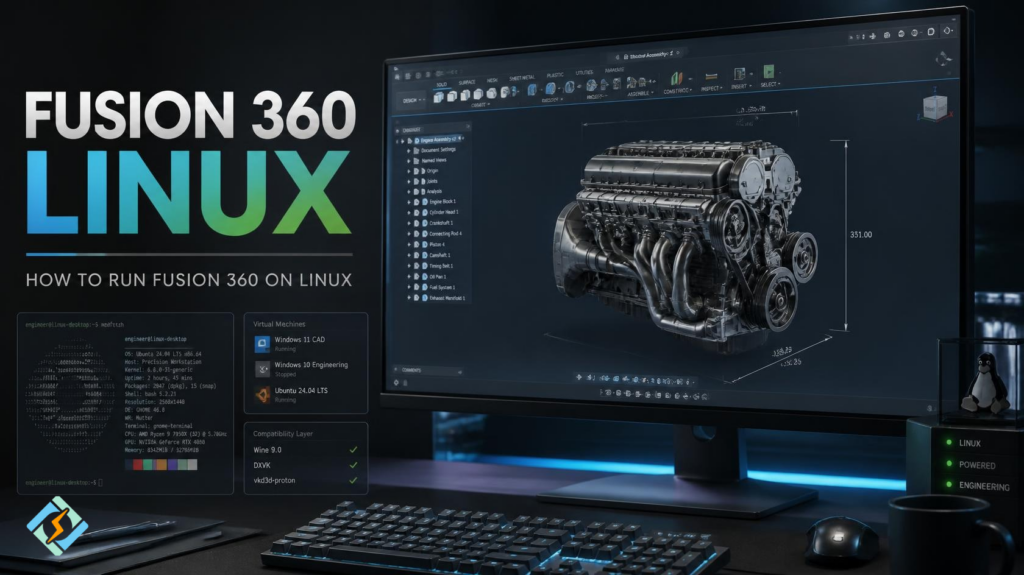
Fusion 360 Linux is a common search query among Linux users who want to use Autodesk Fusion 360 on a Linux computer. The problem is that Fusion 360 does not have a native Linux desktop application, so getting it running requires a workaround.
If you are searching for Fusion 360 for Linux, you may be considering Wine, Bottles, or a virtual machine. The best option depends on your Linux distribution, hardware, graphics support, and how seriously you use Fusion 360 for CAD work.
This guide explains the practical options for running Fusion 360 on Linux, what works, what does not, and which approach makes the most sense.
Does Fusion 360 Work on Linux?
Fusion 360 does not officially provide a native Linux version. Autodesk supports Fusion on Windows and macOS, while Linux users have to rely on alternative methods.
That means you cannot simply download a Linux package and install Fusion 360 like you would install Firefox, Blender, or LibreOffice.
The main options are:
- Run Fusion 360 through Wine or a Wine-based tool.
- Use a Windows virtual machine.
- Dual boot Windows and Linux.
- Use a separate Windows computer through remote access.
For occasional CAD work, a compatibility layer may be worth testing. For professional work, Windows or macOS remains the safer choice.
Why Do People Want Fusion 360 for Linux?
Linux is popular among developers, engineers, researchers, and technical users.
Many people prefer Linux because of its:
- Customization
- Security
- Open-source ecosystem
- Package management
- Performance
- Development tools
- Hardware control
- Server capabilities
The problem appears when a user depends on proprietary applications that do not have Linux versions.
Fusion 360 is one of those applications.
A Linux user may already have their entire workflow configured around Linux but still need Fusion 360 for:
- 3D modeling
- CAD
- Product design
- Mechanical design
- Manufacturing
- CAM
- Prototyping
- 3D printing
This creates the demand for Fusion 360 on Linux.
What Is Fusion 360?
Autodesk Fusion is a cloud-connected design and manufacturing platform that combines several workflows in one application.
It can be used for:
- 3D CAD
- Product design
- Mechanical engineering
- CAM
- Simulation
- Rendering
- Electronics design
- Manufacturing
- Collaboration
Fusion 360 is especially popular among makers, engineers, product designers, students, and manufacturing professionals.
Its Linux problem is therefore significant for users who want a complete CAD workflow without leaving their preferred operating system.
Can You Install Fusion 360 Directly on Linux?
No, not in the normal way.
Linux distributions generally use package formats such as:
.deb
.rpm
.AppImage
.flatpak
Fusion 360 does not provide an official Linux package that you can install through your distribution’s normal package manager.
You therefore cannot do something like:
sudo apt install fusion360
and expect Fusion 360 to install.
Instead, Linux users have to create a compatibility environment or use Windows separately.
How Can You Run Fusion 360 on Linux?
There are four practical approaches.
| Method | Difficulty | Performance | Reliability |
| Wine | Medium | Potentially good | Variable |
| Bottles | Medium | Potentially good | Variable |
| Windows VM | Medium to high | Moderate | High |
| Dual boot | Medium | Excellent | Very high |
| Remote Windows PC | Low to medium | Depends on connection | High |
There is no universal winner.
Your choice depends on whether Fusion 360 is a casual application or an essential part of your work.
Method 1: Run Fusion 360 Through Wine
Wine is a compatibility layer that allows many Windows applications to run on Linux without installing the complete Windows operating system.
The basic architecture looks like this:
Linux
↓
Wine
↓
Windows Application
↓
Fusion 360
Wine does not simply emulate a complete Windows PC.
Instead, it translates Windows API calls into operations that Linux can understand.
This can provide better performance than running a complete Windows virtual machine in some situations.
However, Fusion 360 is a complicated application.
It uses:
- 3D graphics
- GPU acceleration
- Windows components
- Network services
- Cloud connectivity
- Hardware acceleration
- Regular application updates
Because of this, compatibility can change over time.
A configuration that works today may stop working after a Fusion 360 or Wine update.
Is Wine the Best Way to Run Fusion 360 on Linux?
Not necessarily.
Wine can be attractive because it avoids the overhead of running a full Windows installation.
But CAD applications are more demanding than simple Windows utilities.
If Fusion 360 is your primary engineering application, reliability matters more than saving a few gigabytes of RAM.
You should therefore test your exact workload before committing to a Wine-based setup.
Method 2: Use Bottles
Bottles provides a graphical interface for managing Wine environments.
Instead of manually configuring every Wine prefix, you can create an isolated environment and manage its settings through a graphical interface.
The concept looks like:
Linux
↓
Bottles
↓
Wine Environment
↓
Fusion 360
This can make Wine easier to manage, particularly if you are not comfortable working entirely from the command line.
Bottles also allows applications to be separated into different environments.
That can be useful because changing Wine settings for one application does not necessarily require changing the configuration of another.
Method 3: Run Windows in a Virtual Machine
A virtual machine is another option.
You can install Windows inside software such as VirtualBox, VMware, or another virtualization platform.
The structure becomes:
Linux Host
↓
Virtual Machine
↓
Windows
↓
Fusion 360
This approach has a major advantage:
Fusion 360 is running on Windows, its supported operating system.
That removes many compatibility problems associated with Wine.
The downside is performance.
3D CAD applications can require substantial graphics resources. A virtual machine may not provide the same GPU performance as running Windows directly on the hardware.
For simple designs, this may be acceptable.
For large assemblies, complex rendering, simulation, or heavy manufacturing workloads, it can become frustrating.
Can Fusion 360 Run in VirtualBox?
In general, it is possible, but there are some significant limitations associated with graphics performance. You can install Windows virtual machines on which you will run Fusion 360,
but in most cases, the graphics performance will be the limiting factor.
VirtualBox is great for many Windows applications and development, but for graphics-intensive applications such as CAD, you have to consider the graphics performance. Before deciding to use VirtualBox for CAD, consider the following factors:
- Your GPU power
- RAM
- CPU cores
- 3D acceleration
- Graphics support in VM
- Your Fusion 360 workload
A powerful workstation will not necessarily help you with the performance of CAD software in a VM.
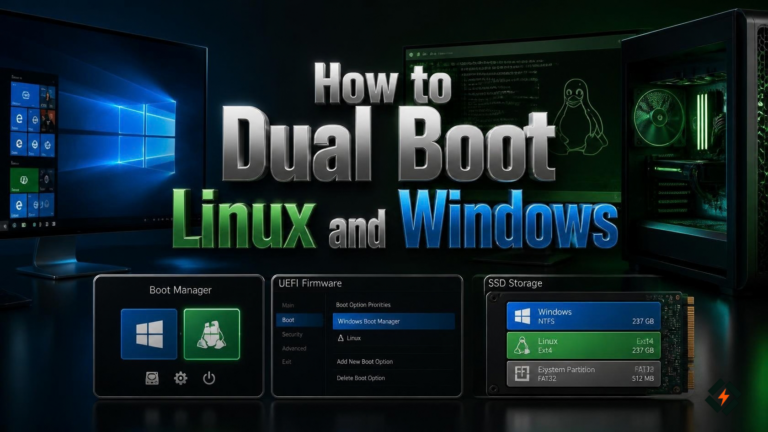
Method 4: Dual Boot Windows and Linux
For serious Fusion 360 users, dual-booting Windows and Linux is often the most practical solution.
You install both operating systems on the same computer.
For example:
Computer
|
+—- Linux
|
+—- Windows
↓
Fusion 360
When you need Linux, boot into Linux.
When you need Fusion 360, boot into Windows.
The biggest advantage is that Fusion 360 gets direct access to the hardware.
You are not depending on Wine compatibility or virtualized graphics.
Advantages
- Excellent performance
- Native Windows environment
- Full GPU access
- Better compatibility
- Suitable for demanding CAD workloads
Disadvantages
- Requires restarting the computer
- Uses disk space for two operating systems
- Requires careful partitioning
- Windows is still required
If Fusion 360 is critical to your work, this is usually a much safer approach than relying on an unofficial compatibility setup.
Method 5: Use a Remote Windows Computer
Another option is to keep Linux as your main operating system and run Fusion 360 on a separate Windows machine.
The workflow can look like:
Linux Computer
↓
Remote Desktop
↓
Windows Workstation
↓
Fusion 360
This can work particularly well if you already have access to a powerful Windows desktop.
You can keep Linux as your daily operating system while using Windows remotely whenever you need Fusion 360.
The main limitation is network quality.
CAD work involving constant visual interaction can become unpleasant if the remote connection has high latency.
Which Method Is Best for Fusion 360 on Linux?
It depends on your workload.
| User | Recommended approach |
| Curious Linux user | Wine/Bottles |
| Occasional Fusion 360 use | Wine/Bottles or VM |
| Student | Dual boot or VM |
| Hobbyist | Wine/Bottles |
| Professional CAD user | Windows or dual boot |
| Heavy 3D modeling | Native Windows |
| Manufacturing/CAM professional | Native Windows |
| Linux-first developer | Wine/Bottles for testing |
| Existing Windows workstation | Remote access |
The key point is simple:
The more important Fusion 360 is to your work, the less you should depend on compatibility workarounds.
What About Fusion 360 Web Access?
Fusion 360 is extremely close to Autodesk’s cloud platform but it does not mean that this software is a Linux web app.
Opening services in a Linux browser does not provide users with native desktop-class Fusion 360 functionality.
Some of the software’s features are available via the cloud.
However, to get the full feature set, one needs to use Fusion 360 as a desktop application.
If one wants to use the majority of the 3D modeling tools, one has to consider using another OS.
Can You Use Fusion 360 on Ubuntu?
As one of the most popular Linux distributions, Ubuntu is a viable option to run Fusion 360.
However, it is important to understand that the software is not officially supported by Ubuntu.
One can attempt to use Wine tools in Ubuntu to launch Fusion 360.
At the same time, such a setup will require one to consider the following variables:
- Linux distribution
- Wine version
- Graphics drivers
- Fusion 360 version
- Native Windows components required to run the app
Therefore, there is a possibility that not all of Fusion 360 functions will work on Linux.
Moreover, one has to recognize that tutorials on how to install Fusion 360 on Linux are created for specific versions of the above-mentioned tools.
A Fusion 360 tutorial that was created for version 2021 might not work for version 2022.
Can You Use Fusion 360 on Linux Mint?
One can also consider using Linux Mint to run Fusion 360.
However, the same limitations apply to using Fusion 360 on this Linux system.
The reason for such a limitation is the lack of a native Linux version of Fusion 360.
One can try to use Wine tools to run Fusion 360 on Linux Mint.
At the same time, one should not assume that all Linux distributions act in the same way.
If one uses Linux Mint as the primary OS and Fusion 360 is critical for daily tasks, it might be useful to mention dual-booting with Windows.
What Hardware Do You Need?
Fusion 360 benefits from reasonably capable hardware regardless of the operating system.
For a comfortable CAD experience, consider:
- Modern multi-core CPU
- 16 GB RAM or more
- Dedicated GPU for demanding workloads
- Fast SSD
- Reliable cooling
- Good display resolution
The exact requirements depend on the size and complexity of your projects.
Running Fusion 360 through Wine or a virtual machine can introduce additional performance limitations.
This is particularly noticeable with GPU-heavy workloads.
Fusion 360 Linux Alternatives
If your goal is simply to use professional CAD software on Linux, you do not necessarily have to force Fusion 360 to work.
There are native Linux alternatives.
| Software | Linux support | Best suited for |
| FreeCAD | Native | Parametric CAD |
| OpenSCAD | Native | Programmatic 3D modeling |
| Blender | Native | 3D modeling and rendering |
| SolveSpace | Native | Parametric CAD |
| LibreCAD | Native | 2D CAD |
FreeCAD is probably the most obvious starting point for someone looking for a native Linux alternative to Fusion 360.
It will not reproduce every Fusion 360 feature or workflow, but it can handle many mechanical and parametric CAD tasks.
Fusion 360 vs FreeCAD on Linux
For someone committed to Linux, FreeCAD deserves serious consideration.
| Feature | Fusion 360 | FreeCAD |
| Native Linux version | No | Yes |
| 3D CAD | Yes | Yes |
| Parametric modeling | Yes | Yes |
| CAM | Yes | Yes |
| Cloud ecosystem | Strong | Limited |
| Linux workflow | Workaround required | Native |
| Windows/macOS | Yes | Yes |
| Open source | No | Yes |
| Best for | Integrated design/manufacturing | Linux-native CAD |
If your priority is staying completely inside Linux, FreeCAD is worth learning rather than spending endless hours trying to force Fusion 360 into an unsupported environment.
Can CyberPanel Help Run Fusion 360 on Linux?
No.
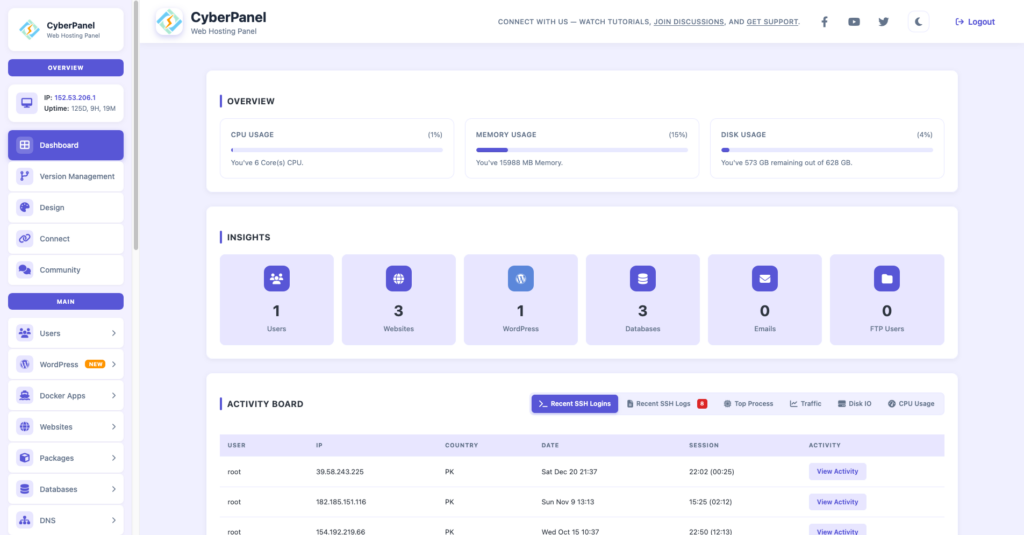
CyberPanel and Fusion 360 solve completely different problems.
CyberPanel is a web hosting control panel designed to manage Linux servers, websites, domains, databases, SSL, and related hosting services.
Fusion 360 is desktop CAD and manufacturing software.
Installing CyberPanel on a Linux server will not provide a way to run Fusion 360.
The distinction is important:
CyberPanel
↓
Web Hosting
↓
Linux Server
Fusion 360
↓
CAD / CAM
↓
Desktop Workstation
If you use CyberPanel to host a website for your engineering business, CyberPanel can manage the website infrastructure. Fusion 360 itself should remain on a compatible workstation.
Is Fusion 360 for Linux Officially Supported?
No.
This is the most important answer for anyone searching for Fusion 360 for Linux.
There is no official native Linux desktop release of Fusion 360.
You may find community-developed installation scripts, Wine configurations, compatibility guides, or unofficial workarounds.
These can be useful for experimentation.
But they should not be confused with official Autodesk Linux support.
Frequently Asked Questions
Can I install Fusion 360 directly with APT?
No. Fusion 360 does not provide a native Linux APT package. APT cannot install an application that does not have an official Linux package.
Is Wine enough for professional Fusion 360 work?
It may work for some users, but professional workflows should be tested carefully. Updates, graphics compatibility, cloud services, and specific CAD workloads can affect reliability.
Does Fusion 360 run better in a virtual machine or Wine?
There is no universal answer. Wine can provide better performance because it avoids a complete virtualized Windows environment, while a Windows VM offers better application compatibility. Your hardware and workload matter.
Final Verdict
Fusion 360 Linux is a complicated topic because the application does not provide a native Linux desktop version.
If you only want to experiment, Wine or a Wine-based application such as Bottles may be worth trying.
If you need Fusion 360 regularly, a Windows virtual machine can provide better application compatibility, although graphics performance can be a concern.
For serious professional CAD work, dual-booting Windows or using a dedicated Windows workstation is the safer option. You get native hardware access and avoid depending on compatibility layers that can break after updates.
If you are determined to remain completely inside Linux, consider a native alternative such as FreeCAD instead of forcing an unsupported application into your system.
The important thing is to choose the solution around your actual CAD workload. A hobbyist designing simple parts has very different requirements from an engineer working with large assemblies, rendering, simulation, and manufacturing.
Keep Linux as your main environment if it fits your workflow, but give Fusion 360 the supported Windows environment it was designed for when reliability and professional CAD performance matter.