On this page
Would you like to have your own S3-like object storage but without the monthly cost of using the cloud? MinIO Docker Compose can help.
If you’re developing apps, backing up data, serving media files, or managing object storage for a production environment, MinIO Docker allows you to quickly and easily deploy high-quality object storage solutions without having complex storage clusters.
This guide provides:
- How-to instructions for using MinIO Docker
- How-to on creating a proper MinIO Docker Compose YAML file
- A working example of a MinIO Docker Compose file
- Best practices for production storage
Everything will be explained in an easy-to-understand manner, so you can deploy with confidence.
What is MinIO?
MinIO is an object storage server that is compatible with the S3 API and designed for use with high-performance storage solutions. MinIO is used by many developers for various applications, including:
- Backup and archiving
- Storing data utilized in AI and machine learning
- Serving media files
- Creating a private cloud object storage solution
- Creating object storage for a Kubernetes environment
MinIO is a compact and powerful platform, and as a result, MinIO Docker Compose is becoming increasingly popular with developers.
Why Consider Utilizing Docker When Working with MinIO?
MinIO in Docker can provide:
- Rapid Implementation
- Isolated Environment
- Easily Scaled
- Simplified Upgrades
- Clean Configurations
Using Docker Compose, you can provision the storage volume(s), credentials, and ports all from one file.
MinIO Docker Compose Example
Here is a clean and practical Docker Compose MinIO example for you:
version: "3.8"

services:
  minio:
    image: minio/minio:latest
    container_name: minio
    command: server /data --console-address ":9001"
    environment:
      MINIO_ROOT_USER: admin
      MINIO_ROOT_PASSWORD: strongpassword
    ports:
      - "9000:9000"
      - "9001:9001"
    volumes:
      - ./minio-data:/data
    restart: unless-stopped
After saving this as docker-compose.yml, run:
docker compose up -dThen access:
- API →
http://your-server:9000 - Console →
http://your-server:9001
MinIO Docker Compose YML
| Component | Purpose |
|---|---|
| Image | Defines MinIO version |
| Command | Sets storage path |
| Environment | Sets credentials |
| Ports | Exposes API and console |
| Volumes | Stores persistent data |
MinIO Docker Compose for Production
When using MinIO in production:
- Do not use the latest tags and instead use fixed versions.
- Utilize strong passwords for your MinIO instances.
- Mount your MinIO storage to SSDs.
- Set up a firewall configuration compatible with MinIO.
- Enable SSL = HTTPS using a reverse proxy to MinIO.
Example version lock:
image: minio/minio:RELEASE.2024-xx-xxTxx-xx-xxZDistributed MinIO Docker-Compose Setup
If you need high availability, MinIO supports distributed mode.
You define multiple storage paths like:
server http://minio{1...4}/dataThis setup allows:
- data redundancy
- load balancing
- failover support
Distributed deployments require proper network configuration
Utilizing MinIO with Reverse Proxy
Most MinIO production systems are found behind:
- Traefik
- Nginx
- Apache
Benefits to using these types of reverse proxies include:
- HTTPS encryption
- Routing of your domains
- Better security
You should not want to expose 9000 or 9001 ports publicly.
Common Mistakes in Docker MinIO Setup
Be sure to avoid the following:
- Not mapping your volumes
- Weak root password
- Console exposure to the public
- Using “latest” tag for production
- Lack of backup strategy
You should always have a backup of your object storage.
Role of CyberPanel in MinIO Hosting
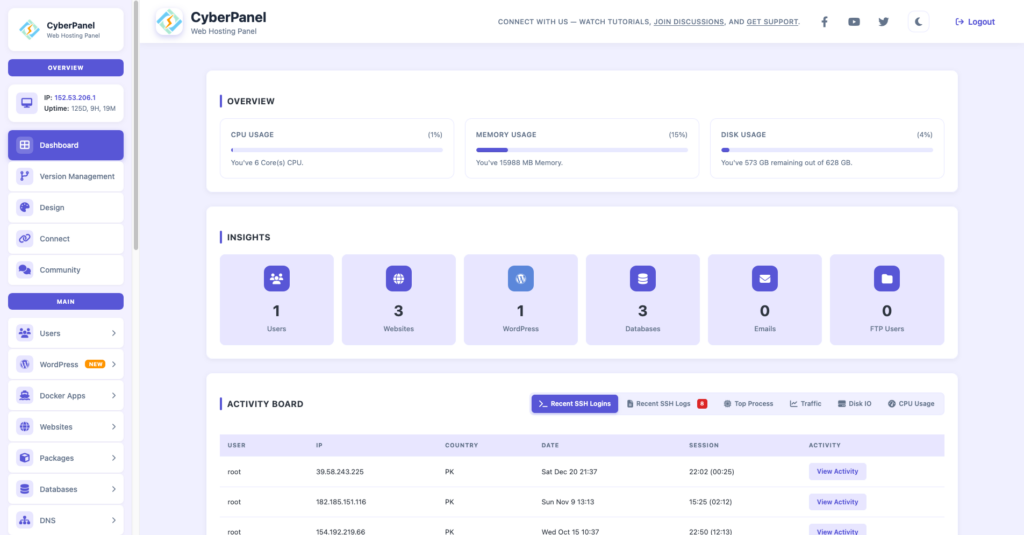
CyberPanel is your free and open-source web hosting control panel. CyberPanel can be extremely helpful if you are hosting your MinIO service with a VPS.
With CyberPanel, you are able to:
- Manage your domain DNS
- Generate SSL certificates
- Configure your firewall
- Monitor the overall performance of your server
- Manage reverse proxy routing
MinIO will manage the object storage in your Docker instances, whereas CyberPanel will manage your overall environment.
This separation helps to keep your infrastructure secure and tidy.
When Should You Use MinIO?
If you need any of the following, then you should consider MinIO:
- Private S3-compatible object storage
- Self-hosted backup solution
- Object storage for application
- A large amount of media storage
- AI dataset storage
Do not use MinIO if you do not wish to take care of your server.
Performance Optimization Suggestions
To increase the performance of your application:
- Utilize NVMe or SSD for your storage
- Adequately allocate enough RAM
- Avoid having network bottlenecks
- Utilize a distributed mode for your heavy workloads
- Regularly monitor your IOPS
The performance of your object Storage will directly affect the speed of your application.
Summary
The simplest way to set up your own S3-compatible storage solution is by using MinIO in Docker with Docker Compose. By creating a valid MinIO docker-compose.yml file, securing it, and using persistent disk volumes, you can run a production-ready storage solution.
Take the time to deploy it properly rather than simply getting it running as fast as possible!
Get started on your MinIO Docker Compose file today, lock the MinIO version you decide to use, build secure and persistent storage volumes, and set up your private object storage with a valid SSL certificate and backup plan.
FAQs
Is it possible to scale MinIO horizontally in the future?
Yes, you will be able to migrate your existing MinIO instance from single-node deployments to distributed deployments with appropriate planning.
What is the minimum amount of RAM required to run MinIO?
1 GB of RAM is generally enough for small instances; however, to run production workloads, you will likely need 4 GB of RAM or more.
Is it possible to run MinIO in Kubernetes rather than using Docker Compose?
Helm Charts and Kubernetes-native deployment methods allow you to easily install and deploy MinIO using Helm and the native methods of deploying your application within a Kubernetes cluster.