
On this page
Security is one of the biggest concerns for Linux users today. Whether you’re protecting personal files, business data, or sensitive online accounts, choosing the right operating system can make a significant difference. While most Linux distributions offer strong security, Qubes Linux OS takes protection to another level by isolating every task into separate virtual machines.
If you’ve searched for Qubes OS Linux, you’re probably wondering whether it’s just another Linux distribution or something completely different.
Unlike traditional Linux operating systems, Qubes OS is built around the idea that no single application or system component should be fully trusted. Instead of relying solely on antivirus software or firewalls, it separates your activities into isolated environments. If one application becomes compromised, the attacker cannot easily access everything else on your computer.
In this guide, you’ll learn what Qubes OS Linux is, how it works, its major security features, the installation process, advantages, limitations, and whether it’s the right choice for you.
What Is Qubes Linux OS?
Qubes OS Linux is a security-oriented desktop operating system that takes advantage of virtualization technologies. With Qubes OS, you can run multiple isolated virtual machines on a single physical computer. Each isolated virtual machine is referred to as a qube.
The operating system is built on Xen, which handles the virtualization part, and utilizes Fedora, Debian, and other Linux distros as templates for virtual machines.
The operating system is one of the most secure desktop environments available due to its unique approach to isolation.
How Does Linux Qubes OS Work?
The main characteristic that distinguishes Qubes OS from a regular Linux distribution is the ability to separate activities into distinct virtual machines. For instance, you can run separate virtual machines for:
- Work
- Personal activities
- Banking
- Programming
- Testing
You can also have different web browsers for each virtual machine. In the case where one virtual machine is compromised, the others are likely to remain secure.
Key Features of Qubes OS Linux Distro
The operating system has several features that make it unique and more secure compared to other Linux distributions.
Isolation
With Qubes OS, you can run applications in isolated environments. This way, the compromise of one application does not lead to the compromise of the entire system.
Xen Hypervisor
The operating system uses the Xen hypervisor to ensure that all virtual machines run separately and securely.
Disposable Virtual Machines
You can use disposable virtual machines to minimize the risks associated with running applications from untrusted sources. The virtual machines are perfect for testing and can be disposed of after use.
Secure Networking
You can also choose to run networking software in isolated environments. This way, you can reduce the risks of compromising the entire system if the network tools are compromised.
Template-Based Management
The operating system allows you to manage applications and updates using templates. This feature ensures that you can update some applications without disrupting the entire system.
Flexible Security Levels
You can use the operating system to run applications with varying levels of security. Instead of running all applications in the same environment, you can run them in different isolated virtual machines.
Why Use Qubes OS?
The operating system is designed to provide the highest level of security. As such, it is suitable for advanced users who want to maximize security. Some of the applications that Qubes OS is suitable for include
- Security research
- Software development
- Journalism
- Government work
The operating system is also ideal for system administrators and power users who want to run multiple virtual machines. It is more difficult to compromise a system running on Qubes OS since the virtual machines are isolated.
System Requirements
Qubes OS has higher hardware requirements than many Linux distributions because it runs multiple virtual machines.
| Component | Recommended |
|---|---|
| Processor | 64-bit Intel VT x or AMD V capable CPU |
| RAM | 16 GB or more |
| Storage | SSD with at least 128 GB |
| Graphics | Compatible integrated or dedicated GPU |
| Virtualization | Enabled in BIOS or UEFI |
For the best experience, 32 GB of RAM is recommended if you plan to run several virtual machines at the same time.
How to Install Qubes OS Linux
Installing Qubes OS is a relatively quick procedure if you have compatible hardware.
- Download the latest ISO image from the official website of this OS.
- Then, you need to create a USB drive with this image using Rufus, Ventoy, or balenaEtcher.
- Next, you need to turn on the computer’s virtualization technology in the BIOS or UEFI.
- After that, install Qubes OS by following the prompts on the screen, selecting the drives to install the system on.
- Then, restart the computer and configure the system using the setup wizard.
- Finally, create qubes for work, personal use, and the Internet.
The Benefits of Qube Linux OS
The Qubes OS has many advantages over similar systems. It provides exceptionally high levels of security:
- isolation of applications running in separate qubes
- written in open source
- under active development
- has support for many Linux templates
- provides excellent privacy protection
- reduces the risk of malware attacks
- allows you to isolate a web browser in a separate qube
Drawbacks of Using Qubes OS
However, it has some significant disadvantages over other operating systems, such as Linux.
The system has a relatively steep learning curve, requires modern hardware, uses more RAM than standard Linux distributions, and does not support all types of computer hardware. Using it is not convenient for playing computer games. The system is not recommended for use by inexperienced Linux users.
Qubes OS vs Traditional Linux
| Feature | Qubes OS | Traditional Linux |
|---|---|---|
| Security Isolation | Excellent | Standard |
| Virtual Machines | Built in | Optional |
| Performance | Higher resource usage | More efficient |
| Ease of Use | Moderate | Beginner friendly |
| Privacy | Excellent | Good |
| Malware Resistance | Very High | High |
How CyberPanel Supports Qubes OS
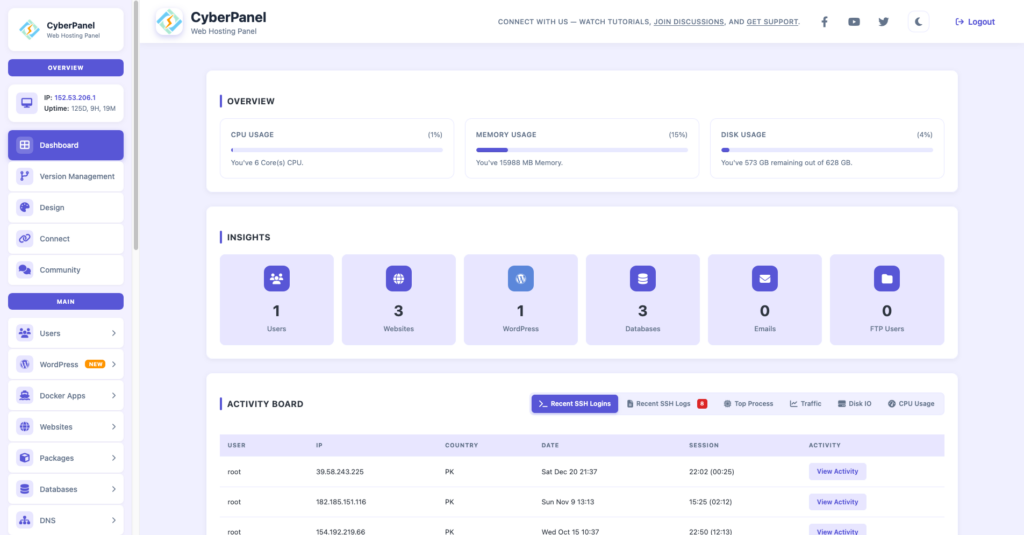
CyberPanel complements the security of the desktop environment provided by Qubes OS with the functionality of managing websites and Linux servers via a web hosting control panel. In addition, it allows you to configure web hosting, secure connections, backups, databases, and other services while using Qubes OS as your default OS and taking advantage of its security features.
Conclusion
The Qubes OS Linux distribution is among the most prominent OS’s with built-in security features. However, unlike the conventional approach of incorporating additional tools for increased protection, this OS utilizes a unique method, which is based on isolation. Specifically, applications are separated in independent virtual machines at the operating system level, which minimizes the risks of potential breaches and unauthorized access. Although the approach requires advanced hardware components and has a complex learning curve, it ultimately significantly increases the overall security levels and serves as a reliable protection layer against various threats.
Download Qubes OS and experience the enhanced safety of your Linux-based desktop environment, which features the isolation concept to provide improved protection against modern cybersecurity threats.
FAQs
Can beginners install Qubes OS?
Yes, but beginners may find it challenging because of its virtualization-based design. Users with basic Linux knowledge generally adapt more quickly.
Is Qubes OS more secure than a standard Linux distribution?
For desktop security, yes. Its isolation-based architecture significantly reduces the impact of compromised applications compared to traditional desktop operating systems.
Can Qubes OS run Windows applications?
Yes. Windows can run inside a dedicated virtual machine, provided your hardware supports virtualization and you have a valid Windows installation.