
On this page
Have you ever encountered an instance where a website wouldn’t load, yet it was unclear if DNS, domain setup, or propagation was the cause? On Linux, this is a typical example of a troubleshooting situation that calls for developers, sysadmins, and DevOps to be familiar with.
Linux dig command is the first utility that comes to mind when one desires a simple and reliable way to query DNS server lines for diagnosing domain-related problems.
One of the most dependable digital tools for DNS lookups is the dig Linux command that lets you query domain name servers and is indispensable when troubleshooting DNS-related problems. You can use the Linux dig command for debugging a website, verifying DNS records, checking propagation, or server connectivity analysis. It is a very powerful utility and can provide you with a lot of helpful information about the DNS in a very short time.
The nslookup tool is very simple by comparison; DIG will retrieve a lot more information, such as time of the query, DNS server, answer section, and it supports multiple record types, including A, AAAA, MX, NS, TXT, and SOA.
Infrastructures these days are so complex that uptime, DNS accuracy, and quick problem-solving always go hand-in-hand. That means knowing how to use the Linux dig command is essential to anyone whose work involves either servers or networking.
What Is The DIG Command In Linux?
The dig command (Domain Information Groper) is a tool available in Linux, which is used to query DNS (Domain Name System) name servers.
When you execute the dig command in Linux, it sends a DNS query to a DNS resolver and returns detailed information about the queried domain.
It is typically used for:
- Checking what IP is mapped to a domain
- Fixing DNS problems
- Confirming DNS propagation
- Looking at various DNS records
- Comparing expected and actual records of authoritative name servers
But unlike other tools that only give brief information, Linux dig shows you the complete step-by-step technical explanation of the DNS transaction, which makes it great for getting to the bottom of problems.
How DIG Command Work In Linux?
Consider you run this command:
dig example.comTechnically, this is what happens behind:
- Linux sends a DNS query request
- The resolver contacts configured DNS servers
- The DNS server answers with record data
- DIG formats and displays the response
The output you see generally includes:
- Header section (query metadata)
- Question section (what was asked)
- Answer section (actual result)
- Authority section (DNS authority info)
- Additional section (extra details)
This detailed presentation is what empowers the dig Linux command as a diagnostic tool.
Basic DIG Command Syntax
dig [domain]Example:
dig google.comThis returns full DNS resolution details, including IP addresses.
Common DIG Command Linux Use Cases
1. Check A Record (IP Address)
dig example.com AThis shows the IPv4 address of a domain.
2. Check MX Records (Email Servers)
dig example.com MXUsed for verifying mail server configuration.
3. Check NS Records (Name Servers)
dig example.com NSShows authoritative DNS servers.
4. Check TXT Records
dig example.com TXTUsed for SPF, DKIM, and verification records.
5. Short Output Mode
dig example.com +shortReturns only IP addresses without detailed output.
Debugging DNS Problem
One of the most powerful uses of the Linux dig command is debugging DNS problems.
Example scenario:
A website is not opening for users.
Using DIG:
dig example.comYou can identify:
- Wrong IP pointing
- DNS propagation delay
- Missing records
- Incorrect name server setup
This makes Dig Linux essential for DevOps troubleshooting workflows.
Advanced dig Command Options
Now, let’s discuss few advanced dig command options:
Trace DNS Path
dig example.com +traceShows full DNS resolution path from root servers.
Trace DNS Path
dig example.com +traceShows full DNS resolution path from root servers.
Specify DNS Server
dig @8.8.8.8 example.comUseful for testing Google DNS or Cloudflare DNS.
Reverse DNS Lookup
dig -x 8.8.8.8Returns domain associated with IP.
Real World Use Case In DevOps
The application of dig command Linux in actual infrastructure scenarios include this:
- Deployment confirmation
- Inspection of CDN propagation
- Troubleshooting of load balancers
- Ensuring correct cloud DNS setup
- Tracking DNS alterations post update
As part of the CI/CD process, developers use DIG frequently to validate that DNS is correct before making the traffic public.
DIG Command Vs Other DNS Tools
| Tool | Detail Level | Use Case |
|---|---|---|
| dig | High | DNS debugging |
| nslookup | Medium | Basic queries |
| host | Low | Quick lookup |
Troubleshooting DNS Issues
One of the most powerful uses of Linux dig command is debugging DNS problems.
Example scenario:
A website is not opening for users.
Using DIG:
dig example.comYou can identify:
- Wrong IP pointing
- DNS propagation delay
- Missing records
- Incorrect name server setup
This makes dig Linux essential for DevOps troubleshooting workflows.
CyberPanel Role In DNS And Hosting Environments
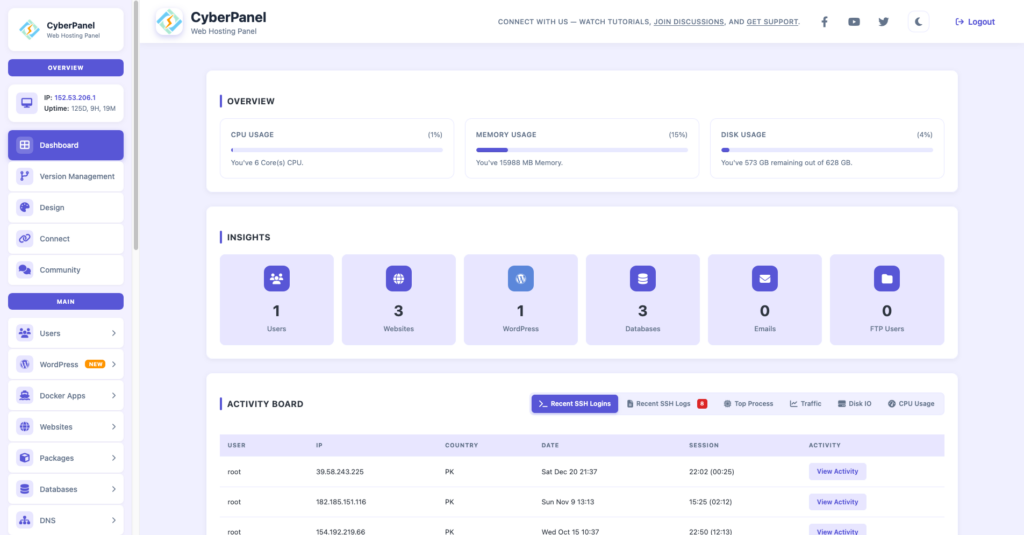
In actual server settings, DNS and hosting are usually interconnected.
CyberPanel is a free and open-source web hosting control panel based on OpenLiteSpeed. It makes it simple to manage a server, configure DNS, host websites, set up SSL, and deploy workflows on Linux machines.
Although dig linux command is the way to validate DNS from a technical point of view, CyberPanel offers a graphical interface to handle and roll out these settings with ease, most of all for hosting environments and production servers.
Common Mistakes When Using DIG Linux
1. Not checking specific record types
Many users only run:
dig example.comwithout checking MX, TXT, or NS records.
2. Ignoring propagation delays
DNS changes can take time globally.
3. Not using +short for quick debugging
Verbose output is not always necessary.
Conclusion
The dig command is a Linux tool that ranks among the most crucial utilities for DNS troubleshooting and network diagnostics. Be it checking domain setup, resolving web problems, or studying DNS propagation, linux dig command gives precise and detailed insights that basic tools don’t come close to.
If you are in DevOps, system administration, or backend infrastructure, learning to use dig linux command is not up for discussionit is one of the fundamental skills that guarantee quick debugging and enhanced system reliability.
FAQs
Can DIG be used for troubleshooting websites?
Yes, DIG is widely used for diagnosing DNS issues when websites are not resolving correctly.
Is DIG better than nslookup?
Yes, it provides more detailed and structured DNS information compared to nslookup.
What is the fastest way to use DIG command?
Use:
dig example.com +short
It returns only IP addresses without extra details.