
On this page
Were you ever curious how a single instruction can freeze an entire Linux system in just a few seconds? After all, it is truly impressive that the modern Linux system is most of the time very stable, secure, and performant even with a very large number of running processes. Still, no matter which operating system one uses, if the protective measures are not implemented correctly, it is possible to perform a resource exhaustion attack that will most likely lead to the system being crashed or at least very slow and/or unresponsive.
One of the best-known examples, even among non-technical people, is the so-called fork bomb Linux. System administrators, DevOps engineers, and Linux enthusiasts have been using fork bombs for years as a study example of the impact unlimited process creation can have on system resource consumption and overall performance. Though several protections are present in modern Linux distributions, grasping involved concepts is still necessary for those who administer Linux systems and enforce their security.
Administrators who understand how fork bombs work would be able to take appropriate measures, limit users, and keep servers, workstations, and even cloud environments running smoothly.
This article explains fork bombs: what they are, how Linux process management is done, what makes fork bombs so harmful, what modern systems do to prevent such attacks, and what practices administrators should adopt to stay away from resource exhaustion.
What Is a Fork Bomb Linux?
A fork bomb Linux is when a program keeps creating new processes nonstop at such a rapid pace that the system resources become so overloaded that it freezes or crashes.
The word “fork” comes from the mechanism of process creation in Linux. When one process creates another process, it is like it makes a copy of itself, and now you have a parent-child relationship.
Normally, process creation really helps in:
- Launching applications
- Running commands
- Administering services
- Performing background processes
Only if process creation becomes uncontrolled, the operating system may exhaust its resources.
The aftermath can be:
- Very high CPU utilization
- Running out of memory
- System becoming sluggish
- Various services breaking
- Problems with user logins
How Process Creation Works In Linux?
To understand the fork bomb in Linux scenarios, consider understanding how Linux handles processes.
- Every running application exists as a process.
- When a process needs to start another task, Linux creates a new process.
This model allows Linux to:
- Multitask efficiently
- Isolate applications
- Manage workloads
- Improve stability
Most systems handle thousands of processes without problems because process creation is controlled and resource limits are enforced.
Problems occur when process growth becomes exponential and exceeds available resources.
Why Are Fork Bombs Dangerous?
Fork bombs do not typically exploit a software vulnerability.
Instead, they abuse normal operating system functionality.
Their impact comes from resource exhaustion.
Common consequences include:
CPU Saturation
The processor becomes busy managing an excessive number of processes.
Memory Exhaustion
Each process consumes memory resources.
As process counts increase, available RAM decreases.
Process Table Exhaustion
Operating systems maintain process tables.
Excessive process creation can exhaust available entries.
Service Disruption
Critical services may fail to start because resources are unavailable.
Reduced System Availability
Users may be unable to log in or execute commands.
Mechanisms On Linux Work Against Fork Bombs
A wide variety of techniques are available in modern Linux versions that help to mitigate the risks.
Limit the Number of Processes of User
Administrators can prevent users from creating more than a certain number of processes.
This stops one single account from using up all the system resources.
Resource Control Groups
With Linux cgroups, it is possible for administrators to regulate this:
- CPU time
- Memory consumption
- Number of processes
Because of this, workload isolation can be achieved at a substantial level.
Systemd Resource Controls
Systemd has the capability to set restrictions on services and applications.
Admins can map out process creation limits that are so tight that they exclude the possibility of runaway processes.
Container Isolation
Containers are a good way of isolating workloads, and that’s why limiting the extent of the impact to the whole system.
Fork Bomb Vs Denial Of Service Attack
| Feature | Fork Bomb | Traditional DoS |
|---|---|---|
| Focus | Process Exhaustion | Network Traffic |
| Resource Target | CPU, Memory, Processes | Bandwidth, Services |
| Origin | Local System Activity | External Requests |
| Detection | Process Monitoring | Traffic Monitoring |
Best Practices For Preventing Fork Bomb Incidents
Companies need to put in place several protective measures at different layers.
Enforce User Limits
Set boundaries on the number of processes each user can run.
Monitor Resource Usage
Keep an eye on:
- processor usage
- memory usage
- number of processes
Employ Containerization
Where feasible, separate different tasks.
Set Up Systemd Restrictions
Limit resource usage at the service level.
Security Auditing
Keep a check on system setups and user rights on a regular basis.
These actions are quite effective in minimizing the risks involved in operations.
Why Fork Bomb Awareness Still Matters In 2026?
Some system administrators think that fork bombs are a thing of the past since Linux has been through major changes.
Even so, learning about them still helps since they reveal:
- Basics of resource administration
- Understanding of process control
- Methods of system protection
- Planning for system failure recovery
Real-World Relevance For DevOps Teams
Nowadays, one of the major infrastructure concerns is reliability.
DevOps teams often handle what comes next:
- Cloud Servers
- Containers
- Kubernetes Clusters
- CI/CD Pipelines
Knowledge of process exhaustion situations can enlighten engineers about creating robust systems that won’t go down due to a lack of resources.
How CyberPanel Supports Linux Server Stability?
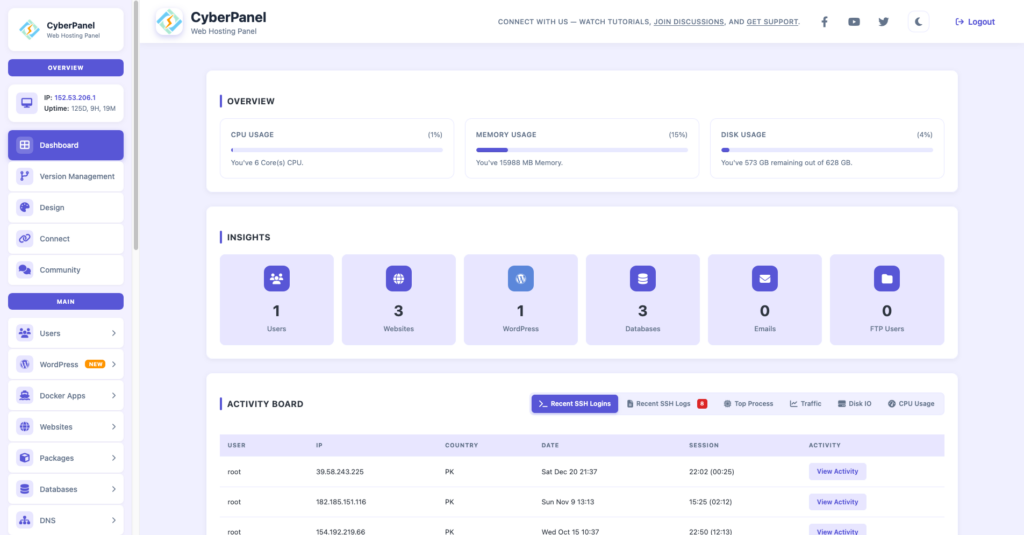
The stability of a system is influenced not only by how resources are managed but also by the level of administrative visibility.
CyberPanel is an open-source and free web hosting control panel that runs on OpenLiteSpeed. It helps in the complicated act of server administration, managing websites, taking backups, configuring security, and monitoring performance.
For those who are in charge of Linux hosting environments, CyberPanel offers a single dashboard that is extremely helpful for finding performance problems and keeping the system running stably in combination with Linux resource controls.
Final Thoughts!
The Linux fork bomb is still the best demonstration of how system instability can be caused by resource exhaustion. Today’s Linux distros have led to tighter security on this front, but it is still important for tech support people to know how to handle processes, set user limits, and control resource usage, so that a system does not crash because of a wild-running fork bomb. Putting in place the right checks and balances, as well as close watching of the system, will help an organization make sure that the creation of a massive number of processes does not lead to the failure of the system or the entire operation.
Would you like to sharpen your skills in Linux administration? Get started by checking the resource limits of your system, keeping an eye on the activities of different processes, and placing protective measures of a contemporary nature that will keep your system running in a safe and strong way without breaking down.
FAQs
Can Containers Prevent Fork Bomb Effects?
Containers help limit impact by isolating workloads and enforcing resource restrictions.
Are Fork Bombs Considered Security Threats?
They are generally categorized as resource exhaustion threats because they impact system availability.
Can A Fork Bomb Damage Hardware?
No. Fork bombs exhaust system resources but do not physically damage hardware components.