
On this page
Linux revolves around the philosophy that tiny commands can be combined to perform very powerful tasks. Instead of relying on only one complicated command, Linux gives you the ability to merge several commands into a single workflow. This idea is called Linux piping, and it is among the most useful skills for Linux users, system administrators, and DevOps engineers.
Linux piping can be used to filter log files, find processes, sort data, or automate repetitive tasks. Besides efficiency, the main advantage of command piping is that it can process data without creating intermediate files. One of the greatest advantages of Linux piping is the ability to connect the output of one command directly to the input of another, allowing you to create highly flexible and extremely powerful command-line workflows with very little effort!
Professionals frequently use the phrases piping commands Linux, piping Linux, and Linux piping commands for that matter, as pipes are a very common feature in the daily life of a server manager, a scripter, a troubleshooter, or someone involved in automation. After you get the hang of piping, you won’t need to run various commands one after another, but instead, you’ll be able to get precise results through just one command.
This article will teach you about Linux piping – its working principle and the most useful piping commands, as well as show you some examples, go over common mistakes, and provide you with best practices.
What Is Linux Piping?
Linux piping is the process of sending the output of one command directly as the input to another command using the pipe (|) operator.
Instead of displaying output on the terminal, a pipe transfers it to the next command for further processing.
For example:
ls -l | grep ".txt"This command lists all files and immediately filters only those ending with .txt.
Pipes make command execution cleaner, faster, and more efficient.
Why Use Linux Command Piping?
Using Linux command piping offers several advantages:
- Reduces manual work
- Combines multiple commands
- Eliminates temporary files
- Speeds up data processing
- Simplifies shell scripting
- Improves command readability
Because of these benefits, piping is widely used in Linux administration and DevOps automation.
Basic Linux Piping Commands
Here are some of the most common Linux piping commands.
List and Filter Files
ls | grep ".log"Output
system.log
error.logOnly log files are displayed.
Count Running Processes
ps -ef | wc -lOutput
248This counts the total number of active processes.
View Large Files
cat access.log | lessInstead of printing the entire file, the output becomes scrollable.
Search for Specific Text
cat users.txt | grep "admin"Only lines containing admin are displayed.
Common Commands Used with Pipes
Linux pipes become even more useful when combined with common command-line utilities.
| Command | Purpose |
|---|---|
grep | Search text |
sort | Sort data |
uniq | Remove duplicate lines |
awk | Extract columns |
sed | Replace or edit text |
wc | Count lines, words, or characters |
head | Show first lines |
tail | Show last lines |
tee | Save and display output |
xargs | Pass output as command arguments |
These commands form the foundation of many Linux automation workflows.
Practical Linux Piping Examples
Find Active SSH Connections
ss -t | grep ":22"Displays active SSH connections.
Display Top Memory Processes
ps aux | sort -nrk 4 | head -5Shows the five processes using the most memory.
Count Log Errors
grep "ERROR" app.log | wc -lReturns the total number of error entries.
Find Large Files
find . -type f | wc -lCounts all files in the current directory tree.
Using Multiple Pipes
One of the biggest advantages of piping Linux commands is chaining several commands together.
Example:
cat access.log | grep "404" | sort | uniq | wc -lThis command:
- Reads the log file.
- Finds all 404 errors.
- Sorts the results.
- Removes duplicates.
- Counts the remaining entries.
A single pipeline replaces several manual steps.
Linux Piping vs Redirection
Although beginners often confuse them, piping and redirection serve different purposes.
| Linux Pipe | Redirection |
| Sends output to another command | Sends output to a file |
| Uses` | Uses > or >> |
| Processes data immediately | Stores data for later use |
| Ideal for command chaining | Ideal for saving results |
Understanding this difference helps you choose the right approach for each task.
Best Practices Linux Piping
When working with command pipelines, you should:
- Make pipelines simple and readable;
- Run grep first if you are about to deal with a large output;
- Not use the cat command for something that can be done without it;
- Check the capability of every command separately before joining them into a pipeline;
- While using scripts, put some notes to explain what your complex pipelines mean.
These practices will not only enhance your performance but also your understanding of the process if things are not working properly.
Common Errors
If you are a beginner in Linux pipes, you may run into these mistakes:
- Using the wrong order of commands
- Leaving out spaces around the pipe operator
- Piping unnecessary output
- Not checking command exit status
- Creating long pipelines that are difficult to work with and maintain
Splitting complex tasks into smaller, logical parts can help(s) make pipelines more understandable.
How CyberPanel Makes Linux Easier To Use For Server Administration?
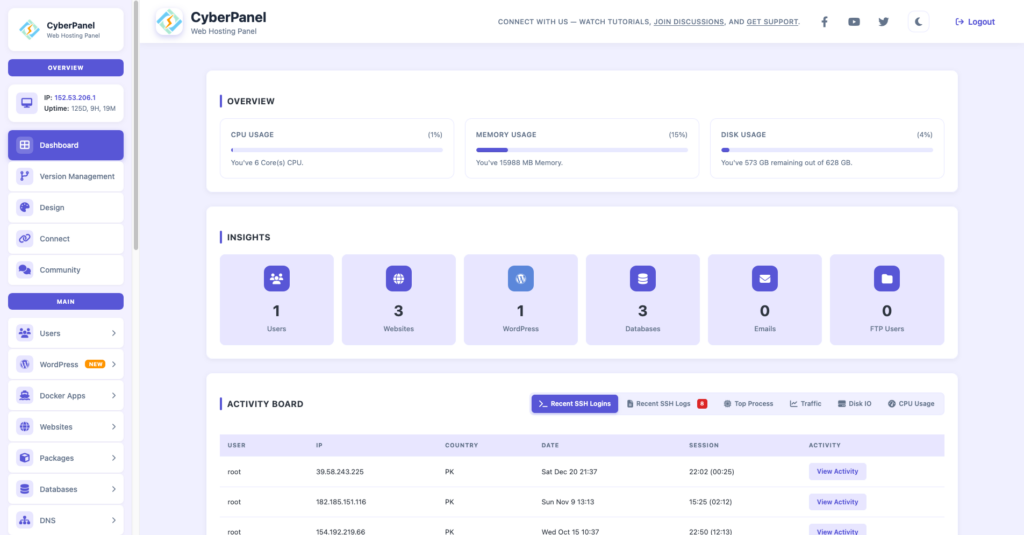
Linux command-line skills will be very useful for server management. Yet, it is also true that a graphical interface can handle a lot of administrative tasks that are generally done manually through a command line.
CyberPanel is a free, open-source web hosting control panel with OpenLiteSpeed at its core. It is a very versatile tool for deploying websites, SSL certificate management, making backups, handling databases, setting up DNS, email hosting, and, in general, managing a Linux server.
CyberPanel is a handy tool for those administrators who are used to switching from terminal mode to web interface mode. This tool will be a good companion to Linux command-line workflows, and server management will be less of a manual effort.
Conclusion
In Linux, piping is probably one of the most amazing capabilities of the command line. When you connect several commands with the pipe sign, it’s like data passing between them so that you can easily filter change find, and examine the content without making intermediate files or doing the same operations manually several times. Whether you are a newbie in Linux command piping, a curious explorer of the Linux piping commands, or even a skilled Linux piper who is seeking to refresh the knowledge of Linux piping commands, this feature will definitely help you get a command-line workflow that is faster, cleaner, and much more productive.
Are you willing to get more work done on the Linux command line? Then take the time to practice Linux piping and turn several basic commands into extensive automation workflows.
FAQs
Can I use multiple pipes in one command?
Yes. Linux supports chaining multiple commands together using several pipe operators in a single command.
Which Linux commands are commonly used with pipes?
Commands such as grep, awk, sed, sort, uniq, wc, head, tail, tee, and xargs are frequently used with Linux piping.
Why are pipes useful in Linux?
Pipes allow multiple commands to work together, making data processing faster, cleaner, and more efficient.