On this page
The rapid delivery of software for businesses with high security and reliability is a challenge to the world of ever-connected businesses. However, conducting DevOps operations in-house can be complicated and resource-intensive. And here is where DevOps Managed Services come into the picture. Such platforms offer fully managed DevOps infrastructure for organizations, enabling them to shift their focus from operational issues to innovating.
What if your development team could deploy an application without a hitch, automatically scaling its infrastructure and identifying security threats without needing to get involved in any of the backend operations? By using DevOps as a managed service, businesses can benefit from continuous integration, automated deployments, and improved monitoring without maintaining an in-house DevOps team.
Let’s dive in together!
DevOps Managed Services: What Are They?
DevOps Managed Services encompass all kinds of outsourced solutions that automate, monitor, and manage a company’s DevOps infrastructure. These services combine CI/CD, security, and cloud infrastructure management into a seamless ecosystem.
Essential Aspects of Managed DevOps Services
CI/CD Pipeline Management — This is the automation of build, test, and deployment processes.
Infrastructure as Code (IaC)– Infrastructure management using tools like Terraform and Ansible.
Monitoring & Logging – Real-time observability tools like Prometheus, Grafana, ELK stack
Security & Compliance – Enabling DevSecOps hardware-software build + run environments.
Cloud Management – The use of AWS, Azure, and Google Cloud to maximise cloud resources.
Incident Response & Support — 24/7 monitoring and troubleshooting for uptime.
Organizations can rely upon DevOps managed services to isolate the operational complexities whereby deployments are faster, infrastructures are more secure, and performance is consistently improved.
Advantages of DevOps as a Managed Service
Cost Effective – Minimizes the requirement of an in-house DevOps team while optimizing cloud costs.
Accelerated Deployment Cycles – Facilitates continuous delivery with minimal downtime
Improved Security — Embeds security in the DevOps lifecycle.
Scalability – Adapts to application and user dynamic demands.
24/7 Monitoring & Support – This guarantees early incident resolution and system reliability.
How to Adopt DevOps Managed Services
Here is how to implement DevOps managed services.
How to Choose a DevOps Managed Service Provider
Then, you must prioritize the best fit cloud platform, security measures taken by your DevOps managed service provider, automation tools used, and availability to support.
Building Infrastructure as Code with Terraform
Infrastructure as Code (IaC) type solutions are commonly used in the managed DevOps domain to provision the cloud resources. The following is a Terraform code to deploy an AWS EC2 instance:
provider "aws" {
  region = "us-east-1"
}

resource "aws_instance" "web" {
  ami           = "ami-12345678"
  instance_type = "t2.micro"
  tags = {
    Name = "ManagedDevOpsInstance"
  }
}
Setting Up CI/CD with Jenkins
The DevOps culture focuses on automating the pipeline for deployments and outcomes during the software development cycle to ensure quick reactions and efficient solutions for the users. An example of a basic Jenkinsfile to automate a CI/CD pipeline:
pipeline {
    agent any
    stages {
        stage('Build') {
            steps {
                sh 'mvn clean package'
            }
        }
        stage('Test') {
            steps {
                sh 'mvn test'
            }
        }
        stage('Deploy') {
            steps {
                sh 'scp target/app.jar user@server:/deploy/app.jar'
            }
        }
    }
}
Monitoring with Prometheus
Prometheus can be utilized to monitor metrics to ensure high availability:
scrape_configs:
  - job_name: 'node'
    static_configs:
      - targets: ['localhost:9100']
When we combine our monitoring solutions, DevOps teams are able to identify and fix performance issues before they reach end users.
CyberPanel in DevOps Managed Services
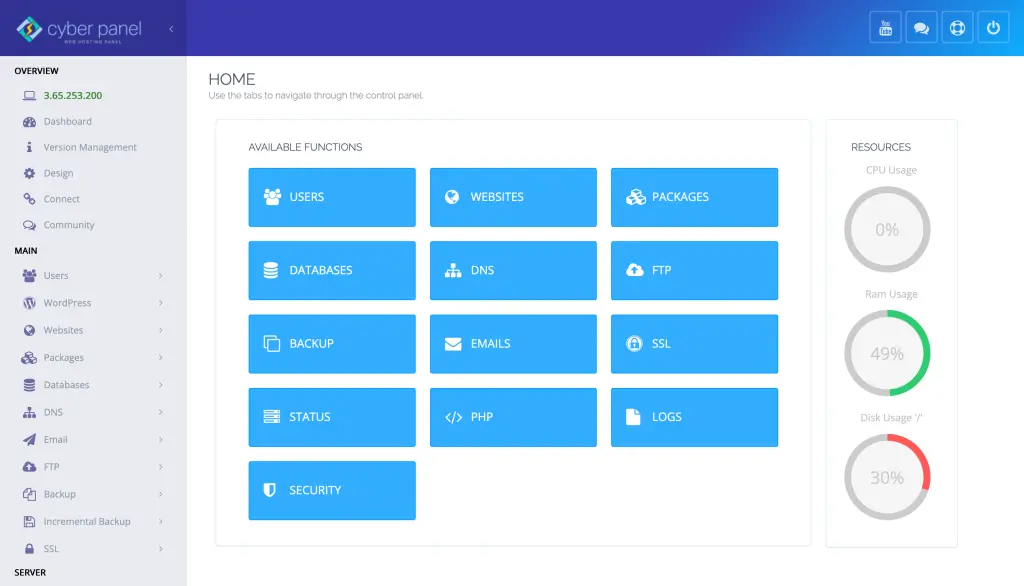
CyberPanel, i.e., web hosting control panel, provides a lightweight, fast, and automated hosting solution powered by OpenLiteSpeed to simplify your DevOps. It provides:
- One-Click Application Deployment – Automate hosting workflows for web apps
- WAFs like ModSecurity, CSF Firewall, and even SSL are all installed with it.
- Git Integration – This covers version control and deployments.
- Performance Boosting – Boosts server speed up to LSCache plus LiteSpeed Web Server.
The one-stop solution CyberPanel helps businesses to adopt DevOps best practices and maximize performance for their web applications.
FAQs
What are DevOps managed services used for?
With automation, security, monitoring, and cloud infrastructure being a part of DevOps managed services, business (s) can automate their processes of software development and deployment.
How do managed DevOps services enhance speed to deploy?
With hardware provisioning, CI/CD pipelines, and monitoring automation, DevOps managed services help you reduce deployment time and avoid manual errors.
How does security translate into DevOps managed services?
Security is an essential part of the process, with practices such as DevSecOps involving automated vulnerability scanning, compliance monitoring, and continuous security testing.
Culmination
With DevOps managed services, businesses can be empowered by automating deployments and optimizing cloud infrastructure while adding layers of security. From startups seeking to optimize software delivery to enterprises that want to improve scalability, managed DevOps services give the resources and automation required for success.
Are you ready to take your DevOps workflow to the next level? Learn more and get consistent automation, security, and performance.