On this page
Docker container Nginxis one of the most popular configurations for running web applications, APIs, and reverse proxies. Developers love Docker as it guarantees environment consistency. Nginx is the first choice due to its speed, low memory footprint, and production readiness. Combining the two results in a deployment stack that is scalable and dependable.
Running an Nginx Docker container within a Docker container eliminates the issues of system-level dependencies. Without any changes, you can operate the same Nginx Docker container locally, on a staging server, or in production. Such an arrangement is quite standard for static sites, PHP applications, Node.js applications, and microservices.
With this tutorial, you’ll explore the functioning of a Docker Nginx container, the process of building one, and the method of nginx proxy_pass Docker container configuration. The material subscribes to practical use rather than theoretical. Each segment resolves a specific user query and is immediately applicable.
What is a Docker Container Nginx?
A Docker container Nginx is a standalone environment where the Nginx server is executed, with all necessary dependencies and Nginx bundled inside the container image. It guarantees the same behavior on different systems.
The Nginx Docker container configurations are mainly for web servers, reverse proxies, and load balancers. The container listens on a particular port and directs the requests to the backend services if necessary.
How Does Docker Nginx Container Work?
A Docker Nginx container works by pulling the official Nginx image from Docker Hub. The container exposes port 80 or 443 and serves content or proxies requests.
You can mount configuration files and web content from the host machine into the container. This makes updates easy without rebuilding the image.
How to Run an Nginx Docker Container?
You can start an Nginx Docker container using a single command.
docker run -d-p80:80 --name nginx-server nginxOutput
- Nginx server starts
- Port 80 is accessible
- Default Nginx page is served
Docker Container with Nginx and Custom Content
To run a Docker container with Nginx and custom content, mount a volume.
docker run -d-p80:80 \

-v$(pwd)/html:/usr/share/nginx/html \

--name nginx-custom nginx
This command maps your local HTML folder into the container.
Creating a Docker Nginx Container Using Dockerfile
You can create a custom Docker Nginx container using a Dockerfile.
FROM nginx:alpine

COPY ./html /usr/share/nginx/html

COPY ./nginx.conf /etc/nginx/nginx.conf
Build and Run
docker build -t custom-nginx .

docker run -d-p80:80 custom-nginx
Nginx Docker Container as Reverse Proxy
An Nginx Docker container is often used as a reverse proxy for backend services.
Sample nginx.conf
server {

listen 80;

location / {

proxy_pass http://backend:3000;

proxy_set_header Host $host;

proxy_set_header X-Real-IP $remote_addr;

}

}
This setup forwards traffic using the nginx proxy_pass Docker container configuration.
Nginx Proxy_Pass Docker Container Explained
The nginx proxy_pass Docker container approach allows Nginx to forward requests to another container. Containers communicate using Docker networks.
Create Network
docker network create app-networkRun Containers
cker run -d --name backend --network app-network node-app
docker run -d -p 80:80 --network app-network nginx
Common Issues with Docker Nginx Container
| Issue | Cause | Solution |
|---|---|---|
| 502 Bad Gateway | Wrong proxy_pass | Check container name |
| Port not accessible | Port not exposed | Use -p flag |
| Config not loaded | Volume issue | Restart container |
Best Practices for Nginx Docker Container
- Opt for alpine images
- Keep configuration files outside
- Leverage Docker networking
- Turn logs on
- Ensure the application is functional through health checks
Role of CyberPanel
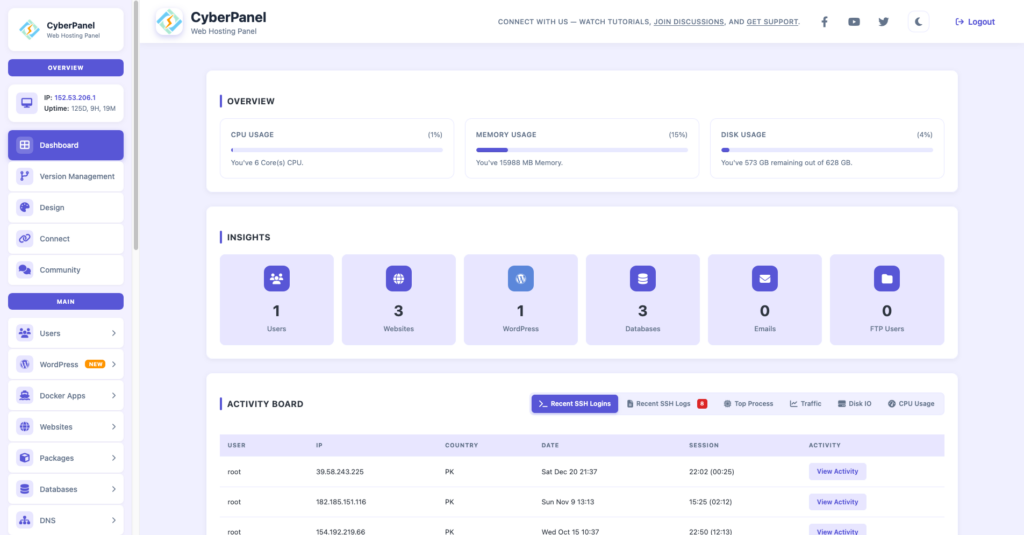
CyberPanel can be a great help if you are using Docker and Nginx. With this web hosting control panel, you can have a single place where you can look at and manage your containers, reverse proxies, and domains. Without going through the hassle of manual configuration, you can get a container with Docker Nginx running and keep an eye on its performance live.
Summary
With Docker container Nginx you get speed, flexibility, and robustness.
Whether it is a basic web server you are looking for or a sophisticated nginx proxy_pass Docker container, this method adjusts to your deployment requirements.
A Docker Nginx container is the right tool to cut down the complexity of your infrastructure and up-scale easily at a pace you are confident with!
People Also Ask
Can I use SSL with Nginx Docker container?
Yes. SSL certificates can be mounted into the container and configured in Nginx.
Is Nginx Docker container production ready?
Yes. It’s setups are widely used in production with proper configuration and security setups.
Is Docker container with Nginx better than VM?
Yes, containers are fast, ligher, and easier to scale compared to virtual machines.