On this page
Security is one of the key drivers that convince many people to go for Linux. However, just installing Linux will not magically secure your machine. Basically, every device connected to the net requires a firewall to regulate inbound and outbound traffic. If there is none, then open ports and access from unwanted sources may become serious threats. That is precisely the point where Linux UFW has a vital function. UFW, which stands for Uncomplicated Firewall, is aimed at making firewall management an easy task.
Instead of having to remember complicated networking commands, you can set up your system’s security with clear and simple rules that are easy to understand. Whether you have Ubuntu, Arch, Alpine, or Amazon Linux, getting to know the Linux UFW basics can help you shield servers, desktops, and dev environments without undergoing any trouble. Many users want to find a guide that covers their particular Linux distribution, like UFW Arch Linux, Alpine Linux UFW, or Amazon Linux UFW, since there is a slight variation in the setup steps among the different distros.
The positive side is that if you grasp the main idea, then you will find UFW usage very intuitive anywhere. This article explains what Linux UFW is, the mechanism behind it, how to install it on various distros, sample firewall rules, and the role of CyberPanel when used in conjunction with UFW in actual server scenarios.
What Is Linux UFW?
Linux UFW is a very user-friendly firewall tool that makes it easy for users to control the flow of network traffic by issuing simple commands rather than complicated firewall syntax.
Essentially, it is a frontend for iptables or nftables that still makes the configuration very understandable and friendly for beginners.
Main purposes:
- allow trusted traffic
- block unwanted connections
- secure open ports
- manage server access safely
It is a popular choice as it strikes a nice balance between being powerful and simple.
How Does UFW Linux Work?
UFW Linux operates by setting up firewall rules that specify what kind of network traffic can pass through or will be denied, depending on ports, protocols, or IP addresses.
For instance:
- allow SSH connections
- block all unknown incoming traffic
- permit web server ports
UFW implements these rules on its own at the system level.
Why Use Linux UFW Instead of Manual Firewall Commands?
Linux UFW manages the firewall easily, and it is less error-prone compared to manual iptables configurations.
The advantages include:
- easy-to-understand command syntax
- fast installation
- secure default settings
- simple rule setting
- clear configuration
UFW is sufficient for almost all users and administrators, and it is very easy to use.
How to Install UFW Linux
Ubuntu / Debian
sudo apt update
sudo apt install ufw
Arch Linux UFW
For ufw arch linux, installation is simple:
sudo pacman -S ufw
Enable service:
sudo systemctl enable ufw
sudo systemctl start ufw
Alpine Linux UFW
Alpine Linux UFW requires package installation through apk:
apk add ufw
Since Alpine is minimal, ensure networking tools are installed before enabling UFW.
Amazon Linux UFW
Amazon Linux UFW is not preinstalled. Install it manually:
sudo yum install ufw
Then enable:
sudo systemctl enable ufw
sudo systemctl start ufw
Basic UFW Linux Commands You Should Know
Enable firewall
sudo ufw enable
Check status
sudo ufw status
Allow SSH
sudo ufw allow ssh
Allow web traffic
sudo ufw allow 80
sudo ufw allow 443
Block a port
sudo ufw deny 3306
These commands cover most daily firewall needs.
UFW Linux Across Different Distros
| Distribution | Installation | Service Setup | Notes |
|---|---|---|---|
| Ubuntu / Debian | apt install ufw | Auto-ready | Most beginner-friendly |
| Arch Linux | pacman -S ufw | Manual enable | Lightweight setup |
| Alpine Linux | apk add ufw | Extra networking setup may be needed | Minimal systems |
| Amazon Linux | yum install ufw | Manual enable | Good for cloud servers |
Recommended UFW Setup for Beginners
Safe starting configuration:
- Deny all incoming traffic
- Allow outgoing traffic
- Allow SSH
- Allow required application ports
Example:
sudo ufw default deny incoming
sudo ufw default allow outgoing
sudo ufw allow ssh
sudo ufw enable
Common UFW Linux Use Cases
UFW is perfect for:
- VPS servers security
- development machines protection
- database access restriction
- only web traffic allowance
- unwanted scans blocking
Most of the server security depends on firewall rules properly configured.
The Role of CyberPanel with Linux UFW
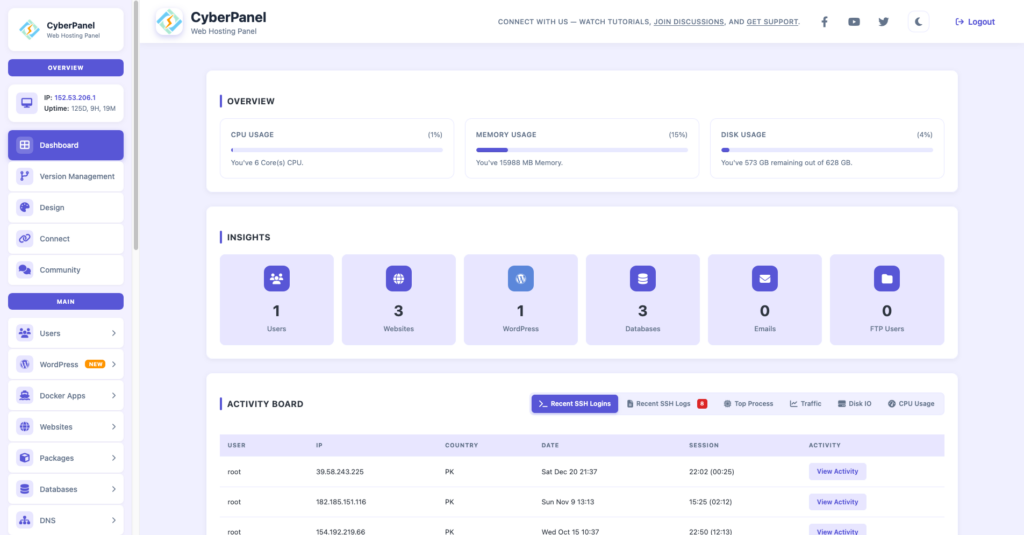
CyberPanel is your web hosting control panel powered by OpenLiteSpeed. It is a server management tool, but firewall security is still very important. UFW is a great solution to work together with CyberPanel.
Typical scenario:
- CyberPanel looks after websites and services
- UFW decides which ports are available
- unwanted traffic is kept blocked
Thus:
- Open ports 80 and 443 for your websites.
- Allow SSH to login to the admin panel.
- Close all other ports.
This duo gives you both security and simplicity without complicated procedures.
Common Mistakes to Avoid
Don’t make these mistakes:
- activating UFW without enabling SSH first (will get you locked out)
- opening unnecessary ports
- not verifying status after changes
- using multiple firewall utilities concurrently
Be sure to test your rules very well before you deploy them remotely.
Final Thoughts: Why Linux UFW Is Essential
There is no such thing as a non-essential firewall. Linux UFW offers you an effortless solution to safeguarding your device, whether it is a laptop or a production server, and you do not have to acquire complicated networking skills.
Since it is compatible with major distributions such as Arch, Alpine, and Amazon Linux, it can be considered a dependable security layer for almost any setting. Couple UFW with CyberPanel for both secure and efficient server management, thus, you get not only the ease but also the sturdiness of the protection.
Turn on UFW now, open only those ports that you really need, and get your Linux system safe before you expose it to the public.
People Also Ask
Is UFW better than iptables?
UFW is easier to manage, while iptables offers deeper manual control.
Does UFW affect system performance?
No. It is lightweight and has minimal impact on performance.
Can I use UFW with Docker?
Yes, but Docker may modify firewall rules. Extra configuration may be required.