On this page
Blender Linux is increasingly the go-to environment for creators seeking excellent performance, full control, and great stability without the need to be tied to a specific vendor. The range of users is pretty vast, from solo artists to multi-million dollar professional studios, so the Linux Blender workflows have become a standard across animation, VFX, game design, and 3D visualization. With more reliable GPU drivers, fully native packages, and a vibrant community to support you, Blender on Linux has all the firepower of other platforms and even comes out ahead in resource efficiency in some cases.
What prevents many users from making the jump to Blender on Linux is installation confusion and compatibility myths. The truth of the matter is that Blender is an officially supported platform, is under active testing, and is very common in production environments. Whether you are rendering complex scenes, sculpting high-poly models, or working with geometry nodes, Blender on Linux performs reliably on modern distributions.
This article provides a comprehensive introduction to Linux Blender. If you are after a neat, speedy, and top-notch 3D workflow of the future then a Blender Linux installation would be your best choice. It is no longer a choice; it is simply a clever decision.
What is Blender Linux and How Does it Work?
It is the native Blender application that runs officially on Linux-based operating systems. It shares the same core engine as other platforms but can take advantage of Linux kernel performance, open-source drivers, and flexible package management. Blender communicates directly with GPU drivers and system libraries for rendering, simulation, and viewport acceleration.
Is Blender Officially Supported on Linux?
Yes, Blender for Linux is officially supported by the Blender Foundation. Linux builds are released simultaneously with Windows and macOS versions. Bug fixes, updates, and new features are tested on major Linux distributions, thereby ensuring stability and long-term usability for professional work.
Which Linux distributions Are Best for Blender?
Most modern Linux distributions support Blender, but some offer smoother experiences. Ubuntu LTS, Fedora, Arch Linux, and Pop!_OS are the most common distributions used for Blender workflows. These distributions have updated GPU drivers, modern kernels, and strong package support, which leads to better rendering and viewport performance.
Blender Linux Install
The safest method is using the official Blender binary or your distribution’s trusted package manager. AppImage is recommended for portability, while Flatpak offers sandboxed stability. Avoid unofficial builds to prevent driver or dependency conflicts.
Comparison of Different Installation Methods
| Method | Stability | Updates | Best Use Case |
|---|---|---|---|
| AppImage | High | Manual | Portable setup |
| Flatpak | High | Automatic | Stable desktop use |
| Package Manager | Medium | Repo-based | System integration |
| Source Build | Advanced | Manual | Custom development |
Does Blender Perform Better on Linux?
More often than not, Blender on Linux matches or outperforms other platforms. This is because Linux has less background overhead, offers better memory management, and supports Vulkan and OpenGL to a great extent. As a result, rendering engines like Cycles are able to capitalize on the latest GPU drivers for Linux, be it on AMD or NVIDIA hardware.
Common Issues & Fixes
Driver mismatches are the most frequent cause of problems in a Blender for Linux environment. Do not hesitate to use official GPU drivers, and do not mix open-source and proprietary drivers. GPU permissions should also be enabled if you are a Flatpak user. Upgrading the kernel and Mesa stack regularly will also help you avoid viewport bugs.
Can Beginners use Blender Easily?
Certainly. When properly set up, Blender is accessible to beginners. Almost all tutorials are cross, platform, and Blender’s user interface stays the same. Additionally, Linux users are given more options through scripting, terminal automation, and render pipelines.
Role of CyberPanel in Blender on Linux Workflows
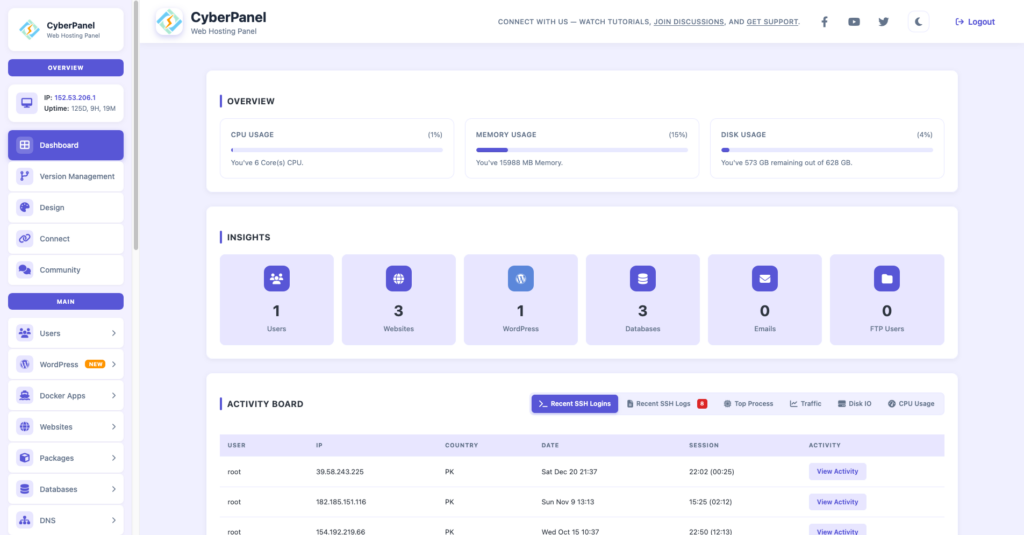
CyberPanel is an open-source web hosting control panel. It helps Blender on Linux users by being the platform that hosts the asset libraries, render outputs, and collaborative project files from its self-managed servers. Creatives can use CyberPanel to launch minimal Linux servers, where they can store Blender projects, automate backups, and securely control the outputs of their render farms.
Final Thoughts!
Once considered merely an alternative, Blender on Linux has evolved into a professional, grade solution that is widely trusted by creators across the globe. The combination of official support, excellent performance, and a range of installation options means that Blender for Linux has all the tools needed for contemporary 3D workflows. Those who prioritize control, speed, and stability over time will find that Blender on Linux is the best option.
People Also Ask
Does Blender on Linux support tablets and stylus input?
Yes, most drawing tablets work well with Blender on Linux using proper drivers.
Is Blender on Linux good for professional studios?
Many studios use it for production due to stability and automation.
Can Blende use CUDA and OpitX on Linux?
Yes, NVIDIA CUDA and OptiX are fully supported on Linux with proper drivers.