On this page
Cockpit Linux has evolved into one of the most incredibly useful tools for administering Linux servers via a browser. Instead of an SSH command-line only, Cockpit offers a neat web interface to instantly check system health, manage services, control storage, and users.
In 2026, Linux infrastructure will be more complex, and administrators will demand visibility, control, and speed. Cockpit provides them with these without doing away with the command line. It is kind of a partner, not a replacement.
This tutorial clarifies what Cockpit is, its functioning on various distros, how to properly install it, and its production use cases.
What Is Cockpit Linux?
Cockpit Linux is a graphical web interface for Linux server management. It can be thought of as a lightweight application that runs on your server and can be interacted with via a browser.
- Cockpit gives system administrators the ability to:
- View CPU, memory, disk, and network usage
- Operating system services and logs
- Set up storage and filesystems
- Handle user accounts
- Take a look at containers and virtual machines
- Oversee multiple servers from a single panel
Cockpit is not a hosting control panel. It is a system management interface
Alma Linux Cockpit Support
Alma Linux Cockpit is fully supported and commonly used in enterprise environments.
Why it fits well on Alma Linux:
- Stable release cycle
- RHEL compatibility
- Official repository support
- Strong SELinux integration
Install Cockpit on Alma Linux
sudo dnf install cockpit
sudo systemctl enable --now cockpit.socket
Access it via:
https://server-ip:9090
Alma Linux is one of the best platforms for Cockpit in production.
How Linux Cockpit Works
Cockpit does not replace system tools. It connects directly to existing Linux components.
Key design principles:
- Uses system APIs and tools
- No custom configuration format
- Real-time updates
- Minimal resource usage
- Secure by default
Communication between Cockpit and the server is over SSH and system services, so the behavior remains predictable.
Why Use Cockpit on Linux Servers?
It balances simplicity and power.
Benefits:
- No heavy installation process
- Works with standard Linux tools
- Browser-based access
- Suitable for headless servers
- Easy onboarding for junior admins
Cockpit is a very handy tool in a small to medium environment.
Alpine Linux Cockpit Availability
Alpine Linux Cockpit support is very limited.
Reasons are:
- Alpine uses musl instead of glibc
- Minimal base system design
- Different service management model
Cockpit is not officially supported on Alpine Linux.
There might be workarounds via containers, but these are not suitable for production.
If you stick to Alpine, Cockpit is generally not the correct option.
Arch Linux Cockpit Installation
Arch Linux Cockpit is available from community packages.
Arch users enjoy:
- the most recent Cockpit releases
- rolling updates
- flexible system configuration
Install Cockpit on Arch Linux
sudo pacman -S cockpit
sudo systemctl enable --now cockpit.socket
Because Arch is rolling-release, occasional breakage is possible. Updates should be tested.
Cockpit Linux Features Explained
System Monitoring
Cockpit has live charts for:
- CPU usage
- Memory consumption
- Disk I/O
- Network traffic
This helps solve problems quickly.
Service Management
You are allowed to:
- start and stop services
- switch on/off services at boot
- See the service logs at once
This is very handy for systemd-based systems.
Storage and Filesystems
With Cockpit, you can:
- Disk inspection
- Configure RAID
- Manage mount points
- Handle logical volumes
It makes storage visual without losing the complexity.
User and Access Management
You can:
- Create and remove users
- Assign group permissions
- Manage SSH access
Security remains tied to system authentication.
Cockpit Linux Security Model
Cockpit is designed with security in mind.
Key points:
- Uses system authentication
- Respects SELinux policies
- Does not store passwords
- Encrypted browser access
Administrators should still restrict network access to port 9090.
Cockpit vs Traditional SSH Management
| Aspect | Cockpit Linux | SSH Only |
|---|---|---|
| Ease of use | High | Medium |
| Automation | Limited | High |
| Visual monitoring | Yes | No |
| Learning curve | Low | Higher |
| Script control | No | Yes |
Performance Impact of Cockpit Linux
Cockpit is a lightweight tool.
Typically, its impact includes:
- Minimal CPU usage
- Small memory footprint
- Idle when not accessed
- Performance overhead on modern servers is very low.
When Cockpit Linux Is Not Ideal
There can be cases where Cockpit is not the right tool:
- Complete automation is the only solution
- No browser access in a headless environment
- Strict minimalism is enforced
- Alpine Linux only environment
- In such situations, CLI tools are still a better choice.
Role of CyberPanel in Server Management
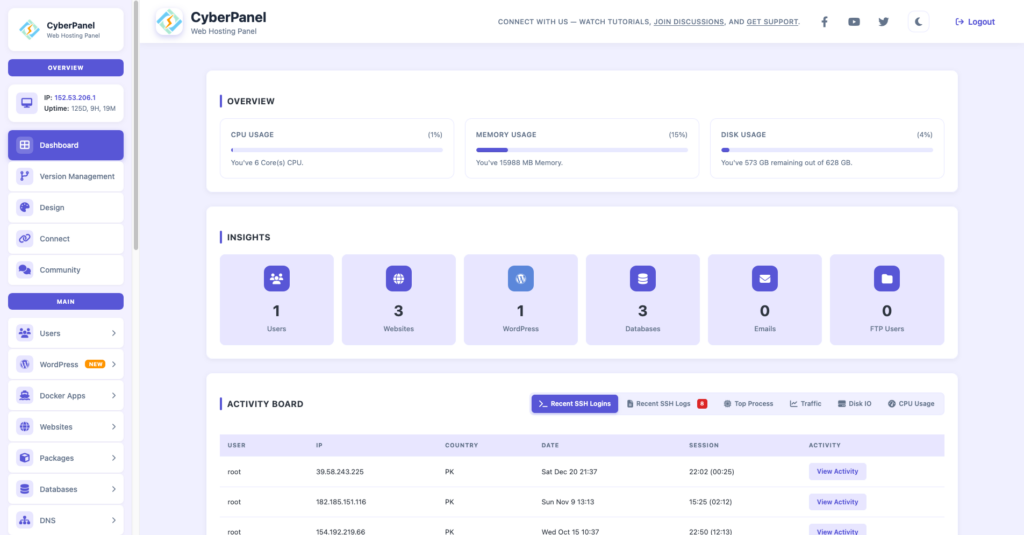
CyberPanel is a free and open-source web hosting control panel. It is powered by OpenLiteSpeed. While Cockpit Linux is mainly concerned with system-level management, CyberPanel works at the application and hosting layer. If combined, Cockpit can keep an eye on server health, whereas CyberPanel controls web services, databases, and domains, thus establishing a full Linux server management cycle.
Summary
Cockpit Linux provides a neat, hassle-free approach to handling Linux systems, and still supports the use of traditional tools. It is most effective when used on distributions such as Alma Linux and Arch Linux, whereas its performance on Alpine Linux is not very satisfactory.
For sysadmins who yearn for insight, command, and quickness, Cockpit can be a really good choice for contemporary Linux setups in 2026.
People Also Ask
Does Cockpit work inside a container?
It is not designed for container-only environments.
Is Cockpit suitable for production servers?
Yes, when properly secured and updated.
Can Cockpit manage remote servers?
Yes, it can connect to multiple servers via SSH.