

To establish communication with other containers or connect to the outside world, containers need a network. While Docker accomplishes this by establishing a default “Docker bridge networking” mechanism that provides a simple, isolated approach to networking, it is also the most frequently used mechanism during development and production.
In this article, we will describe what Docker bridge networking is, review how Docker’s bridge networking works and how it interacts with Docker Compose, outline when to use and when not to use Docker bridge networks, and explain the differences between Docker Compose bridge networks and the default Docker networking mechanism to allow designers to build cleaner container-to-container communications.
What is a Docker Bridge Network?
Docker uses an internal bridge for containers that are on the same container host. Communication between these containers occurs through both their internal IP addresses and their container names.
Docker creates a virtual Ethernet bridge on the host. Each of the containers that is part of the bridge has its own virtual interface connected to the bridge. Unless specified otherwise, the traffic between the containers on the bridge is limited to communication with other containers on the same bridge.
Benefits from using this model are:
1) Network isolation
2) Automatic internal DNS service
3) Controlled access from outside components to containers on the bridge.
How Docker Bridge Networking Works?
In Docker’s bridge network, Docker uses networking features of the Linux Kernel (i.e., iptables, network namespace).
Internally, this looks like:
- Docker creates a bridge interface called and generally referred to as docker0
- Each container gets a Virtual Ethernet device
- The other end connects to the bridge
- NAT rules allow outbound internet access
Containers can talk to each other directly on the bridge without exposing ports.
Default Bridge Network vs. User-Defined Bridge Network
- Default Bridge Networks do not have built-in DNS resolution provided by default when referencing containers by name, have a legacy implementation, and are not recommended practice for new deployments.
- User-Defined Bridge Networks are created via the ‘docker network create’ command, have built-in DNS resolution when referencing containers by name, and provide superior isolation between user-defined networks compared to default bridges. Therefore, user-defined bridge networks are highly recommended for use with Docker Compose.
Real-Life Use Cases of Bridge Network Docker
Docker Bridge Networks are used for developing web applications with backend services, deploying microservices to a single host, setting up a local development environment, running continuous integration (CI) pipelines, and testing service-to-service communication.
Note that Docker’s Overlay Network implementation is a better solution to support multi-host clustering than Bridge Networks.
Docker Compose Bridge Network Explained
Docker Compose creates a bridge network by default for each project.
When you run:
docker compose up
Docker automatically:
- Creates a user-defined bridge network
- Names it after the project
- Connects all services to it
Each service can communicate using the service name as a hostname.
Docker Compose Network Bridge Configuration
You can explicitly define a Docker Compose network bridge in your docker-compose.yml.

Example:
networks:
  app_bridge:
    driver: bridge
Then attach services:
services:
  web:
    image: nginx
    networks:
      - app_bridge

  api:
    image: node
    networks:
      - app_bridge
This ensures controlled and isolated communication.
Docker Compose Bridge Network With Custom Settings
You can customize the bridge network.
Example:
networks:
  app_bridge:
    driver: bridge
    ipam:
      config:
        - subnet: 172.20.0.0/16
This helps when:
- Avoiding IP conflicts
- Integrating with VPNs
- Debugging complex environments
Bridge Network Docker And Port Exposure
Bridge networks do not expose containers automatically.
To allow external access, you must publish ports.
Example:
ports:
  - "8080:80"
Internal communication does not require published ports. This improves security.
Docker Bridge Networking And DNS Resolution
User-defined bridge networks provide automatic DNS.
This means:
- Service name = hostname
- No hardcoded IPs
- Containers can restart without breaking communication
Example:
curl http://api:3000
This works only on user-defined bridge networks.
Common Networking Mistakes with Docker Bridge
The Bridge networking model has several common errors:
- Using the default Bridge network instead of a user-defined Bridge network
- Hardcoding container IP addresses
- Exposing ports that are not needed
- Mixing Bridge networking with Host Networking
- Forgetting Network Aliases
These common mistakes compromise security and reduce the stability of your applications.
When You Shouldn’t Use the Docker Bridge Network
You shouldn’t use the Bridge network model for:
- containers running on multiple hosts
- when you’re using Kubernetes
- when you need service discovery between nodes
- when you’re deploying large-scale distributed systems.
In these scenarios, an overlay or CNI-based networking model will be a better fit.
Security Considerations of Docker Bridge Networking
The Bridge networks in Docker are isolated from the host network; however, they are not completely immune to attacks. Best practice recommendations to help reduce security threats associated with Bridge networking are:
- Use a user-defined Bridge network
- Only expose the required ports
- If not required, disable inter-container communication between the containers within the Bridge network
- Use Firewall rules as an additional means of Network Security
- Avoid running containers as ROOT
Effective Network Security begins with Network Design.
How CyberPanel Facilitates Connectivity Between Containers
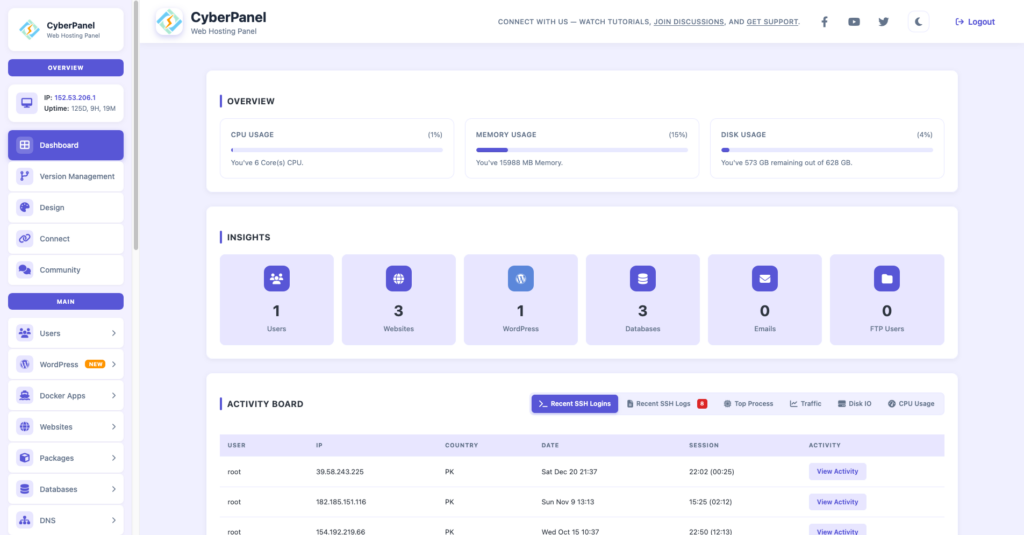
CyberPanel is a web hosting control panel that assists in managing servers and containers more easily. Using Docker bridge networks alongside CyberPanel allows for better management of services by being able to use one interface to view what is going on in the containers, how they communicate with each other; and what ports are exposed so that CyberPanel users can keep their containers separated from external traffic.
Advantages & Disadvantages of Docker Bridge Networks
Advantages:
- Easy to set up
- Provides strong isolation
- Built-in DNS Service
- Performs well using Docker Compose
- Lightweight and fast
Disadvantages:
- Can only run on a single host
- Scales manually
- Limited use in clustering
- Must publish ports to access services
Conclusion
The principle of connectivity between containers running on a single host is the Docker Bridge network. It combines safe and easy-to-use predictable behavior. When using Docker-Compose with the Docker Bridge Network, users can design their environments to create more maintainable environments.
If you are using Docker on your local machine or one server, moving your User-Defined Bridge Networks is an excellent idea. Refactoring your Docker Compose files will help create a more high-performing communication system between your services.
People Also Ask
Is Docker bridge networking slower than host networking?
There is minimal overhead, but host networking is slightly faster.
Can multiple Docker Compose projects share one bridge network?
Yes, if the network is declared as internal.
Is Docker Bridge network supported on rootless Docker?
Yes, but with some limitations depending on the host setup.