On this page
Linux and GitHub work well together. Most Linux development nowadays, be it from open source to enterprise software, is done on GitHub. It does not matter if you are managing code on a server, contributing to the Linux kernel, or just using a desktop workflow; GitHub on Linux empowers you with full control and flexibility.
This article simplifies the concepts of Linux GitHub, GitHub Desktop Linux, Linux kernel GitHub, and desktop GitHub Linux workflows. It is targeted at both beginners and professionals who are interested in understanding rather than being confused.
What Is GitHub for Linux?
GitHub is essentially a code hosting platform built on top of Git. Linux users depend on it to store their code, keep track of modifications, work together, and trigger builds.
There are three main ways of using GitHub on Linux:
- Command-line Git on Linux
- Desktop-based GitHub tools
- Web-based GitHub access
- Linux provides the best Git experience as Git itself was originally developed for Linux.
GitHub Linux Workflow
The steps in a regular GitHub Linux workflow are as follows:
- Write the code on a Linux platform
- Use Git to keep track of changes
- Upload code to GitHub repositories
- Examine changes with pull requests
- Automatically deploy or build software
This workflow is identical on servers, laptops, and cloud machines as well.
Linux Kernel GitHub and Why It Matters
The Linux kernel GitHub mirrors are critical for developers and contributors.
While the official kernel is managed through mailing lists, GitHub mirrors provide:
- Easy code browsing
- Issue discussion
- Pull request testing
- Learning access for new contributors
Many developers study kernel code through GitHub before contributing upstream.
Why the Linux kernel GitHub is important:
- Public visibility of kernel development
- Easier learning for students
- Faster testing and collaboration
- Transparent development history
GitHub Desktop Linux: What You Need to Know
GitHub Desktop does not have an official Linux release. However, Linux users still have reliable options.
GitHub Desktop Linux Alternatives
Most Linux developers prefer these tools:
| Tool | Best For |
|---|---|
| Git CLI | Full control and speed |
| GitKraken | Visual Git management |
| VS Code Git | Editor integrated workflow |
| GitHub CLI | Terminal based GitHub actions |
Desktop GitHub Linux Setup
Setting up GitHub on Linux desktop is simple.
Step 1: Install Git
sudo apt install git
Step 2: Configure Git
git config --global user.name "Your Name"
git config --global user.email "[email protected]"
Step 3: Connect to GitHub
Use SSH keys for secure access.
ssh-keygen -t ed25519
Add the key to your GitHub account.
This setup works across all Linux desktops.
GitHub Linux for Daily Development
Linux GitHub users are typically engaged in:
- Web development
- System tools
- Cloud automation
- Container builds
- Kernel modules
Linux OS is known to perform Git-related tasks faster and more reliably than most desktop environments.
GitHub Linux for Servers and Automation
Linux servers employ GitHub for:
- CI pipelines
- Configuration management
- Infrastructure code
- App deployment
Integration of GitHub Actions and webhooks, for example, is a breeze on Linux servers.
Role of CyberPanel in GitHub Linux Workflow
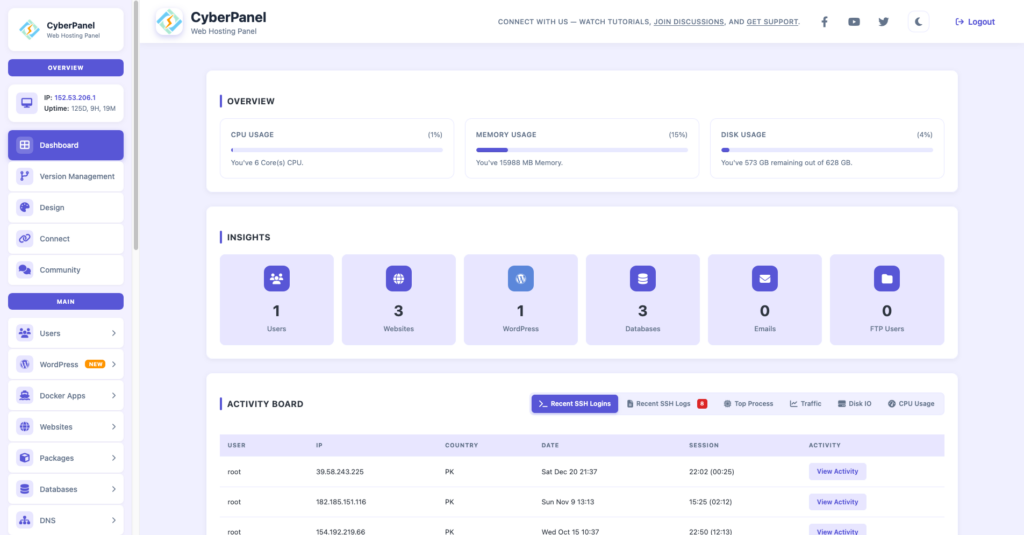
CyberPanel works seamlessly with GitHub Linux workflows. It is a web hosting control panel, and with it, one can:
- Perform Git based website deployment
- Manage servers via Linux
- Update applications from GitHub repositories
- Secure hosting automation
Using Linux GitHub together with CyberPanel, developers are able to transfer the code from the repository to the live server rapidly and securely.
Typical GitHub Linux Use Cases
- Hosting open-source projects
- Managing private repositories
- Collaborating with global teams
- Tracking bugs and features
- Automating builds and releases
With Linux, users get unrestricted and direct access to every GitHub feature.
GitHub Desktop Linux vs Command Line
| Feature | Desktop Tools | Command Line |
|---|---|---|
| Speed | Medium | Fast |
| Learning | Easy | Steeper |
| Automation | Limited | Powerful |
| Server Use | No | Yes |
| Control | Basic | Full |
Security on GitHub Linux
Linux users enjoy:
- SSH authentication
- GPG commit signing
- Fine-grained access control
- Secure server environments
For this reason, Linux is generally the best platform for secure GitHub operations.
Final Thoughts!
Linux GitHub workflows are reliable, speedy, and dependable. You can have total control over GitHub projects with Linux, regardless of whether you are using command-line tools, desktop editors, or server automation.
The experience is strong and uniform, whether you are doing Linux kernel GitHub development or just using desktop GitHub Linux.
If you are after neat development, dependable deployments, and total control of your code, Linux and GitHub are a good pair. If you add CyberPanel to the mix, you can go from code to production smoothly.
People Also Ask
Does GitHub Desktop officially support Linux now?
No. Most Linux users rely on Git CLI or third-party desktop tools.
Can I manage GitHub Actions from Linux servers?
Yes. Linux servers integrate directly with GitHub Actions and runners.
Is GitHub safe to use on Linux servers?
Yes. With SSH keys and proper permissions, GitHub usage on Linux is secure.