
On this page
Linux xargs is a very effective utility in the command line, but it is also incorrect to say that it is one of the least understood ones. If you use Linux every day, you probably figured out that many of the commands generate long outputs. The real problem begins when you want to provide the output of one command as input to another command. This is exactly where Linux xargs becomes a necessity. The Linux xargs command accepts input from standard input and transforms it into command-line arguments. It lets you create highly effective command pipelines without having to write scripts.
The Linux command xargs is a favorite tool of system administrators, developers, and DevOps engineers for handling large datasets, files, and system outputs. Whether it is about deleting thousands of files, managing the users, or setting the permissions, xargs in Linux lessens the time and manual effort. Many beginners, to be honest, have a hard time because they dont know what really goes on inside xargs Linux behind the scenes.
Let’s get started!
What is Linux xags?
It is a built-in command that takes the standard input and turns it into arguments for a different command. It comes in handy when a command can’t take input velocity from a pipeline.
Simply put, xargs in Linux acts as a middleman between the output of one command and the command arguments.
Why Is the xargs Command in Linux Used?
This command in Linux is used for efficiently managing large or complicated outputs. Without this command, many of the commands would not be able to take piped input directly.
Another advantage is that it enhances performance through the execution of commands with multiple arguments, which is contrary to running the identical command over and over again.
How Does Linux Command xargs Work?
Linux command xargs receives input from stdin, breaks it down into arguments, and sends them off to the command you’ve specified. Normally, it will add the arguments to the end of the command.
This feature makes Linux xargs perfect for tasks such as file operations, process management, and performing bulk actions.
Basic Syntax of xargs Linux
The basic syntax of xargs linux is simple and easy to remember:
| Command | Description |
|---|---|
| xargs | Reads input and executes a command |
| xargs command | Passes input as arguments to command |
Example:
ls | xargs echoThis prints all file names in one line.
How to Use xargs in Linux with Find?
Using xargs in Linux with find is one of the most common use cases. It allows you to perform actions on large sets of files.
Example:
find . -name "*.log" | xargs rmThis deletes all log files found in the directory tree.
How to Use the xargs Command Safely in Linux?
The xargs command in Linux is a powerful tool that can cause severe damage if used recklessly. One wrong step can wipe out your essential files.
Therefore, the best practice is that you should always keep the -p option turned on to ask for confirmation before performing the action.
Example:
find . -name "*.tmp" | xargs -p rmWhat Does the -n Option in Linux xargs Do?
The -n option restricts the number of arguments that are sent to a command at a single time. Consequently, this makes it easier to regulate the command’s execution.
Example:
find . -name "*.tmp" | xargs -p rmThe output will be processed as pairs.
What is the -I Option in xargs Linux?
The -I option lets you define a placeholder. This means you can control precisely where the arguments go.
Example:
echo "file1 file2" | xargs -I {} cp {} /backupEach file is copied individually.
Difference Between xargs and pipes in Linux
Pipes connect the output of a command straight to the input of the next, while xargs changes output into command-line arguments. Some commands only take arguments, not input through pipes.
Therefore, the Linux command xargs is indispensable in many workflows.
Common Real-World Examples
| Use Case | Command | What It Actually Does |
|---|---|---|
| Delete files listed in a file | cat files.txt | xargs rm | Removes all files named inside files.txt |
| Handle spaces in filenames | find . -type f -print0 | xargs -0 rm | Safely deletes files with spaces or special characters |
| Change permissions in bulk | find . -type f | xargs chmod 644 | Applies permissions to many files at once |
| Search text in multiple files | grep -rl "error" . | xargs sed -i 's/error/warning/g' | Finds and replaces text across files |
| Compress multiple files | ls *.log | xargs tar -czf logs.tar.gz | Archives all log files into one file |
| Run command per item | cat urls.txt | xargs -n 1 curl -O | Downloads each URL separately |
| Limit CPU usage | cat tasks.txt | xargs -P 4 -n 1 ./script.sh | Runs tasks in parallel with control |
| Delete Docker images | docker images -q | xargs docker rmi | Removes all unused Docker images |
| Kill multiple processes | ps -ef | grep node | awk '{print $2}' | xargs kill -9 | Run the command per item |
Common mistakes when using xargs in Linux
Many users misuse it by ignoring spaces or special characters in file names. This causes errors or unexpected results.
Using the -0 option with null-terminated input avoids these problems.
Example:
find . -print0 | xargs -0 rmRole of CyberPanel in Linux Automation
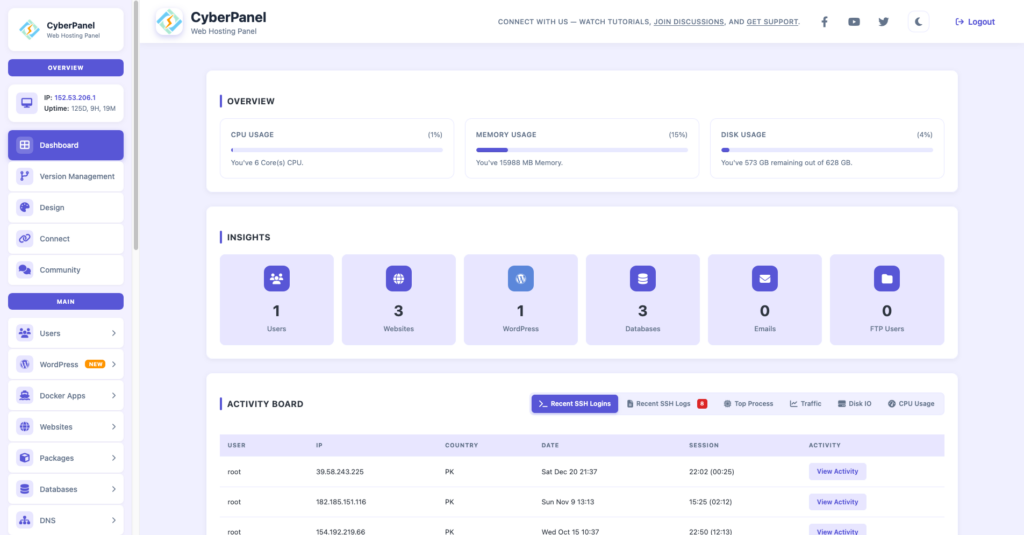
CyberPanel is a next-gen web hosting control panel. It is great at making Linux server management easier by cutting down the work you do on the command line. Even xargs that require manual input can be done via the CyberPanel’s UI.
But if you know the xargs command in Linux, you have more power over the machine even without automation. CyberPanel is more effective when used with command-line knowledge.
Conclusion
Linux xargs is an essential tool if you want to take Linux seriously. It helps you save more time and be more productive with powerful command combinations. By learning and mastering the xargs command in Linux, you can open new advanced workflow capabilities.
Start using it today and make Linux command xargs your daily tool.
People Also Ask
Is xargs safe to use in Linux?
Yes. xargs in Linux is safe when used carefully with options like -p and -0 to prevent accidental file deletion.
What is the difference between xargs and exec?
Xargs executes commands in batches, while exec runs a command for each input item individually
Is Linux command xargs faster than loops?
In most cases, the Linux command xargs is faster and more efficient than shell loops.