On this page
Yocto Linux is no ordinary Linux distro. It is actually a robust framework for creating tailor-made Linux systems on embedded devices. In case you operate IoT hardware, ARM boards, industrial controllers, or custom appliances, Yocto Project Linux will offer you operating system-level freedom.
Instead of setting up a pre-packaged OS, Yocto enables you to create your own Linux image totally from scratch. You decide on the kernel, packages, services, boot behavior, and even the update mechanism.
This article breaks down the concept of Yocto Linux in a straightforward manner. By the end of it, you will understand what Linux-Yocto is, how the Yocto Project Linux functions, the typical commands, restarting a Yocto system, and when it is a good decision to use Yocto.
What is Yocto Linux?
It stands for the Linux operating systems created through the Yocto Project. The Yocto Project is a collaborative open-source initiative that offers tools, templates, and metadata for building custom Linux distributions from scratch.
Yocto is not a substitute for Linux. Rather, it is a tool for Linux creation.
Main features:
- They are embedded systems-oriented
- They are highly flexible
- Stands separate from any particular hardware
- Suitable for long- term support
- Allows reproducible builds
Applications of Yocto Linux can be seen in the areas of automotive systems, networking devices, robotics, medical equipment, and smart appliances.
Yocto Project Linux Explained
Yocto Project Linux is built around a tool called BitBake. BitBake reads instructions called recipes and builds everything from source.
Core components of the Yocto Project:
| Component | Purpose |
|---|---|
| BitBake | Build engine |
| Poky | Reference distribution |
| OpenEmbedded | Metadata framework |
| Layers | Modular feature sets |
| Recipes (.bb) | Build instructions |
Instead of installing packages later, Yocto builds them into the image at compile time.
This approach improves stability, security, and performance.
What is Linux-yocto?
Linux-Yocto is the official Linux kernel maintained by the Yocto Project.
It is not a separate fork of the kernel. It is a kernel tree that has been designed and configured to be tested and compatible with Yocto releases.
- linux-yocto delivers:
- Hardware compatibility
- Stable kernel configuration
- Alignment of long-term maintenance
- Kernel customization made easier
You are still allowed to use vendor kernels; however, Linux-Yocto is the best choice for predictable builds.
How Yocto Linux Works
Yocto is built around the idea of creating before building.
High-level workflow:
- Specify target hardware
- Pick layers
- Set up image features
- Run BitBakeFlash image
- Everything is pre-built
There is no need for a package manager on the device unless you decide to include one.
This leads to:
- Smaller images
- Faster boot times
- Fewer runtime dependencies
Linux-Yocto vs. Traditional Linux Distros
| Feature | Yocto Linux | Ubuntu / Debian |
|---|---|---|
| Target | Embedded systems | Desktop / Server |
| Package install | Build time | Runtime |
| Customization | Extreme | Limited |
| Image size | Very small | Large |
| Update control | Full | Partial |
Common Use Cases
One employs the Yocto Project Linux in scenarios:
- Hardware resources are limited
- Boot speed matters
- Security must be tightly controlled
- Updates must be predictable
- Long-term support is required
Typical devices:
- ARM
- SBCs
- Industrial HMIs
- Routers and gateways
- Automotive ECUs
- Smart TVs
How to Reboot a Yocto Linux System
The reboot process is the same as standard Linux unless restricted.
Comando Para Reiniciar Linux Yocto
reboot
Or using systemctl if systemd is enabled:
systemctl reboot
If BusyBox is used:
shutdown -r now
Yocto allows you to control which reboot method is included during build time.
Yocto Linux Image Types
Yocto can generate multiple image formats:
.wicfor disk images.ext4for partitions.tar.gzfor root filesystems.sdimgfor SD cards
You choose this in the image recipe.
Layer System in Yocto Project Linux
Layers make Yocto modular.
Common layers:
| Layer | Purpose |
|---|---|
| meta | Core metadata |
| meta-poky | Reference distro |
| meta-openembedded | Extra packages |
| meta-vendor | Hardware support |
Package Management
Yocto can accommodate runtime package managers as an option:
This is beneficial in:
- Security
- Predictability
- Performance
- Updating Yocto Linux Systems
You can take the following steps for updates:
- Using A/B partitioning
- OTA systems
- Your own update frameworks
Some of the popular choices are:
- SW
- Update
- RAUC
- Mender
Yocto works smoothly with all of them.
Security Advantages of Yocto Linux
By laying the security aspects out from the beginning, it thus enhances the security:
- Minimal attack surface
- No unused services
- Custom kernel options
- Controlled updates
You only deliver the essentials and nothing more.
The Role of CyberPanel
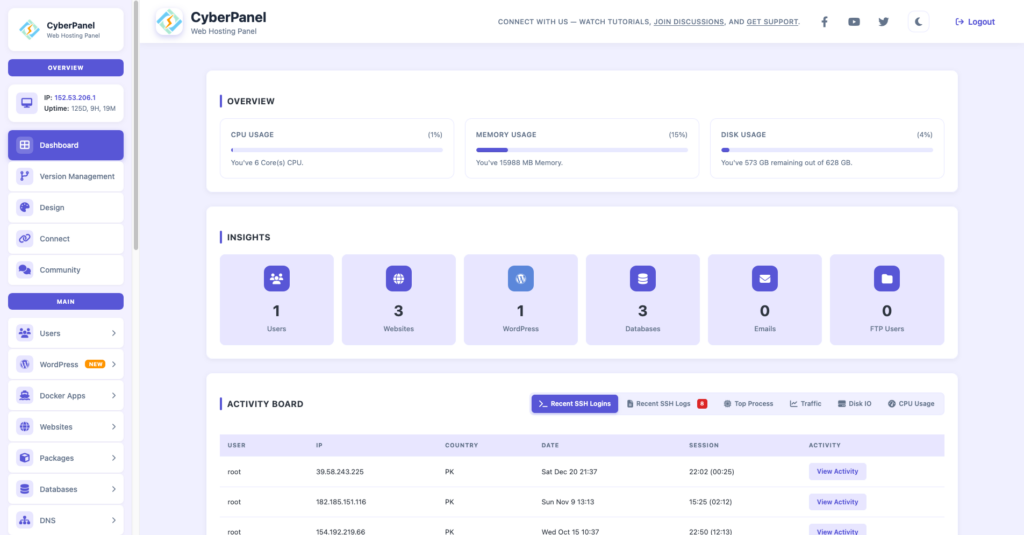
After installing a Yocto Linux system on suitable hardware, one can install CyberPanel on supported Linux servers to control the web services that communicate with embedded devices.
CyberPanel, a web hosting control panel, greatly facilitates:
- Deployment of web apps
- API hosting
- Database management
- Secure opening of services
It goes well with Yocto-based systems by efficiently handling the backend infrastructure.
Final Thoughts
Yocto Linux is not for end users. It is for developers who want full control of their Linux system.
If your desires are for:
- Custom images
- Predictable builds
- Small footprint
- Long-term control
Then Yocto Project Linux and linux-yocto are the right tools.
Once you master Yocto, no off-the-shelf distro will feel flexible enough again.
People Also Ask
Is Yocto Linux a distribution?
No, it is a build framework used to create custom Linux distributions.
How long does a Yocto build take?
Initial builds can take hours. Incremental builds are much faster.
Does Yocto support Docker?
Yes. Containers can be added, but Yocto is not container-first.