On this page
ZFS on Linux has been turned from a mere concept into a very viable production option that developers, sysadmins, and homelab enthusiasts alike can rely on. Nowadays, Linux ZFS doesn’t only serve enterprise storage, but it also supports virtualization, backups, and even desktop systems. Still, a lot of folks are hesitant. While some users applaud its data integrity and snapshots, others are concerned about memory usage and licensing constraints.
Such a contradictory image leads to confusion, especially among the ones who are contemplating Linux on ZFS for their Ubuntu server or workstation. Actually, the truth is quite straightforward. ZFS Linux is not some kind of magical solution, nor is it a dangerous tool if one knows how to use it properly. It is a feature-rich filesystem that comes with very strict rules. When you abide by these rules, it runs seamlessly and offers you features that traditional Linux filesystems still can’t match.
But if you choose to ignore those rules, then soon enough you will face problems. The year 2026 saw a surge in people interested in ZFS Linux Ubuntu setups. This happened as a result of greater kernel compatibility, better tooling, and official installer support. At the moment, users want nothing more than clear-cut answers. What is the appropriate time for you to use ZFS on Linux? When would it be better to stay away from it? What is its actual performance on real systems?
This article will give you a comprehensive explanation of Linux ZFS starting from scratch. You will have a thorough knowledge of its functionality, the installation process, how to operate pools, and the most appropriate scenarios for its usage.
What Is ZFS on Linux?
ZFS on Linux is a powerful filesystem and volume manager that was initially developed by Sun Microsystems. It integrates storage management, data integrity, and filesystem functionalities into a single system.
Traditionally, Linux filesystems only handle the files and directories on the disk. However, ZFS goes a step further; it has the ability to manage both disks and the way data is physically stored. That is the main reason why ZFS on Linux behaves differently compared to ext4 or XFS.
Core Capabilities
- Copy-on-write data protection
- End-to-end checksumming
- Built-in RAID (RAID, Z)
- Instant snapshots and clones
- Compression and deduplication
- Self-healing data repair
Thanks to these functionalities, ZFS Linux is especially suitable for systems whose primary concern is data safety but that do not want to sacrifice simplicity.
How Linux ZFS Works Internally
ZFS replaces the classic Linux storage stack. Instead of a filesystem on top of LVM, ZFS handles everything itself.
Key Components
| Component | Purpose |
|---|---|
| Pool (zpool) | Group of physical disks |
| Dataset | Filesystem inside a pool |
| Vdev | Virtual device inside a pool |
| ARC | In-memory read cache |
| ZIL / SLOG | Write-intent logging |
| L2ARC | Secondary read cache |
Why Use ZFS on Linux?
Data Integrity First
ZFS checksums every block of data, and if any corruption occurs, ZFS will detect and correct it automatically if there is redundancy. In contrast, traditional Linux filesystems are known to fail silently.
Instant Snapshots with No Performance Impact
Linux ZFS snapshots are immediate and very space-efficient. Hence, they are ideal for backups, rollbacks, and trial purposes.
Compression That Really Works
With ZFS compression, you are able to reduce not only your disk usage but also, in most cases, enhance the system’s performance. Today’s powerful CPUs can easily take care of this fact.
Built-in RAID Without Mdadm
With RAID-Z, you are able to get rid of the complexity of the Linux software RAID. Moreover, everything remains in one management layer.
When You Should Avoid Linux ZFS
ZFS is not for everyone.
Don’t go for ZFS Linux if:
- Your hardware has very little RAM
- You need filesystem support embedded in the kernel
- You change disks between systems frequently
- You rely heavily on proprietary kernel modules
- ZFS hardware level is stable and requires disciplined administration.
Installing ZFS on Linux (Ubuntu Focus)
Supported Systems
- Ubuntu Server (recommended)
- Ubuntu Desktop
- Debian-based distributions
Install ZFS on Ubuntu
sudo apt update
sudo apt install zfsutils-linux
Verify installation:
zfs version
Creating Your First ZFS Pool on Linux
Single Disk Pool
sudo zpool create tank /dev/sdb
RAID-Z Pool
sudo zpool create tank raidz1 /dev/sdb /dev/sdc /dev/sdd
Check pool status:
zpool status
Managing ZFS Datasets on Linux
Create a Dataset
zfs create tank/data
Enable Compression
zfs set compression=lz4 tank/data
Create Snapshot
zfs snapshot tank/data@backup1
Roll Back Snapshot
zfs rollback tank/data@backup1
This is where Linux on ZFS shines for backups and testing.
ZFS Linux Performance Considerations
Memory Usage
ZFS consumes RAM very aggressively. This is not a waste. It actually improves performance. Here are the recommended minimums:
- 8 GB RAM for light usage
- 16 GB for servers
- 32 GB+ for virtualization
SSDs and Caching
- NVMe for SLOG if necessary
- L2ARC will benefit from read-heavy workloads
- Do not tune excessively if you do not understand the impact
ZFS Linux Ubuntu for Root Filesystem
Ubuntu can support an installation of Linux ZFS as a root filesystem.
Advantages:
- Boot environments in snapshots
- Rollback to previous version easily after updates
- Recover to stable system
Limitations:
- Slightly more complex recovery
- Bootloader limitations still exist
ZFS vs ext4 vs XFS on Linux
| Feature | ZFS | ext4 | XFS |
|---|---|---|---|
| Data Integrity | Yes | No | Partial |
| Snapshots | Native | No | No |
| RAID | Built-in | External | External |
| Compression | Yes | No | No |
| RAM Usage | High | Low | Medium |
Choose ZFS on Linux when reliability matters more than minimalism.
Common Mistakes with Linux ZFS
- Overusing deduplication
- Running ZFS on low-RAM VPS
- Mixing unstable disks
- Ignoring scrubs
Run monthly scrubs:
zpool scrub tank
Security and Stability in 2026
Linux ZFS has become stable and production-ready. There is still kernel module separation because of licensing, but the tooling and updates are mature.
Canonical and OpenZFS keep the long-term support.
How CyberPanel Fits into Linux ZFS Infrastructures
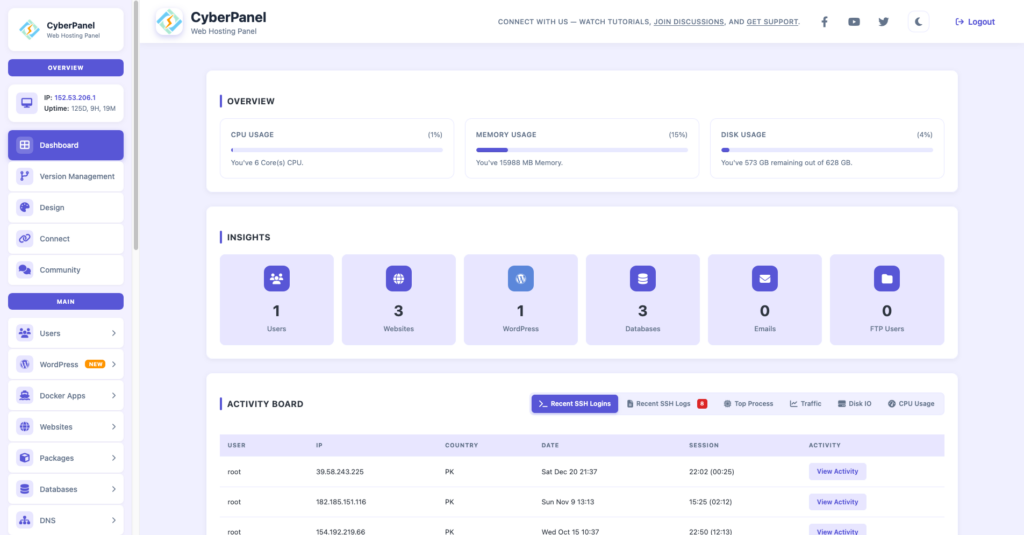
CyberPanel on a Linux ZFS server works well because it maps each website data as a separate ZFS datasets. Thus, the action before updates can be snap shots taken instantly, restores can be done at the speed of the lightning, and the protection of hosting data can be greatly improved. ZFS compression comes to the aid of disk usage reduction for web servers running CyberPanel, your own web hosting control panel.
Final Thoughts!
ZFS on Linux is not a filesystem for beginners. It offers incomparable data safety and a high level of control to those who plan meticulously. By 2026, Linux ZFS will be a mature, stable, and extremely capable tool that, if used properly, will deliver great results. On the one hand, if you are into server, backup, or virtual machine management, ZFS is definitely the one to go for and to learn. However, if your system is small or has limited resources, it might be better to stick to simpler filesystems.
Go for ZFS if you want to be more reliable. Follow its rules. It won’t let you down.
People Also Ask
Does ZFS on Linux support TRIM for SSDs?
Yes. The modern Linux ZFS supports TRIM and automatic discard for SSDs.
Can ZFS Linux be used inside virtual machines?
Yes, but it works best when given direct disk access rather than virtual disks.
Is ZFS Linux safe for desktop systems?
Yes, as long as sufficient RAM is available and power loss protection is considered.
Can I migrate from ext4 to ZFS on Linux?
Migration requires data copy. In-place conversion is not supported.
Does ZFS on Linux slow down boot time?
Boot time impact is minimal on modern systems with SSDs.